
European Economic
and Social Committee
EESC PLENARY: EESC presents exploratory opinion on Circular Economy Act to Commission Executive VP Ribera
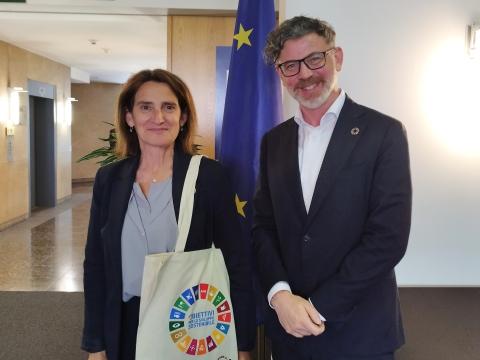
During a plenary debate on Driving a just, competitive and ecological transition towards a circular and climate-neutral economy at the European Economic and Social Committee (EESC), the European Commission Executive Vice-President for a Clean, Just and Competitive Transition, Teresa Ribera, stressed the strategic importance of the Circular Economy Act for Europe’s future. This point was underlined by EESC members, who called for circularity to be put at the heart of Europe’s competitiveness and resilience agenda. It should be seen not only as an environmental objective but also an economic and geopolitical strategy.
The debate built on the EESC’s ongoing work on the future Circular Economy Act, led by the rapporteur and President of the Civil Society Organisations' Group Cillian Lohan. At the request of the European Commission, the Committee prepared and adopted an exploratory opinion - NAT/986 Circular Economy Act – Circular economy and responsible resource consumption within planetary boundaries – which will feed directly into the forthcoming legislation, reflecting the close cooperation between the two institutions in shaping Europe’s circular transition.
EESC President Séamus Boland highlighted the social dimension of the transition and the need to ensure that citizens and businesses are fully involved: The transition will only succeed if citizens understand its benefits and if it creates quality jobs and protects our planet for future generations. It must also provide opportunities for workers, businesses and communities. Europe does not lack circular-economy ideas – what we need are the right economic conditions to scale them up
, Mr Boland said.
Members of the Civil Society Organisations’ Group participated in the debate:
The rapporteur for NAT/986, Cillian Lohan, highlighted from the podium, this exploratory opinion’s ability to make a difference in the content at the critical early stages
. He underlined the three key messages of the opinion demanding a clear mapping of circular economy legislation, the involvement of stakeholders and installing transition brokers.
Domantas Tracevičius stressed that many unsustainable businesses that thrive in the linear economy are working hard to sabotage any real shift toward circularity
.
Highlighting the agricultural sector support for the circular economy, José Manuel Roche Ramo emphasised that anything we do for the environment has to take into account the necessary financial supports for small and medium sized farms
.
Corina Murafa Benga emphasised that we need to know how the European Commission is supporting regions in the transition shift from linear to circular
, and regions who are still operating business as usual are not doing so because they do not want something else but because they do not have the capacity for something else
.
Laura Albu warned that an industry-focused circular transition would fail women twice over as grassroot workers and as consumers
’ and she asked how will the upcoming Circular Economy Act explicitly support women-led social economy and ensure the right to repair and reuse is financially accessible to vulnerable households
.
We need a just transition to take place
, said Nuno Serra, that cannot happen if costs are borne by the producers in the shape of reduced income
.
One in two young people say they would like to find training or a job in this just transition
, stated Laure Niclot, we need to have a just transition for young people
.
#CircularEconomyAct: Statement by rapporteur Cillian Lohan