
European Economic
and Social Committee
EESC PLENARY: EESC champions sodium batteries for Europe’s industrial and energy future
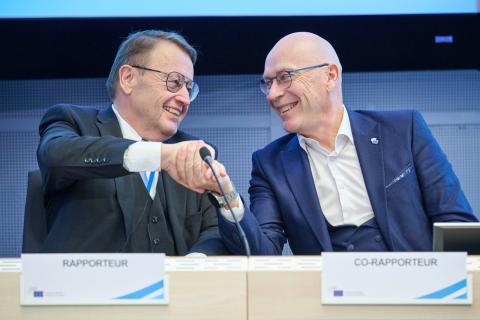
The European Economic and Social Committee (EESC) considers sodium batteries a strategically important technology for Europe and calls for them to become a key element of the EU’s industrial strategy, as highlighted during the Committee’s plenary session debate on the potential of these batteries, held on 19 February, and in its latest adopted opinion.
Marc Lemaître, Director-General of the European Commission’s Directorate-General for Research and Innovation, and Fabrice Stassin, Secretary-General of the Batteries European Partnership Association (BEPA), took part in the debate.
Opening the debate, EESC President Séamus Bolandsaid: Sodium batteries, and batteries more broadly, are key for the EU’s competitive edge, and it is urgent that the next
Multi-Annual Financial Framework
recognises this by providing the necessary funds for the sector.
Several members of the Civil Society Organisations' Group engaged in the discussion:
Alain Coheur, president of the Committee's CCMI, expressed his view that Sodium batteries are not just an alternative energy storage solution; they represent a real opportunity for our industry in the context of the
EU Preparedness Union Strategy
, the
EU Blue
and
Green Deal
, and increasing our strategic autonomy.
The adoption of the Committee's opinion on the potential of the sodium battery manufacturing sector would not be the end of the journey, but only the beginning: Developing a competitive sodium battery industry in Europe will require political will, coordinated action and strong investment.
Corina Murafa Benga considered the clean tech sector an opportunity to increase EU competitiveness, provided the EU managed to move quickly beyond research and development to deployment. We must stimulate both supply and demand. Targets, enablers and incentives need to address both the manufacturing and the demand side. Simply subsidising only production will not work.
She concluded by warning that if new technologies were not affordable, customers would not adopt them.
Pietro Vittorio Barbieri, group vice-president, said the development of sodium batteries gave people with disabilities hope for day-to-day mobility solutions that came with fewer problems and risks then current solutions. In term of their practical development, he emphasised that mobility devices were often produced by SMEs, which do not have the capacity to pass complex tests required for lithium-ion batteries. Mr Barbieri said: We need to avoid this in the case of sodium batteries.
While Ina Agafanova saw an opportunity to shape the emerging value chain in line with the EU's strategic priorities – namely sustainability, resilience and industrial balance - she urged: The development of sodium batteries must involve cohesion regions, peripheral economies and smaller Member States from the outset. We need to link research centres, SMEs, industrial conversion sites and port-based logistics into an integrated value chain. If we succeed, sodium batteries will not only strengthen Europe's technological sovereignty, they will also reinforce its internal cohesion.
This plenary debate set the stage for a broader EESC focus on sodium batteries, with upcoming opinions, stakeholder debates and a dedicated study aimed at placing sodium batteries firmly on Europe’s industrial agenda and supporting a more resilient, competitive and sustainable economy.