
European Economic
and Social Committee
EDITORIAL: Making all voices heard in decision-making
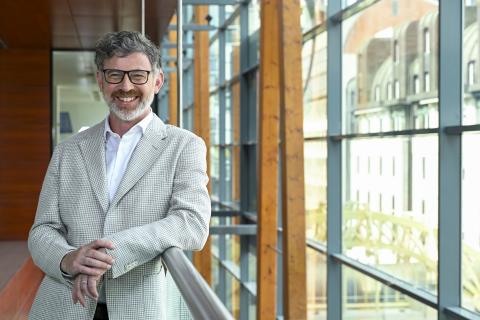
We begin the summer months with a farewell to the Cyprus Presidency of the Council of the European Union and in keen anticipation of the Irish Presidency, which will kick off on 1 July. In this context, the Civil Society Organisations’ Group of the European Economic and Social Committee (EESC) will be following its mission to Larnaca with a conference in Cork on 30 June. This event will be an important opportunity to continue our work on resilient communities and the sustainability agenda.
I am also looking forward to the upcoming EESC plenary session in June, where members will adopt the EESC's exploratory opinion on the Circular Economy Act, for which I myself was the rapporteur. Teresa Ribera, Executive Vice-President of the European Commission for a Clean, Just and Competitive Transition, will participate in the related plenary debate. We will then receive direct feedback from the highest political level of the European Commission. Our opinion will certainly have an important and concrete impact on the CEA, which the Commission is expected to adopt in a few months.
In this month’s edition of the Civil Society Organisations’ Bulletin you can get the full up-to-date context surrounding the European Sustainable Development Report 2026. Our Insider Briefing focuses on the upcoming Circular Economy Act. You will also find an article on Erasmus+, the EU’s programme to support education, training, youth and sport in Europe, highlighting that education is at the heart of resilience.
Last month, at the invitation of Enrico Letta, Dean of the School of Politics, Economics, and Global Affairs at the IE University in Spain and former Prime Minister of Italy, I attended the launch of the university’s IE Competitiveness Hub in Brussels. This may be the start of a move towards more European universities establishing hubs at the centre of EU policymaking.
Well informed, evidence-based policymaking is a cornerstone of effective democracy. It works best when coupled with efforts to ensure that all voices are heard in decision-making. This is part of our group’s motivation for organising events outside Brussels and in cities that are not necessarily the capitals of EU Member States. It’s also why our group is continuing to expand partnership events.
Our members bring a wide variety of representative voices and specific expertise to the EESC. We also try to expand beyond our members wherever possible to ensure that we are fulfilling our role as the link between organised civil society and the European institutions.
Following our partnership event with the European Anti-Poverty Network (EAPN), focusing on the eradication of poverty, we worked with the Italian Alliance for Sustainable Development (ASviS) to hold a conference in Brussels celebrating the 10th anniversary of the Italian Sustainable Development Festival, at which we called for a renewed focus on sustainable development in EU politics.
Last week, I had a very informative and productive meeting with the co-chair of the EESC Liaison Group, Piotr Sadowski, to discuss how we can ensure we always give space to the wide variety of civil society voices active in the EU.
I hope you are all keeping well, and that you will be able to enjoy a good break at the end of the busy next couple of months. I am looking forward to the end of July, when I will take the greatest pleasure in spending a few weeks at home by the sea and recharging through nature and my community before continuing our work to strive for sustainable communities, the beating heart of civil society and democracy.
President, EESC Civil Society Organisations’ Group