
European Economic
and Social Committee
EDITORIAL: End of EESC’s 2020-2025 term
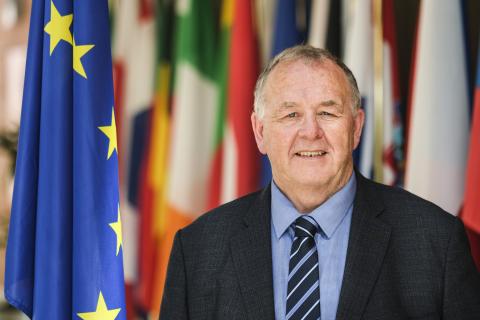
There are many emotions as we come to the end of the European Economic and Social Committee’s (EESC) 2020-2025 term and look forward to the next one. Some of the members of the EESC’s Civil Society Organisations’ Group will be saying goodbye and will face old or new responsibilities in just a few days. Others will be returning to voice civil society’s concerns at EU level and officially welcome new members at the inaugural plenary session of the new term from 21 to 23 October 2025. Personally, I will hand over the presidency of the Civil Society Organisations’ Group to my fellow Irishman Cillian Lohan, to whom I wish the best of success.
This is a moment to reflect on the group’s achievements over the last five years in an extraordinary period of shifting history. The term started with the epoch-changing COVID-19 pandemic. A pandemic that shook the world and demonstrated not only the fragility of our health system, but also of humanity itself. We are all still coming to terms with the effect that this pandemic has had and yet despite the success of bringing an effective vaccine to all EU citizens, we still have to translate the lessons learnt, for instance on health research, preparing for future crisis situations and using this knowledge for current challenges, including the treatment of cancer and rare diseases. A new Global Health Resilience Initiative, as announced by European Commission President Ursula von der Leyen in her State of the Union speech in front of the European Parliament on 10 September, is very welcome in this regard.
But the pandemic was just one factor that marked the past term. In February 2022, Russia declared war on Ukraine. This unjustified full-scale invasion marked a serious attack on the sovereignty of a nation on European grounds. It also marked the end of the peace that we took for granted for many years and threatens to destabilise peace not just in Europe, but in the rest of the world as well.
The election of Donald Trump as President of the United States of America and the consequences of his declared vision of ‘making America great again’ are already redefining global trade and political and military alliances, including with the EU. In upscaling defence systems and spending, EU Member States will have to make, both individually and collectively, significant budgetary choices. It is almost certain, despite the slogan ‘no one should be left behind’, that people who are living in poverty will have little chance to improve their situation. Indeed the 93.3 million people in the EU currently declared at risk of poverty or social exclusion[1] could be joined by almost the same number of people within five years.
In renaming our group the Civil Society Organisations’ Group, and making the eradication of poverty our overarching priority during the past term, we as a group have declared who we are and why so many of us work on a daily basis across all Member States against the forces that continue to create inequalities in our society. COVID-19 saw organisations reaching out to young and old for support, and organisations have helped Ukrainian refugees from the first day of war, and are providing relief to people living in poverty on a daily basis. We also highlighted how civil society organisations are first at the scene of the various climate disasters in the EU that are now sadly becoming part of our realities.
From the conviction that these organisations need to have a say in policy-making, we have been advocating a structured civil dialogue over this term, not at least through our open letter to the Presidents of the European Commission and the European Parliament, and the Presidency of the Council of the European Union. With the aim to strengthen civil dialogue in a sustainable and inclusive manner, our group also requested a study entitled Mapping civil dialogue practises in the EU institutions. This study was launched on 16 July and presented by some of its co-authors from the Centre for European Policy Studies at our web-streamed group meeting. It takes stock of current practises and gives concrete recommendations for next steps. I hope it will help to further advance the implementation of Article 11 of the Treaty on European Union.
In the coming term, I sincerely hope that the commitment to establish a meaningful civil society platform, even if not reiterated by President von der Leyen in her State of the Union speech, will be delivered. In her speech, she mentioned initiatives such as the European Anti-Poverty Strategy, the Child Guarantee, measures to bring relief to farmers and the first EU Housing Summit. These initiatives are essential for eradicating poverty by 2050. To say it in the President’s own words ‘Eight years ago, the European Pillar of Social Rights[2] made housing a social right in Europe. It’s time to turn this promise into reality’. A strong cohesion policy and support for the social economy will be other important elements.
Last but not least, I would like to wholeheartedly thank members and stakeholders for their cooperation and support during my presidency.
President, EESC Civil Society Organisations' Group