rue Belliard 101, Jacques Delors building, room JDE 70
Brussels
Belgium
The European Commission is in the process of developing a European Affordable Housing Plan, to be launched in 2026. This political debate will explore what elements and policies should be included in order to produce a holistic and inclusive housing plan.
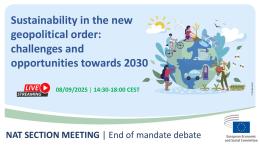
On 8 September 2025 (14:30-18:00), the NAT section of the EESC will host its end of mandate debate with the aim of addressing some of the crucial and systemic questions raised by the new geopolitical order from the point of view of civil society, and to chart possible pathways for the future.
Public debate on Defence-related investments in the EU budget in the context of the new geopolitical order, to contribute to the final report of the EESC´s ad hoc group on the new geopolitical order, and in the framework of the opinion ECO/679 - Defence-related investments in the EU budget.
On 11 February, the European Commission published its 2025 work programme. Several initiatives in the work programme – initiatives to enhance competitiveness through the promotion of reforms and investments, both private and public, the new the Savings and Investment Union, as well as the next Multiannual Financial Framework, just to name a few – fall in the remit of the Section for Economic and Monetary Union and Economic and Social Cohesion (ECO) of the European Economic and Social Committee (EESC). We organise this debate to discuss with representatives of the Commission and the members of the EESC the conditions and actions needed for the EU and its Member States to successfully implement what is outlined in the Commission and achieve the shared goals of the Union.
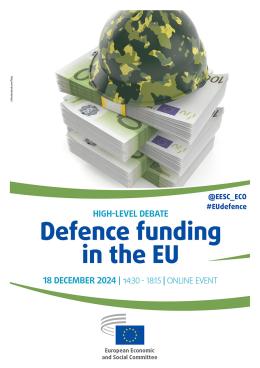
The ECO section is organising a high-level debate on Defence Funding in the EU. This topic is of utmost importance in the current political debate, particularly given the new geopolitical context, the new EU institutional and legislative cycle that is just starting, and the preparations for the post-2027 Multiannual Financial Framework.
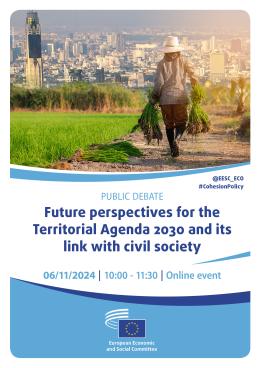
The EESC is organising this public debat to discuss how civil society partners can use a results-orientation approach in cohesion policy for the next programming period. The principles of multi-level governance and shared management are contradictory or complementary to the results-focused cohesion policy ?
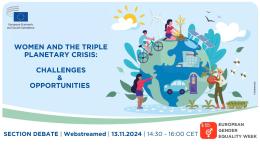
In the context of the European Gender Equality Week, the European Economic and Social Committee is organising a thematic debate during the meeting of its Section for Agriculture, Rural Development and the Environment (NAT) on 13 November 2024 (14:30 - 16:00 CET), focusing on the disproportionate impact of climate change, pollution, and biodiversity loss on women and girls, and the critical role they play in advocating for solutions.
Public debate organised by the EESC's Associational Life Category in cooperation with Civil Society Europe
Event type
Debate
Location
Rue Belliard 99
Brussels
Belgium
The debate will be a hybrid event. For in-person and online participation prior registration is required. The registration period has ended. You can still follow the event live via webstreaming on our website in English.