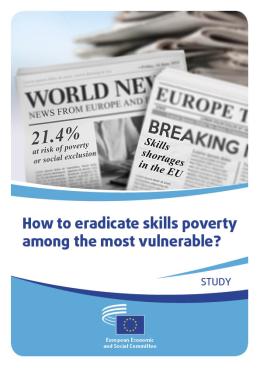
How to eradicate skills poverty among the most vulnerable? On 10 July, the Civil Society Organisations’ Group of the European Economic and Social Committee held a thematic debate exploring this question. The debate saw the launch of a new exploratory study on this same issue.
regrets that exclusion from the labour market is still a widespread issue, especially affecting women with disabilities and people with the most severe disabilities and believes that solutions such as sheltered employment often end up perpetrating segregation;
urges Member States to promote policies and measures that strengthen access to the open labour market and the Commission to implement the related policy actions under the Disability Employment Package;
calls on the Member States to step up the employment of persons with disabilities, for example through a joint fund for reasonable accommodation. Such fund would be financed by private and public employers who fall short of any set quotas.
asks the Commission and Member States to adopt policies reducing economic and educational inequalities, as these factors hinder cultural participation, particularly in rural areas. It also recommends creating and strengthening programs to eliminate various barriers (physical, economic, linguistic, etc.) to ensure inclusive cultural participation, with a focus on marginalized and discriminated groups;
proposes that the EU and Member States adopt budgetary strategies for supporting cultural policies in sparsely populated rural areas as a key pillar for sustainable development. It recommends integrating public investment and infrastructure development into a broader strategy to revitalize rural regions, attracting private investment and increasing cultural participation;
recommends integrating more cultural and artistic training in school curricula, and encourages specialised cultural professionals to settle in rural areas to drive local development.
calls on the European Commission to adopt a coordinated, cross-cutting EU approach to intergenerational solidarity, ensuring the rights of both young and older people. Moreover, intergenerational solidarity should be one of the criteria for assessing whether legislation and other EU instruments contribute to the aims set out in Article 3(3) TEU: ‘The Union (...) shall promote (...) solidarity between generations;
welcomes the intention to appoint an EU Commissioner with responsibility for intergenerational fairness. The EESC will consider hosting an Intergenerational Solidarity Forum for the exchange of information and experience, evaluating existing and developing new concepts of and strategies for intergenerational solidarity as well as, in cooperation with the European Commission, to monitor the implementation of the opinion's recommendations. Civil society organisations and social partners’ involvement is key in implementing the recommendations, given their important role in promoting intergenerational solidarity;
calls on the European Commission to publish a Green Paper on Intergenerational Solidarity, which may include, within the context of the Welfare State, challenges, opportunities and solutions in the various fields mentioned in this opinion. Requests establishing intergenerational solidarity as one of the objectives under the European Social Fund in the 2027-2034 Multiannual Financial Framework and its implementing regulations.
Joint policy conference of the EESC Workers' Group and FEPS
Location
Rue Belliard 99/101, 1040 Brussels
Brussels
Belgium
AI is affecting the world of work in many ways and becoming a prominent feature in many people's jobs.
To understand the challenges in terms of job quality, employment, working conditions, health and safety, as well as concerns regarding the strong potential for worker surveillance, the EESC’s Workers’ Group and FEPS jointly is organising a conference entitled “Computer in Command: Do the Consequences of Algorithmic Management for Workers Require EU Policy Action?” on 16 October from 14.30 to 18.30.
Aprobados on 30/04/2025 - Bureau decision date: 11/07/2024
Referenza
ECO/652-EESC-2024
Rapporteur
, Luca JAHIER (Civil Society Organisations - GR III/Italy)
Plenary session number
596
-
Information Report ECO/651 and Own-initiative opinion ECO/652 are a continuation of the European Semester Group's (ESG) work to consult annually national economic and social councils, social partners and civil society organisations from EU Member States on reform and investment proposals made in the context of the European Semester and their implementation in the Member States. The Information Report aims to collect the views of social partners and civil society organisations in the Member States on the reform and investment proposals and their implementation, in particular those indicated in the 2024 Country-Specific Recommendations. The Own-initiative opinion aims to complement the Information Report and to include the EESC's policy recommendations based on the results of the stakeholder consultation. It allows the EESC to formulate general and specific considerations, and to present the associated EESC's conclusions and policy proposals.
Download — Dictamen del CESE: The EESC's recommendations on the reform and investment proposals formulated as part of the 2024-2025 European Semester cycle
Information Report ECO/651 and Own-initiative opinion ECO/652 are a continuation of the European Semester Group's (ESG) work to consult annually national economic and social councils, social partners and civil society organisations from EU Member States on reform and investment proposals made in the context of the European Semester and their implementation in the Member States. The Information Report aims to collect the views of social partners and civil society organisations in the Member States on the reform and investment proposals and their implementation, in particular those indicated in the 2024 Country-Specific Recommendations. The Own-initiative opinion aims to complement the Information Report and to include the EESC's policy recommendations based on the results of the stakeholder consultation. It allows the EESC to formulate general and specific considerations, and to present the associated EESC's conclusions and policy proposals.
Download — Information report: The point of view of organised civil society in the EU Member States on national reform and investment proposals and their implementation (2024-2025 European Semester cycle)
Far-right parties are gaining significant traction in Europe, potentially becoming the third or fourth largest group in the European Parliament after the upcoming European elections. This shift presents a critical threat to the rights and freedoms of millions of workers across the continent based upon their voting behaviour on social policy.