
European Economic
and Social Committee
EESC renewal: Members of the Civil Society Organisations’ Group take on new positions in the Committee
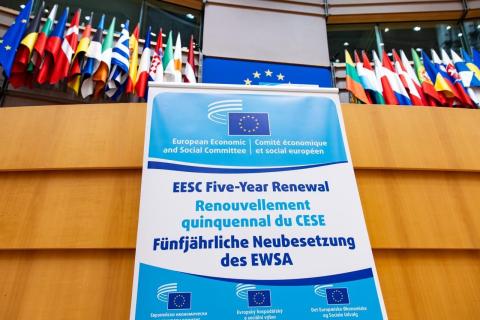
During the EESC’s inaugural plenary session for its new term of office (2025-2030), the EESC plenary elected members of the Civil Society Organisations’ Group to several leadership positions. Séamus Boland is the new President of the European Economic and Social Committee (EESC), after chairing the Civil Society Organisations’ Group from 2020 to 2025. Elena-Alexandra Calistru takes over the presidency of the Committee’s Section for Economic and Monetary Union and Economic and Social Cohesion (ECO), and Stoyan Tchoukanov will hold the presidency of the Section for Agriculture, Rural Development and the Environment (NAT). Alain Coheur will be president of the Consultative Commission on Industrial Change (known by its French acronym CCMI, Commission consultative des mutations industrielles), and Maurizio Mensi will represent the Civil Society Organisations’ Group as one of the EESC’s Quaestors.
Unlike EESC members, who are elected for a five-year term of office, the presidencies of the EESC, its sections and other permanent and ad hoc bodies are elected for a period of two and a half years, in rotation between the three groups which make up the EESC. New presidencies usually start with the EESC renewal and mid-term renewal. As the EESC’s 2025-2030 term of office started on 21 September, the new presidencies will last until April 2028.
Positions to be held by members of the EESC Civil Society Organisations’ Group during the 2025-2028 term:
- Séamus Boland – EESC President
- Elena-Alexandra Calistru – President of the ECO Section
- Stoyan Tchoukanov – President of the NAT Section
- Alain Coheur – President of the CCMI
- Maurizio Mensi – Quaestor
- Ioannis Vardakastanis – Vice-President of the ECO Section
- Giuseppe Guerini – Vice-President of the INT Section
- Baiba Miltoviča – Vice-President of the TEN Section
- Ariane Rodert – Vice-President of the SOC Section
- Corina Murafa Benga – Vice-President of the NAT Section
- Ionuţ Sibian – Vice-President of the REX Section
- Giovanni Marcantonio – President of the Labour Market Observatory
- Baiba Miltoviča – President of the Permanent Group on Transport
- Michael Mc Loughlin – Co-Chair of the EU-Ukraine Civil Society Platform
- Cristian Pîrvulescu – Co-Chair of the EU-Republic of Moldova Civil Society Platform
- Danko Relić – President of the EU-Montenegro Joint Consultative Committee
- Ioannis Vardakastanis – President of the EU-Türkiye Joint Consultative Committee
- Juraj Sipko – President of the European Economic Area Consultative Committee
- John Comer – President of the Latin America Follow-up Committee
- Séamus Boland – President of the EU-Brazil Round Table
- Séamus Boland – President of the EU-China Round Table
- Martin Böhme – President of the Ethical Committee
- Stoyan Tchoukanov – President of the Permanent Group on the Conference of the Parties to the UNFCCC
Background information:
The EESC is made up of 329 members from the 27 Members States. Nominated by their national governments, they are appointed by the Council of the European Union for a renewable period of five years. EESC members then work independently in the interests of all EU citizens. Members are not politicians but employers, trade unionists and representatives of various activities such as farming, consumer and environmental organisations, the social economy, SMEs, the liberal professions and associations representing persons with disabilities, young people, the voluntary sector, etc.
For the 2025-2030 term of office, the Civil Society Organisations’ Group is composed of 110 members (46 new members, corresponding to 42%), including, as usual, a wide range of civil society representatives from the economic, civic, professional and cultural fields.
For more information on the EESC renewal and the Group visit the EESC webpage.
Work organisation
Downloads
-
PR: EESC renewal: Members of the Civil Society Organisations’ Group take on new positions in the Committee
Recommended for you
La UE necesita más inversión pública en infraestructuras energéticas para luchar contra el cambio climático
News
En un Dictamen aprobado en el pleno de septiembre, el Comité Económico y Social Europeo (CESE) afirma que se necesita una inversión pública masiva para lograr la transición energética y cumplir los…
Energía: el CESE advierte contra la creación de nuevas dependencias
News
El Comité Económico y Social Europeo (CESE) se pronuncia con firmeza sobre la energía en un Dictamen aprobado en su pleno de septiembre: la propuesta de la Comisión es un paso en la dirección…
La transición digital debe ser justa: los derechos humanos y el control humano deben seguir teniendo una importancia fundamental
News
El Comité Económico y Social Europeo (CESE) señala las oportunidades que presenta la revolución digital, pero también advierte de sus peligros: si se implantan con demasiada rapidez, las soluciones…
La UE necesita ya un plan de acción para ofrecer una vivienda asequible y digna
News
En la conferencia de alto nivel que el Comité Económico y Social Europeo (CESE) celebró en Riga los participantes dieron la voz de alarma por la crisis de la vivienda asequible y advirtieron que ya…
La Presidencia checa de la UE replanteará, reconstruirá y reactivará Europa
News
En el pleno de julio del Comité Económico y Social Europeo (CESE) se celebró un debate con el ministro checo de Asuntos Exteriores, Jan Lipavský, para debatir las prioridades de la Presidencia checa…