by Stefano Mallia, EESC Employers' Group president
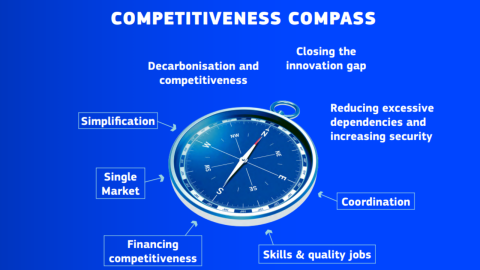
On 29 January, the European Commission adopted the Competitiveness Compass, a critical and timely step to reignite Europe’s economic engine that will chart the EU’s course for the next five years.
by Stefano Mallia, EESC Employers' Group president
On 29 January, the European Commission adopted the Competitiveness Compass, a critical and timely step to reignite Europe’s economic engine that will chart the EU’s course for the next five years.
EU employers have long advocated for an overarching competitiveness agenda, and we welcome the three pillars of the compass: closing the innovation and productivity gap, combining decarbonisation with competitiveness, and reducing dependencies to secure supply chains. These are key to ensuring that Europe can compete globally, attract and retain talent and foster innovation.
However, the ultimate success of the compass hinges on the development of concrete measures and their timely implementation. Key initiatives such as the Omnibus Simplification package, the Clean Industrial Deal and the horizontal strategy to deepen the single market will play a decisive role. Nonetheless, rebranded strategies and catchy titles alone cannot shield us from the challenges ahead.
For example, simplifying the regulatory framework is the first and most urgent step. Reducing burdensome bureaucracy and promoting speed and flexibility are essential. For too long, EU businesses have struggled with overcomplexity and sluggish decision-making. We also need meaningful implementation of the competitiveness check, so that new legislative and regulatory measures support, rather than hinder, business growth.
The compass rightly focuses on fostering innovation through a robust Capital Markets Union and addressing structural barriers to unlock Europe's potential in deep tech, clean energy and advanced manufacturing, while creating a fertile ecosystem for start-ups and scale-ups.
The never-completed Capital Markets Union is indeed a reminder that we cannot afford any delays. While the compass promotes better coordination of national government investments, it lacks a clear plan on other common sources of funding. But the world will not wait for us.
The race is on and now is the time to go into top gear. Unlocking competitiveness is not just an economic imperative, it is the key to shared prosperity for all. European businesses are and will remain part of the solution.
The legitimate interests of the EU in the European Arctic will be best defended together through an EU Arctic strategy that strengthens civil society participation in all relevant decisions. Close cooperation with Greenland is also vital for sustainable investment in the Arctic in order to ensure the region’s prosperity and resilience.
The legitimate interests of the EU in the European Arctic will be best defended together through an EU Arctic strategy that strengthens civil society participation in all relevant decisions. Close cooperation with Greenland is also vital for sustainable investment in the Arctic in order to ensure the region’s prosperity and resilience.
EESC member Anders Ladefoged, rapporteur for the opinion, said: ‘With our new opinion on the EU’s Arctic policy we are offering a civil society perspective on how the EU could develop its policy for this region. Both to take care of its own interests and to help secure a resilient and prosperous region for the people who live there.’
The EESC also supports and encourages full consultation and cooperation with indigenous people in the Arctic. In this context, EESC member Christian Moos, co-rapporteur for the opinion, said: ‘The interests of European Arctic states are best defended together, through both cooperation between the northern EU Member States and a European Arctic strategy, which must ensure civil society participation and uphold the rights of local and indigenous people.’
Greenland, which is also discussed in the opinion, faces a similar situation to the European Arctic when it comes to both challenges and opportunities relating to the rapid transformation in the region.
Regarding Greenland, Mr Moos said: ‘Enhanced European cooperation, including in Greenland, is vital for sustainable investment in the European Arctic to make it a prosperous and resilient region.’
For Greenlanders, one of the main focuses is strengthening their self-determination as a nation under the slogan ‘nothing about us, without us’. However, the EU is seen as a close ally based on shared values, such as human rights and social dialogue. (at)
The EU needs a sharper focus on competition policy to strengthen its global competitiveness, boost productivity and ensure the Single Market remains a pillar of economic strength.
The EU needs a sharper focus on competition policy to strengthen its global competitiveness, boost productivity, and ensure the Single Market remains a pillar of economic strength.
At its January plenary, the European Economic and Social Committee (EESC) adopted the opinion entitled A Competition Policy at the Heart of EU’s Competitiveness. The opinion calls for deeper integration of national economies and smarter state aid strategies to unlock Europe’s economic potential and address key global challenges, including digitalisation, climate change and resilience.
The EESC underscored that competition policy is critical to fostering innovation, sustainability and economic growth. ‘There is no conflict between competition and competitiveness’ , said rapporteur Isabel Yglesias. ‘With streamlined procedures, flexible tools and sufficient resources, competition policy can drive prosperity for EU businesses and citizens.’
The EU’s new competition rules, such as the Digital Markets Act (DMA) and the Foreign Subsidies Regulation (FSR), are already addressing market distortions and enhancing the bloc’s global standing. However, the EESC calls for further measures to modernise merger assessments and ensure innovation-driven mergers are effectively controlled, even if they fall below current EU thresholds.
The opinion highlights the vital role of state aid in supporting the green and digital transitions. However, poorly coordinated subsidies risk undermining productivity and growth. Studies show that better coordination within the EU could boost productivity by over 30%. The EESC recommends aligning subsidies across Member States to enhance European value chains and prevent inefficiencies.
The Important Projects of Common European Interest (IPCEIs) and the proposed European Competitiveness Fund should be designed with a pan-European perspective to drive large-scale industrial innovation. These tools must ensure benefits are distributed fairly across the Union, promoting sustainability and resilience.
To position the EU as a global leader, the EESC emphasises the need for:
Greater integration to reduce misallocated subsidies and boost productivity;
Stronger rules to protect European innovation during foreign acquisitions;
Simplified and faster competition and state aid procedures to increase efficiency; and
A balanced merger policy that promotes innovation, sustainability, and infrastructure investment. (ll)
The European Economic and Social Committee (EESC) has called for changes to the European Union’s State aid rules in order to recognise and better accommodate the needs of social economy entities, which play a critical role in tackling societal challenges.
The European Economic and Social Committee (EESC) has called for changes to the European Union’s State aid rules in order to recognise and better accommodate the needs of social economy entities, which play a critical role in tackling societal challenges.
‘We want to make more people aware of the benefits of effective regulation on competition and State aid for both social economy enterprises and the entire system of services of general interest’, said the opinion’s rapporteur, Giuseppe Guerini.
Social economy entities – which range from cooperatives to mutual societies and foundations – employ over 11 million people across the EU, i.e. 6.3% of the working population. They operate in areas such as social and health services, renewable energy and poverty alleviation. Despite their contributions, many face systemic barriers to securing long-term investment capital and navigating public procurement processes, as the current regulatory framework often fails to account for their non-profit or solidarity-based nature.
Among other things, the EESC’s opinion highlights the fact that public authorities are underutilising existing tools such as the General Block Exemption Regulation (GBER) and the framework for services of general economic interest (SGEIs).
That is why the Committee is calling for simplification and modernisation of the overly complex and outdated rules under the GBER for supporting the employment of disadvantaged and disabled workers, in line with some of the recommendations from the Letta Report on the single market.
While the recent increase in de minimis aid ceilings – €300 000 for ordinary companies and €750 000 for SGEI entities – is welcomed, the EESC also argues that more tailored instruments, such as the GBER or specific SGEI provisions, would better address the needs of social economy entities in fields like health and social services. (ll)
Young people in the Mediterranean region must be included every step of the way, from policymaking to implementation. They shape not only policies but also life, as highlighted in the debate held by the European Economic and Social Committee (EESC).
Young people in the Mediterranean region must be included every step of the way, from policymaking to implementation. They shape not only policies but also life, as highlighted in the debate held by the European Economic and Social Committee (EESC).
The debate linked to the adoption of the opinion on Youth involvement in social and civil dialogue in the Mediterranean region, held at the EESC’s January plenary session,is the first EESC opinion to takeinto account the input of youth representatives from the region. Eight young representatives contributed to the drafting process.
During the debate, the Commissioner for the Mediterraneanregion, Dubravka Šuica, stressed the importance of young people for the prosperity, stability and resilience of the region. ‘The future of the Mediterranean is in the hands of its young people. For a shared and sustainable future, we must engage with young generations directly, ensuring that their voices guide our policies and priorities. Together, we will shape the new pact for the Mediterranean by investing in education, jobs and growth.’
EESC president Oliver Röpke gave his support for Commissioner Šuica’s new pact, which targets investment, sustainability and migration, adding that civil society must be actively involved in designing it. ‘Youth engagement is essential for the region’s future, and the EESC is committed to ensuring that their voices shape policy and decision-making. Together with the Union for the Mediterranean and the Anna Lindh Foundation, we are striving to build a peaceful and thriving Mediterranean.’
Underlining the importance of the young representatives’ contribution to the opinion, Princess Rym Ali, president of the Anna Lindh Foundation, said that working with young people is not only important, but urgent and generative. ‘There is so much at stake. Without the buy-in of youth, without offering them tools to participate equally, we cannot build a solution for the future. They need a seat at the table’, she said.
Eliane El Haber, youth representative for the opinion and advisor at the UNESCO Sustainable Development Goal 4 Youth and Student Network, embraced the EESC’s initiative to actively involve young people who represent diverse regional, gender, educational and cultural backgrounds. (at)