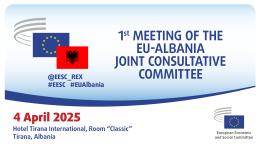
The first meeting of the EU-Albania Joint Consultative Committee (JCC) took place on 4 April 2025 in Tirana, Albania. This platform, established within the institutional framework of the EU-Albania Stabilisation and Association Agreement (SAA), will enable representatives from both the EU and Albanian civil society to monitor the country's accession negotiations, discuss issues of common interest, and highlight concerns to be addressed on Albanian's path towards the European Union.
emphasises the urgent need to enhance European competitiveness while maintaining sustainability and social cohesion. The EU must act decisively to stay competitive without compromising environmental sustainability, workers’ rights or regional balance. The EESC advocates for growth aligned with social and territorial cohesion;
calls for greater investment in key areas such as social infrastructure, digital transformation and energy transition. The EESC emphasises the need for substantial investments in modern infrastructure - education, research, digitalisation and renewables - to sustain Europe’s economic strength and competitiveness and tackle demographic, technological and climate challenges;
stresses the need for the EU to drive global economic transformation rather than just preserve past achievements. Europe is at a crossroads: it can either take a proactive role in global economic transformation or risk falling behind. The EESC therefore calls for the proactive adaptation of the single market, reduced reliance on non-EU supply chains and stronger strategic industries.
The European Economic and Social Committee (EESC) must be involved from the outset in the European Commission’s initiatives to step up engagement with civil society. The EESC’s upcoming study on Mapping civil dialogue practises in the EUinstitutions and its 2025 Civil Society Week (17-20 March) can provide valuable input, according to the EESC’s Civil Society Organisations’ Group.
underscores the urgent need for a unified and robust EU defence funding mechanism to address geopolitical challenges, particularly the Russian aggression against Ukraine;
stresses the necessity of aligning EU defence policy with NATO strategies to ensure complementarity and interoperability in security operations;
calls for enhanced joint procurement mechanisms, including the European Peace Facility (EPF), to optimise resource efficiency and operational readiness;