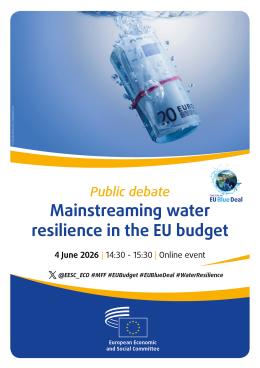
Mainstreaming Water Resilience in the EU Budget is a timely discussion on securing Europe’s water future. Discover how smarter EU investments can strengthen water resilience, sustainability, and preparedness, and how we should shape tomorrow’s funding priorities across programmes in the context of the EU´s next Multiannual Financial Framework.
The EESC says that the European Union needs a sustainable, secure and affordable energy supply and that it must be seen as a public good for EU prosperity, economic and social development and competitiveness.
The EESC says that the European Union needs a sustainable, secure and affordable energy supply and that it must be seen as a public good for EU prosperity, economic and social development and competitiveness.
In the opinion adopted at the March plenary session and drafted by Thomas Kattnig, the EESC stresses the economic importance of the energy system, as mentioned in the Draghi report. Energy prices play a pivotal role in overall inflation; therefore, it is essential to lower network costs to avoid further increases in grid tariffs.
‘Europe needs strong, smart and secure electricity grids,’ said Mr Kattnig during the plenary session. ‘They must be organised as a public good that guarantees security of supply, sustainability and affordability.’
In the opinion, the EESC underlines that grid development should be well coordinated with the current requirements arising from renewable energy integration as well as with the targeted energy mix and the structure of electricity generation.
The EESC also adds that it is essential to prioritise the efficient use of existing grids, placing optimisation before expansion, supported by flexibility solutions.
More specifically, the EESC supports expanding decentralised energy generation, which can lower the pressure on the grid – and so reduce the need for grid expansion – and increase public acceptance of the energy transition.
At the same time, the EU needs better coordination on electricity grids. This is why the EESC calls for stronger EU coordination in grid governance while maintaining Member States’ responsibility for planning and oversight as the costs of grid expansion, congestion management and stability are primarily borne by the Member States.
The Committee also underlines the importance of accelerating the digitalisation of electricity networks and ensuring that network development plans align with national energy and climate plans (NECPs). (mp)
The EESC urges the European Commission to maintain a clear and credible long-term signal in favour of zero-emission vehicles. At the same time, when used primarily in an electric mode, low-emissions vehicles can act as a short and mid-term enabler of alternative fuel infrastructure and support industrial adaptation.
The EESC urges the European Commission to maintain a clear and credible long-term signal in favour of zero-emission vehicles. At the same time, when used primarily in an electric mode, low-emissions vehicles can act as a short and mid-term enabler of alternative fuel infrastructure and support industrial adaptation.
In the opinion adopted at the March plenary session and drawn up by Corina Murafa Benga, the Committee assesses the European Commission’s proposal on Clean Corporate Vehicles.
In the EESC’s view, the proposed Regulation should prioritise zero-emission vehicles but also recognise the transitional role which low-emission vehicles can play by supporting industrial adaptation in the short and medium term, preserving quality jobs and maintaining the European automotive sector’s competitiveness.
This approach provides companies and workers with the time needed to invest, innovate and reskill, facilitating an orderly transition towards full electrification while safeguarding Europe’s industrial and social fabric.
The EESC takes note of the proposed EU-wide, demand-side approach to clean corporate vehicles. However, it underlines that national targets should not be lower than what the market is already delivering, must not turn into company-based targets when the Regulation is introduced, and must be accompanied by an effective roll-out of supporting charging infrastructure and adequate capacity of the electricity grids, to safeguard business competitiveness.
The Committee also calls on Member States to consider tax incentives for decarbonising corporate fleets, including by removing direct and indirect advantages for fossil-fuel company cars.
National tax frameworks for corporate vehicles remain one of the most powerful demand-side levers. Aligning company car taxation, benefit-in-kind rules and depreciation schemes with the Regulation’s objectives can speed up purchasing decisions, influence vehicle use patterns and support timely fleet renewal. (mp)
‘Housing is a fundamental right,’ said Mr Kattnig during the plenary session. ‘Europe must curb speculation, protect people from energy poverty and invest in affordable, sustainable homes for families and future generations.’
In the exploratory opinion, requested by the Cyprus Presidency of the Council of the European Union, the EESC welcomes the European Affordable Housing Plan presented by the European Commission in December 2025. However, it is of the view that the Commission must act swiftly to present the announced initiatives and even stronger measures, including:
better framework conditions;
a right to adequate and affordable housing in EU primary law;
a fundamental reform of the energy market design;
sufficient funding; and
a stronger focus on young people, families and sustainability.
The Committee criticises the lack of clear land-use and spatial planning guidance, the risks of urban sprawl and of climate backsliding and the insufficient role given to cities, regions and local authorities.
In addition, it calls for an effective rural development strategy and proven tools, with a mandatory percentage of subsidised, affordable housing. (mp)
The EESC is placing a very heavy stone at the heart of the EU’s military mobility debate, noting that the European institutions must join forces with all relevant stakeholders to make the European Union safe and ready to act, both in times of crisis and in times of peace.
The EESC is placing a very heavy stone at the heart of the EU’s military mobility debate, noting that the European institutions must join forces with all relevant stakeholders to make the European Union safe and ready to act, both in times of crisis and in times of peace.
The EU is currently facing a paradox: it has built the world’s most sophisticated single market, where goods cross borders quickly and seamlessly. However, when it comes to moving the tools and assets of its own security, there are still obstacles, both literal and bureaucratic.
‘Further action and stronger civil-military cooperation are needed. This is not optional – it is the only way forward, and it must be built on trust and transparency’, said EESC President Séamus Boland during the debate held at the EESC March plenary. ‘Military mobility is not about tanks on highways – it is about trust between soldiers and civilians, between governments and transporters. We either build that trust, or we risk breaking under pressure’.
Mr Boland added: ‘this is not a job for governments alone. It is a job for all of us: the policymakers who write the rules, the military planners, the companies that build the networks, the transport operators who move more cargo in a week than some armies do in a year, the workers who keep everything running, the medics who must be on alert, the drivers who deliver, and above all, the citizens who depend on all of them’.
Along the same lines, Maja Bakran, Deputy Director-General of the European Commission’s Directorate-General for Mobility and Transport (DG MOVE), confirmed the need to join hands at all levels. She referred to the proposal Military Mobility Package, which was presented by the European Commission and High Representative for Foreign Affairs and Security Policy in November 2025 to ensure that troops, equipment and military assets can move swiftly across the EU.
By adopting the opinion drafted by Tomas Arvidsson, the EESC provides an essential contribution in order to overcome the barriers to military mobility.
Military mobility is the backbone of European independence. It is not only the concern of generals and defence officials, and it must be made possible through three key angles: infrastructure, social respect and borders. (mp)