What combination of economic policies is needed to counter the risk that new fiscal rules exacerbate social inequalities and make public finances unsustainable, while also generating adequate resources to implement the green transition...?
In a new set of recommendations adopted in September, the European Economic and Social Committee (EESC) called for pressing action to address the critical funding shortfall threatening the EU’s climate and digital transformation goals. By establishing an EU investment fund with a focus on strategic, future-oriented investments, Europe can secure its competitiveness, reduce external dependencies, and create a more resilient single market.
Almost five years after it was launched, the Green Deal – Europe’s blueprint for a carbon-free Europe – has seen its implementation become increasingly complex. It is high time for a review of the green transition targets and to ensure they will not be achieved at the expense of Europe’s industrial and social systems, workers’ well-being and the EU’s competitiveness.
On 23 September, the European Commission announced the winners of the third edition of the EU Organic Awards. The European Economic and Social Committee (EESC) proudly welcomed the winners of three key categories: Best organic food processing SME, Best organic food retailer, and Best organic restaurant/food fervice.
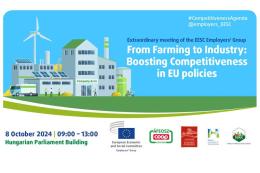
Competitiveness is a key priority of both the Hungarian Presidency and the new von der Leyen Commission for the next political cycle. The issue will be addressed with our members and members' organisations at the extraordinary Group meeting on 8 October in Budapest. The debate will focus on the agri-food and industrial sectors.
This year, the European Economic and Social Committee and the European Committee of the Regions will be jointly hosting the kick-off event of the European Cybersecurity Month.
Three organisations are awarded the 15th EESC Civil Society Prize
Location
Brussels
Belgium
The EESC is pleased to announce the three winners of the 15th edition of the Civil Society Prize, which rewards effective, innovative and creative initiatives carried out on the territory of the EU to combat harmful polarisation of European society.