The EESC issues between 160 and 190 opinions, evaluation and information reports a year.
It also organises several annual initiatives and events with a focus on civil society and citizens’ participation such as the Civil Society Prize, the Civil Society Days, the Your Europe, Your Say youth plenary and the ECI Day.
Here you can find news and information about the EESC'swork, including its social media accounts, the EESC Info newsletter, photo galleries and videos.
The EESC brings together representatives from all areas of organised civil society, who give their independent advice on EU policies and legislation. The EESC's326 Members are organised into three groups: Employers, Workers and Various Interests.
The EESC has six sections, specialising in concrete topics of relevance to the citizens of the European Union, ranging from social to economic affairs, energy, environment, external relations or the internal market.
Creating a political and funding instrument to promote competitiveness has been the long-standing wish of the European business community and finally competitiveness is the compass guiding the EU’s economic direction. Following the Competitiveness Compass and concrete initiatives such as the Omnibus Simplification Packages, the European Competitiveness Fund (ECF) proposal marks a strong step toward restoring Europe’s leadership back at the global economic scene.
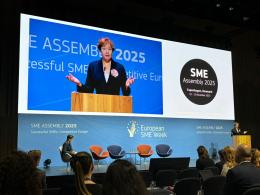
Europe’s Small and Medium-sized Enterprise (SMEs) are at a turning point and the discussions at the SME Assembly showed just how urgently change is needed.