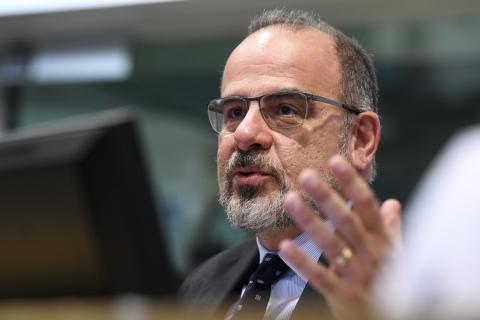
Despite recent progress, discrimination, violence and harassment continue to affect many LGBTIQ+ people across the EU, with particularly severe impacts on trans, non-binary and intersex individuals. An EESC plenary debate in April heard that so-called conversion practices – aimed at changing or suppressing a person’s sexual orientation or gender identity – persist in some parts of Europe and are widely condemned as harmful and incompatible with fundamental rights.
The European Economic and Social Committee (EESC) placed fundamental rights, dignity and equality at the centre of its April plenary session, holding a high-level debate on advancing LGBTIQ+ rights and banning conversion practices. The debate was followed by the adoption of two opinions calling for stronger enforcement of the EU’s LGBTIQ+ Equality Strategy 2026-2030 and a comprehensive EU-wide ban on conversion practices.
Setting the tone, EESC President Séamus Boland firmly rejected any justification for such practices: ‘These so-called conversion practices or therapies are not only harmful, they are a profound violation of human dignity and fundamental rights. Let us be absolutely clear: there is nothing to fix or cure.’
The debate brought together representatives from EU institutions, civil society and international organisations. Caleb Stocco from the European Association Against Conversion Therapy highlighted the lasting harm caused by these practices and called for decisive EU action. From the European Commission, Francesco Zoia Bolzonello outlined efforts to advance equality through the LGBTIQ+ Equality Strategy 2026-2030, stressing the importance of EU leadership in the face of a growing backlash.
International perspectives reinforced the urgent need for action. Béatrice Fresko-Rolfo from the Council of Europe and UN Independent Expert Graeme Reid both emphasised that banning conversion practices was a matter of fundamental human rights and dignity.
Participants pointed to persistent inequalities across Member States, including discrimination, hate speech and barriers to healthcare, housing and employment. The recent Court of Justice of the EU ruling in Commission v Hungary was cited as reaffirming the EU’s obligation to protect LGBTIQ+ rights and uphold fundamental freedoms.
The two EESC opinions adopted translate these concerns into concrete recommendations. Regarding conversion practices, the EESC calls for a comprehensive, legally binding EU-wide ban covering both minors and adults, including effective penalties and support for survivors. On the Equality Strategy, it urges stronger monitoring, binding benchmarks linked to EU funding and decisive action to counter the anti-LGBTIQ+ backlash.
The EESC, as the voice of organised civil society, reaffirmed its commitment to advancing equality and ensuring that all people in Europe can live freely and safely, without fear of discrimination. (lm)
The European Economic and Social Committee (EESC) adopted its opinion on the next Multiannual Financial Framework (MFF) 2028-2034 in January 2026, delivering a clear message to the EU institutions: Europe’s strategic, social and geopolitical ambitions require a stronger and better-designed long-term budget. Read the interview with Luca Jahier, the EESC rapporteur from the Committee's Civil Society Organisations' Group.
The European Economic and Social Committee (EESC) adopted its opinion on the next Multiannual Financial Framework (MFF) 2028-2034 in January 2026, delivering a clear message to the EU institutions: Europe’s strategic, social and geopolitical ambitions require a stronger and better-designed long-term budget. Read the interview with Luca Jahier, the EESC rapporteur from the Committee's Civil Society Organisations' Group.
By the Civil Society Organisations' Group
What are the main findings and recommendations of this opinion?
The EESC’s first key finding concerns the overall volume of the MFF. While acknowledging the European Commission’s proposed nominal increase, the Committee stresses that, once inflation and the repayment of NextGenerationEU debt are taken into account, real resources would remain largely unchanged. This falls short of what is needed to close persistent investment gaps in strategic autonomy, competitiveness, social cohesion, climate action, security and defence. Drawing on recent institutional reports, the EESC calls for a substantial increase in real resources relative to gross national income and for stronger EU-level investment in European public goods, which cannot be delivered effectively by Member States alone.
A second major concern relates to the structure and governance of EU funding. The EESC strongly opposes the proposed reductions to cohesion policy and the Common Agricultural Policy, underlining their proven contribution to economic, social and territorial convergence. It also raises serious reservations about the planned merger of several major policy areas into a single National and Regional Partnership Plan, as is currently proposed, warning that this risks excessive centralisation and weaker stakeholder involvement. The Committee therefore calls for a reinforced partnership principle, mandatory participation mechanisms, adequate support for capacity-building and safeguards where effective involvement is lacking.
The opinion also addresses revenues, competitiveness and democratic resilience. While welcoming the introduction of new EU own resources, the EESC calls for greater ambition and closer alignment with EU policy objectives. It supports EU emissions trading system ETS- and Carbon Border Adjustment Mechanism CBAM-based revenues, subject to transitional support for energy-intensive sectors, but expresses strong reservations about the proposed Corporate Resource for Europe, recommending instead the reintroduction of a digital services tax.
On competitiveness, the Committee stresses that this must go hand-in-hand with social fairness, equal access to funding and substantial investment in research, innovation, skills and infrastructure. Adequate financing for civil society and media programmes is highlighted as essential democratic infrastructure.
Finally, the EESC welcomes the reinforcedGlobal Europe pillar, stressing that increased funding for external action must support strategic autonomy, enlargement and neighbourhood stability, while strengthening the Global Gateway as a coherent instrument for multilateral engagement.
After the adoption of this opinion, what will you do to promote it?
Following the adoption of the opinion, the EESC will actively promote its recommendations through dialogue with the European Commission, the European Parliament, the Council and key stakeholders, ensuring that organised civil society contributes meaningfully to the negotiations on the EU’s next long-term budget.
As discussions on the European Commission’s 2027 Work Programme gather pace, the European Economic and Social Committee (EESC) has underlined the need for a competitiveness agenda that delivers both economic strength and social progress.
As discussions on the European Commission’s 2027 Work Programme gather pace, the European Economic and Social Committee (EESC) has underlined the need for a competitiveness agenda that delivers both economic strength and social progress.
By the EESC Workers’ Group
‘Europe’s competitiveness cannot be built at the expense of workers. The digital, green and energy transitions must be fair transitions, based on quality jobs, skills, social dialogue, equal opportunities and strong workers’ rights’, the EESC states in its contribution to the 2027 Work Programme.
The EESC argues that Europe’s resilience and sustainable growth depend on a strong industrial base, innovation, investment and a deeper single market. At the same time, it stresses that people must remain at the heart of Europe’s transformation, with quality jobs, social dialogue and workers’ rights forming essential pillars of future policy.
The Committee calls for the European Pillar of Social Rights to be implemented in full and supports measures to strengthen fair labour mobility, digital workers’ rights, skills development and social conditionality in EU funding and public procurement. It also highlights the importance of the forthcoming Quality Jobs Act, stronger protection against risks linked to algorithmic management, and greater investment in vocational education and training.
Alongside social priorities, the EESC advocates a modern industrial policy focused on affordable energy, secure supply chains, critical raw materials and strategic infrastructure. It also calls for adequate resources in the next multiannual financial framework (MFF), ensuring that competitiveness, cohesion, social progress and the green transition receive balanced support.
The Committee further emphasises that tackling poverty, improving access to housing and essential services, as well as strengthening health, care and mental well-being are crucial to Europe’s democratic resilience. According to the EESC, sustainable prosperity will only be achieved if economic growth goes hand in hand with social inclusion and a better quality of life for all Europeans.
By Konstantinos Diamantouros, EESC Employers' Group member
The MFF remains a key tool to support EU priorities, especially at a time when Europe’s investment needs are growing. While the majority of funds will come from mobilising private investment, public resources will also be crucial.
The MFF remains a key tool to support EU priorities, especially at a time when Europe’s investment needs are growing. While the majority of funds will come from mobilising private investment, public resources will also be crucial.
By Konstantinos Diamantouros, EESC Employers' Group member
Against this backdrop, the MFF proposal marks an important step forward. First, it places a stronger emphasis on competitiveness, especially through the creation of the European Competitiveness Fund and the reinforcement of Horizon Europe, which can help position industry, research and innovation at the heart of EU growth. Second, the expansion of the Connecting Europe Facility has the potential to enhance transport and energy networks and contribute to lowering energy costs.
In addition, the performance-based approach for national and regional plans is welcomed, provided that the ‘reforms for investments’ logic is aligned with cohesion policy objectives and does not introduce macroeconomic conditionality. On external action, the increase in funding for Global Europe is also a positive step, as it can strengthen the EU’s global role, diversify value chains and enhance security.
At the same time, there are areas of concern. As outlined in the EESC opinion on the next Multiannual Financial Framework (MFF) 2028-2034, we oppose the idea of merging cohesion policy, ESF+, agriculture, fisheries, migration and security into a single fund, as this risks creating competition between priorities which could undermine the long-term planning needed for the seven year period of the MFF. We therefore call instead for a clearer structure, with predictable funding for each policy area.
The proposed Corporate Resource for Europe (CORE) as a new EU own resource also raises concerns: first, because further taxation may run counter to the EU’s competitiveness agenda; and second, because it is a levy based on turnover rather than profit.
Overall, the proposal moves in the right direction, but the final budget must safeguard cohesion, involve social partners, avoid harmful conditionality and ensure fair financing that supports competitiveness.
The European Life Science Strategy along with the Strategy on Research and Technology infrastructures with focus on the treatment of rare diseases DG RTD – Commissioner ZAHARIEVA