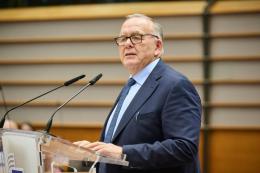
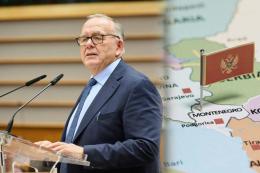
I welcome the decision by European Union Ambassadors to establish a Council Working Party tasked with drafting the Accession Treaty with Montenegro and congratulate Montenegro for this important milestone. This represents both a recognition of progress and an incentive to accelerate reforms.
I welcome the decision by European Union Ambassadors to establish a Council Working Party tasked with drafting the Accession Treaty with Montenegro and congratulate Montenegro for this important milestone.
The 17th meeting of the EU-Moldova Civil Society Platform will place on 24 April 2026 in Chisinau. The debate will focus assessing the state of play in the implementation of the EU-Moldova Association Agreement as well as the progress made by the Republic of Moldova on EU accession path. In addition, the Platform will discuss how to strengthen the civic space and the operating environment for civil society, the role of civil society in monitoring the Growth Plan, and the alignment of the national legal framework governing labour relations and social dialogue with the European acquis. A joint declaration will be adopted at the end of the meeting.
This public hearing will aim to present and discuss the European Commission’s Strategy on Intergenerational Fariness, a new strategic framework to guarantee that current decisions are made with the future in mind, ensuring a fair balance of benefits and burdens across all generations. The event will gather key institutional actors, civil society organisations, social partners and experts to reflect on the Strategy's priorities and to contribute to the preparation of the EESC Opinion (SOC/868).
The event will be webstreamed (EN, original). No registration is needed and participation is free of charge.
Follow us on X: @EESC_SOC
Ask your questions to the panelists via Sli.do with the event code: #IntergenStrategy
On 21st of April, the EESC Workers’ Group brought together experts from the ETUC, S&D MEPs, the Spanish government and the European Commission to examine the current push for competitiveness, the Commission’s proposals on the 28th Regime, also known as EU Inc. proposal and the Quality Jobs Act.
calls for structured engagement with civil societyin the roll-out ofall three facilities. Sustainable and credible reforms require permanent, active and institutionalised roles for the social partners and civil society organisations, alongside national authorities, to secure legitimacy, public trust and societal ownership of these reforms.
Stresses the need for structured, permanent involvement of organised civil society to ensure effective cooperation and accountability;
Believes that reforms on access to finance, simplified procedures, digitalisation and connectivity targeting micro, small, medium-sized enterprises (MSMEs) are necessary to unlock the potential of the private sector.
The EU needs a long-term vision that takes greater account of geographic specificities. Sustainable water management and food security must become top priorities, with food security and biodiversity going hand in hand.