Europe’s transport network is facing a squeeze: higher ambitions, tighter budgets and persistent gaps at borders. As the EU prepares its next long-term budget, the question is no longer how much to invest, but how to invest better. José F. Papí – CEO of Etelätär Innovation and author of a European Parliament study on transport funding – tells EESC Info where EU money makes the biggest difference and where it still falls short.
Europe’s transport network is facing a squeeze: higher ambitions, tighter budgets and persistent gaps at borders. As the EU prepares its next long-term budget, the question is no longer how much to invest, but how to invest better. José F. Papí – CEO of Etelätär Innovation and author of a European Parliament study on transport funding – tells EESC Info where EU money makes the biggest difference and where it still falls short.
Your study, Investing in Transport in the new MFF, highlights that the next multiannual financial framework (MFF) period faces a ‘perfect storm’: an urgent need to decarbonise transport and complete the TEN-T network at a time when public budgets are tightening and connectivity gaps remain, especially at borders. How would you characterise the current state of EU transport investment?
EU transport investment is at a turning point: the foundations are solid, but performance is uneven, and the gap between political ambition and real delivery remains too wide. In the 2021-2027 period, the combination of the Connecting Europe Facility (CEF) for Transport, cohesion policy funds, InvestEU, European Investment Bank lending and temporary recovery instruments has mobilised substantial resources, yet results vary significantly between Member States, corridors and modes of transport.
Where there are strong project pipelines, clear TEN-T corridor strategies and a robust cost-benefit analysis, EU support delivers high value for money. But oversubscribed CEF calls, administrative capacity constraints and fragmented governance mean that many high-quality projects go unfunded or face delays, especially in cohesion countries and peripheral regions.
Looking ahead to 2028-2034, the EU faces a ‘perfect storm’: it must accelerate decarbonisation, complete the revised TEN-T core and extended core networks, modernise critical road links for continued safety and resilience and meet heightened security needs under tighter fiscal conditions, while connectivity gaps persist at borders and in less-connected areas.
The main challenge is less putting instruments in place and more ensuring that they are consistent, have good coverage and are focused: good tools are in place, but they need to be better aligned, more predictable for long-term projects and more explicitly geared towards cross-border, green and dual-use priorities.
The proposed budget architecture for 2028-2034 is quite different from that of the past, relying on an enlarged CEF, on transport windows under the new European Competitiveness Fund (ECF) and on redesigned cohesion funds under national partnership plans. In your view, does this new mix of instruments offer a better way to coordinate research, innovation and deployment?
The proposed architecture has the potential to better coordinate research, innovation and deployment, but only if the division of labour is made more explicit and supported by concrete performance frameworks. An enlarged CEF for Transport is positioned as the EU-level backbone for cross-border TEN-T, major nodes, alternative fuels and dual-use infrastructure, while cohesion funds under national and regional partnership plans are intended to support regional links, urban mobility and last-mile connections, particularly in less developed regions.
The ECF and the successor to Horizon Europe can create an innovation-to-deployment pipeline, with mission-oriented calls and large-scale pilots feeding into mature investment pipelines that are then scaled up along TEN-T corridors with CEF, cohesion and ECF support.
In practice, this will only work if several safeguards are in place. First, there must be a clearer division of labour between instruments: the CEF should focus on cross-border or dual-use projects that are unlikely to proceed otherwise, cohesion funding on accessibility and infrastructure modernisation, and the ECF on industrial capacity and enabling infrastructure.
Second, coordinated programming – including shared roadmaps for zero-emission and digital corridors, joint work programmes and aligned calls – must bridge the traditional gap between research and innovation and deployment.
Third, transport-specific, outcome-oriented indicators should complement the horizontal Performance Regulation so that funding decisions across instruments are guided by measurable progress on TEN-T completion, decarbonisation, safety and resilience rather than absorption alone.
Your study warns that transport priorities could be diluted within broader funding allocations, affecting progress on decarbonisation and safety. You highlight three areas where EU-level intervention is most critical: cross-border links, alternative fuel infrastructure and dual-use projects. If the EU must prioritise, which of these is currently most neglected and why is it essential to keep it as a distinct focus area rather than fold it into general regional funding?
All three areas require EU-level intervention, but the most structurally neglected remains cross-border and missing links on TEN-T, especially where they connect less developed regions and external borders. These projects have strong added value for Europe and high socio-economic returns, yet are politically and administratively demanding, involve long lead times and cost overruns and are often the first to be delayed under national budget pressure. Without a dedicated, sufficiently large EU-level budget and clear governance of corridors, the risk is that Member States focus on purely national segments and that physical and interoperability gaps persist at borders, undermining decarbonisation, cohesion and security.
Alternative fuel infrastructure and digital systems (such as the European Rail Traffic Management System, advanced traffic management and charging networks that comply with the Alternative Fuels Infrastructure Regulation) also tend to be under-provided by markets alone, given high upfront costs and uncertain short-term financial returns. Here, modest but well-targeted EU grants and blended finance could unlock substantial private investment and ensure coherent network development.
Dual-use projects are gaining political visibility but still risk being treated as a niche area. They need to remain a distinct priority to ensure that military mobility investments systematically deliver strong benefits for civilians. If these areas are absorbed into broader regional allocations or horizontal industrial funds, short-term, nationally relevant projects are likely to crowd out cross-border, green and safety-critical investments whose benefits are not as obvious but are essential for a truly integrated, secure European transport area.
If you could make one definitive recommendation to the negotiators to ensure the next MFF delivers a truly resilient and green transport network, what would it be?
If I had to make one recommendation, it would be to agree on a significantly higher, clearly ring-fenced CEF for Transport allocation explicitly reserved for a limited portfolio of high-impact, cross-border, alternative-fuels, safety-oriented and dual-use projects, embedded in a transparent, performance-based governance framework at corridor level. Concentrating scarce EU-level grants on projects with clear added value for Europe – backed by robust cost-benefit analyses and clear milestones – would maximise value for money and send a strong, predictable signal to national authorities, investors and industry.
To make this work, the enlarged CEF should be complemented by transport-relevant sections in cohesion and competitiveness instruments, with safeguards such as minimum quotas for transport or conditionalities in national and regional partnership plans, an innovation-to-deployment pipeline under the successor to Horizon and the ECF, and transport-specific indicators to guide flexibility and mid-term reviews. This would allow the next MFF to respond to shocks and new priorities without losing sight of its long-term objective: completing a resilient, green and genuinely European transport network that individuals and businesses can rely on.
José F. Papíis the CEO of Estonian tech company Etelätär Innovation and President of the Smart Transportation Alliance, a Brussels-based platform for innovation in transport infrastructure. With more than 30 years’ experience in European and international transport policy, he has worked with EU institutions, government agencies and industry on devising and implementing mobility strategies. He is the author of the European Parliament study ‘Investing in Transport in the new MFF’, requested by the European Parliament’s Committee on Transport and Tourism, which assesses how the 2028-2034 EU budget can deliver high-value, green and resilient transport investments. The opinions expressed in this interview are those of the author only and should not be considered representative of the European Parliament’s official position.
The next EU budget is shaping up to be one of the most contested in years, with growing pressure on priorities and funding. In an interview with EESC Info, Anna Heckhausen, EU budget expert at Bertelsmann Stiftung, breaks down the key trade-offs – and why they matter for people and policies across Europe.
The next EU budget is shaping up to be one of the most contested in years, with growing pressure on priorities and funding. In an interview with EESC Info, Anna Heckhausen, EU budget expert at Bertelsmann Stiftung, breaks down the key trade-offs – and why they matter for people and policies across Europe.
In your paper The Devil is in the Budget - A Comprehensive Guide to the MFF Negotiations, you show that the next MFF cycle is facing unusually tight political and fiscal constraints. When looking at the five battlegrounds you identify: budget size, priorities, structure, conditionality, and revenues, which one do you see as the most decisive for determining whether this MFF succeeds or fails?
The battlegrounds EU institutions face in the MFF negotiations are deeply intertwined. Priorities depend on budget size; size depends on new revenues; and the more constrained the overall budget is, the more important structural reform becomes.
If I had to single out one battleground, I would therefore point to the budget’s architecture. The chances of a substantially larger budget are very slim – that makes structure crucial: it will determine whether the EU can spend its limited resources more strategically, effectively and flexibly. This is the logic behind the proposed National and Regional Partnership Plans and the European Competitiveness Fund: to simplify and target spending, reduce bureaucracy, increase synergies across policy areas, and respond better to crises and emerging priorities.
But structural changes can only go so far. New priorities still need to be backed by sufficient money. Ultimately, the question remains who pays – and how much?
Your policy brief Fund or Fumble – How to Make the European Competitiveness Fund Work argues that the EU currently spreads its industrial funding across too many small, complicated programmes, making it hard to focus on big strategic goals. The new proposal tries to fix this by merging 14 different programmes into one large ‘European Competitiveness Fund.’ Do you view this merger as a transformative solution that will make Europe more competitive, or is it merely a rebranding of existing challenges?
At present, EU industrial spending is highly fragmented, complex and rigid. The European Competitiveness Fund (ECF) is the Commission’s response to these weaknesses. More than just adding money, it introduces three reform levers.
The first is consolidation. Replacing silos and overlapping instruments with a more coherent framework could reduce administrative costs. This could make it easier for smaller businesses to access funds, including those in less developed regions.
The second is focus. Rather than dispersing support across too many small envelopes, the ECF would organise funding around strategic priorities through four policy windows. Maintaining a clear strategic focus within these windows should be a central priority in the negotiations.
The third is governance. Funding in the ECF could be more easily adjusted to shifting priorities over time. Moreover, the ECF would bring together different funding modes, such as loans and grants, in a single toolbox to better target industry needs at different stages of the innovation pipeline.
So, yes – the ECF has real transformative potential.
Given that a significant portion of the next budget is already committed to repaying pandemic-era debt, leaving little room for new initiatives, your research suggests major cuts are likely. If the EU must choose between protecting traditional spending on agriculture and cohesion versus investing in strategic priorities like defence and the green transition, which trade-offs do you consider politically feasible?
Both new and traditional spending have their part to play. Europe needs to invest heavily in security, competitiveness and the green and digital transitions. At the same time, cohesion and agricultural support remain important for regional development and the EU’s perceived legitimacy, especially in less developed regions.
Politically, deep cuts to cohesion and agricultural funds are unlikely. They are strongly entrenched, based on pre-allocated national envelopes and backed by powerful interest groups. However, there is scope to make cohesion policy more effective.
The most feasible compromise will therefore be to change what this money is expected to deliver: linking cohesion and agriculture more strongly to reforms and investment in competitiveness, skills, and climate resilience.
In the end, the divide between old and new priorities is less clear-cut than it may seem. Funding for infrastructure, industrial capacity and the economic transition can also support regional development. The key is to think these objectives together: using the ECF for excellence-based industrial support, while relying on cohesion instruments to ensure that less developed and transition regions can also benefit from Europe’s competitiveness agenda.
If you could make one recommendation to negotiators entering the final phase of MFF talks that would most improve outcomes for European citizens five years from now, what would it be?
My advice would be to make choices – you cannot spend the same euro twice. The EU budget is too small to fund every priority at meaningful scale. Synergies, leverage effects and efficiency gains can help, but they only go so far.
Negotiators should therefore resist the temptation to give every constituency, programme and objective a small envelope and instead focus resources where EU-level spending can make the biggest difference – for instance, on cross-border infrastructure, international research projects, or a coordinated EU industrial policy. If the EU wants – or needs – to take on new responsibilities in security, competitiveness and the dual transition, it also needs to decide what should give way – or who pays.
Anna Heckhausen works in the Europe’s Future programme at the Bertelsmann Stiftung, focusing on issues relating to the EU budget. Her research focusses on negotiations on the next Multiannual Financial Framework (MFF 2028-34), budget sustainability and the green transformation of Europe’s economy.The Bertelsmann Stiftung is a German non-profit foundation focused on strengthening democracy, society and public policy.
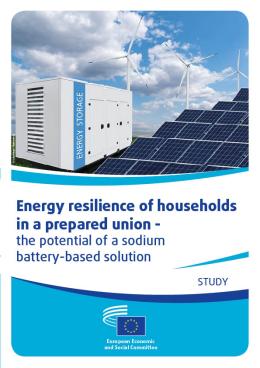
This study examines the potential of sodium ion battery technology to strengthen energy resilience in European households and businesses, particularly in meeting a 72 hour electricity self sufficiency objective under the EU’s preparedness strategy.
The current geopolitical context is shining a harsh spotlight on the price that Europe is paying for its dependency on third countries, as European Council President António Costa said at a plenary debate with the European Economic and Social Committee (EESC). The EU must boost its competitiveness to be able to deliver tangible results in terms of jobs, income and affordable housing.
The current geopolitical context is shining a harsh spotlight on the price that Europe is paying for its dependency on third countries, as European Council President António Costa said at a plenary debate with the European Economic and Social Committee (EESC). The EU must boost its competitiveness to be able to deliver tangible results in terms of jobs, income and affordable housing.
The European Council President described 2026 as a decisive year for Europe’s economic agenda. He argued that strengthening competitiveness is necessary to reduce Europe’s dependence on external developments and safeguard Europe’s social model, economic security and ability to act in a more hostile global environment.
He pointed in particular to the recent agreement by the European Council on the One Europe, One Market roadmap. This initiative aims to remove remaining barriers within the single market, improve conditions for businesses across the EU and deliver on three closely interconnected agendas: competitiveness, sovereignty and trade.
The EESC President Séamus Boland stressed that ‘Europe’s competitiveness and global role cannot be separated from its core democratic values. Respect for the rule of law, fundamental rights, social dialogue and an inclusive social market economy are not constraints: they are our comparative advantage.’
Mr Costa stated that the EESC plays a key role in bringing citizens’ and businesses’ concerns into the EU decision-making process. ‘The EESC is personifying the roots of the European model, of the European institutional architecture.’
Diverse views from EESC members on Europe’s competitiveness path
The debate reflected a broad range of views among EESC members on how Europe should move forward while balancing competitiveness, social rights and inclusiveness.
Sandra Parthie, president of the EESC Employers’ Group said that ‘while Europe speaks of sovereignty and innovation, the market buys elsewhere and EU companies scale elsewhere. If Europe is to remain an economic power, it needs to move from ambition to action as a matter of urgency. It must fully enforce the single market, mobilise capital and design regulation for growth, not for compliance.’
Lucie Studničná, president of the EESC Workers’ Group, said that ‘competitiveness cannot be built by lowering labour standards, environmental protections or consumer rights. Quality jobs, fair wages and strong social dialogue are part of Europe’s economic strength, not a cost to be reduced.’
Cillian Lohan, president of the EESC Civil Society Organisations’ Group, said that ‘it is essential that the EU remains firmly committed to the 17 Sustainable Development Goals set out by the United Nations. They constitute the compass for the EU’s future and for future generations.’ (ll)
The EESC’s annual gathering of civil society communicators, the Connecting EU seminar, will take place in Sofia on 6 and 7 July. This year’s edition will ask how Europe can uphold its core values as economic priorities shift, democratic trust weakens and civic spaces come under pressure – and what civil society can do to defend them.
The EESC’s annual gathering of civil society communicators, the Connecting EU seminar, will take place in Sofia on 6 and 7 July. This year’s edition will ask how Europe can uphold its core values as economic priorities shift, democratic trust weakens and civic spaces come under pressure – and what civil society can do to defend them.
Entitled ‘In defence of European values: The power of civil society’, the seminar will include two panels and an interactive programme with two breakout sessions and a workshop.
• Europe’s new economic compass: Balancing competitiveness, social rights and sustainability
As the old global order frays, Europe is doubling down on security, defence and competitiveness, while adjusting its social and environmental ambitions. Can Europe build an economic model that delivers both competitiveness and social fairness? How can the EU secure long-term growth, strengthen its global position and protect what makes Europe distinctive: quality jobs, a resilient social model and democratic stability?
• Europe’s democratic compass: Can trust and resilience be restored?
Democracy is taking hits from all sides: civil society is being squeezed, confidence in institutions and independent media is eroding and populist narratives, often boosted by foreign influences, are making it harder for citizens to know whom to trust. Can tools like the EU Democracy Shield fight back fast enough against disinformation and malign influence to restore trust in Europe’s democratic model? Or does the EU have to rethink its social contract to remind people that democracy is not a given, but must be actively defended?
• AI as a friend, not a foe
Two breakout sessions will look at how AI can help communicators spot fake news, sharpen their message and work faster. The event will wrap up with a LinkedIn crash course for professional communicators on how to sharpen their voices, build visibility and reach the right audiences.
The keynote speech will be delivered by Dave Keating, European affairs journalist and author of the book The Owned Continent.
The event will take place at the Sofia University ‘St. Kliment Ohridski’ and is organised in partnership with the Bulgarian Economic and Social Council and with the support of the European Parliament Liaison Office and the European Commission Representation in Bulgaria.
The seminar is part of the ‘Connecting EU’ series, now in its 18th year. Every year, this event brings together civil society press and communication professionals, EESC members, EU representatives, partner organisations, journalists and researchers to network and discuss key issues affecting Europe. (ll)
Actively engaging farmers, fishers, and forest owners' organisations in the CBD negotiations
Location
Online
Belgium
This partnership event hosted by the EESC together with the European Bureau for Conservation and Development aims to explore how farmers, fishers, and forest owners’ organisations (at the EU and international level) can better coordinate, strengthen their engagement, and contribute more effectively to the CBD process ahead of COP17.
This brochure presents the European Economic and Social Committee (EESC). The EESC is not like other EU bodies. It is a unique forum for consultation, dialogue and consensus between representatives from all the different sectors of "organised civil society", including employers, trade unions and groups such as professional and community associations, youth organisations, women's groups, consumers, environmental campaigners and many more.