The European Commission is finalising its revision of the General Block Exemption Regulation (GBER), set to enter into force in January 2027. The new regulation aims to simplify State aid rules, reduce administrative burdens and align with evolving economic realities. In its opinion, the European Economic and Social Committee (EESC) places a strong emphasis on ensuring that the GBER actively supports European entrepreneurship and the social economy.
The European Commission is finalising its revision of the General Block Exemption Regulation (GBER), set to enter into force in January 2027. The new regulation aims to simplify State aid rules, reduce administrative burdens and align with evolving economic realities. In its opinion, the European Economic and Social Committee (EESC) places a strong emphasis on ensuring that the GBER actively supports European entrepreneurship and the social economy.
By Giuseppe Guerini
A major step forward for social enterprises
One of the most significant innovations welcomed by the EESC is the long-awaited recognition of social enterprises within the revised GBER framework. This development is fully consistent with the Commission’s Social Economy Action Plan and the Letta report’s recommendations. By explicitly acknowledging social enterprises in the definitions section and as potential beneficiaries of support, the new regulation reflects their specific role in addressing market failures and promoting inclusive growth.
However, the EESC has a critical recommendation: to maximise the potential of this innovation, the definition of ‘social enterprise’ should be aligned precisely with the wording used in the Social Economy Action Plan. This would ensure legal consistency and allow social economy entities to benefit fully from the regulation’s exemptions. Furthermore, the Committee welcomes the explicit recognition of structural ‘market failures’ that affect social enterprises’ access to finance, a persistent barrier to their development.
Supporting disadvantaged workers and work integration
The EESC strongly supports increased provisions for disadvantaged workers and persons with disabilities. To truly foster an inclusive entrepreneurial environment, the Committee proposes amending Article 48 of the Commission’s proposal for the new GBER. Alongside sheltered employment, the article should explicitly include ‘work integration social enterprises’ where at least 30% of permanent employees come from disadvantaged groups. This change would harness the proven potential of social economy actors in job reintegration and aligns with the principles of a social market economy.
Balancing innovation, scale-up, and fair competition
For mainstream entrepreneurship, the EESC sees the revised GBER as striking an appropriate balance between innovation and continuity. The increased use of ‘simplified cost options’ (flat rates and lump sums) is praised for cutting red tape and compliance costs, particularly for SMEs with limited administrative capacity.
Nevertheless, the Committee identifies a critical gap: while the draft GBER remains strong in supporting early-stage R&D, it is weaker in financing technology scale-up, such as pilot plants and first-of-a-kind industrial facilities. To bridge this ‘valley of death’ for innovative enterprises, our opinion recommends creating a specific category or expanding existing ones to finance industrial demonstration projects.
Finally, the opinion insists that State aid must ensure fair competition while protecting quality employment and workers’ rights. It specifically calls on the Commission to re-evaluate measures on share options and warrants (Article 24) to ensure full consistency with national labour legislation and social security rules, grounding entrepreneurship in a framework of social responsibility.
The European Commission plans to modernise and simplify State aid rules under the General Block Exemption Regulation (GBER), allowing Member States to grant support more quickly and with fewer administrative hurdles, while safeguarding competition. We asked Giuseppe Guerini, rapporteur of the EESC opinion Revision of GBER on State Aid, for the Committee’s key recommendations.
The European Commission plans to modernise and simplify State aid rules under the General Block Exemption Regulation (GBER), allowing Member States to grant support more quickly and with fewer administrative hurdles, while safeguarding competition.
We asked Giuseppe Guerini, rapporteur of the EESC opinion Revision of GBER on State Aid, for the Committee’s key recommendations.
As the EU prepares its next long-term budget, concerns are growing that the Social Climate Fund ─ the EU fund designed to make the green transition fairer ─ could lose the sharp focus it was designed to have. Sylwia Andralojc Bodych, Senior Advisor for EU Climate Policy at Germanwatch, spoke to EESC Info about what is at stake for vulnerable households and why stronger safeguards are needed to keep EU climate finance socially just.
As the EU prepares its next long-term budget, concerns are growing that the Social Climate Fund ─ the EU fund designed to make the green transition fairer ─ could lose the sharp focus it was designed to have. Sylwia Andralojc Bodych, Senior Advisor for EU Climate Policy at Germanwatch, spoke to EESC Info about what is at stake for vulnerable households and why stronger safeguards are needed to keep EU climate finance socially just.
The Social Climate Fund was set up to protect vulnerable households from rising energy costs under the new emissions trading system. How does integrating this fund into the Multiannual Financial Framework affect its ability to deliver on this original purpose?
Integrating the Social Climate Fund (SCF) into the Multiannual Financial Framework (MFF) is not problematic. The decisive issue is under which conditions this integration takes place. In its current form, the MFF proposal significantly weakens the SCF’s ability to deliver on its original purpose: providing targeted support to vulnerable households affected by the new emissions trading system ETS2.
Under the existing SCF Regulation, this focus is explicit and binding. The new MFF proposal, however, replaces this requirement with a much broader obligation for Member States to merely ‘address the social impacts of ETS2’ within the National and Regional Partnership Plans (NRPPs), without any reference to vulnerable groups.
This shift dilutes the precision of the SCF’s targeting criteria. Designing measures for vulnerable households is more complex than general climate and social spending, but this specific feature is essential to ensure fairness and avoid regressive outcomes. Without binding language, Member States may choose politically easier, less targeted measures that fail to reach those most exposed to rising heating and transport costs. In this sense, the Green Deal’s promise to ‘leave no one behind’ risks becoming symbolic rather than operational.
The SCF’s original ring‑fencing and governance structure were designed to ensure that ETS2 revenues directly support those most affected. Under the MFF, this clarity is lost, and the risk of diversion to unrelated priorities grows.
Your analysis identifies a potential incentive for Member States to delay submitting their National Social Climate Plans until after 2028. What are the practical implications of such delays for the timely implementation of climate protection measures?
The deadline for submitting the National Social Climate Plans was almost a year ago, and only eight Member States have delivered their plans so far. The postponement of ETS2 has also reduced the pressure on governments to prepare their Social Climate Plans in time. As a result, it is now even more likely that some countries will wait until after 2028, when they can access SCF‑related funding through the broader National and Regional Partnership Plans, which are subject to far less stringent social criteria.
Such delays have real-life consequences.
They postpone targeted protection for vulnerable households, leaving low‑income groups exposed to rising heating and fuel costs during the early years of ETS2. They also slow down the rollout of structural measures, such as building renovations, clean mobility support, and energy‑efficiency upgrades, which require long preparation and implementation periods. Without timely NSCPs, Europe risks having fragmented and inconsistent national approaches instead of consistent, socially just climate policy. And because NRRPs lack the clear milestones and monitoring obligations embedded in NSCPs, delays also weaken transparency and political accountability. Or there is a risk that the plans will not be submitted at all.
You note that there are limited consequences if Member States fail to submit or fully implement their climate plans. What mechanisms would you recommend to ensure that funds remain dedicated to their intended social objectives?
Member States currently face virtually no consequences for failing to submit or implement their National Social Climate Plans. Beyond losing access to SCF payments before 2028, there are no penalties – a gap the EU institutions did not anticipate when designing the regulation. The real consequences, however, will fall on citizens if national governments do not provide alternative funding for the measures needed to cushion the impact of ETS2 for vulnerable households.
To safeguard the social objectives of the SCF within the MFF, three elements are essential. First, the new MFF framework must include binding targeting requirements. Measures financed with SCF‑related resources should be required to directly support vulnerable households, as defined in Article 3 of the SCF Regulation. Without this, funds risk being redirected to broader priorities.
Second, access to SCF‑related funding should be linked to clear milestones and reporting obligations – including the continued submission of NSCPs, progress on implementation, and transparency on the distributional impact of measures. This is not about adding red tape. It is about ensuring that those most exposed to rising heating and transport costs receive timely and effective support. It is also about maintaining public trust that climate policy can be both fair and effective.
Third, restrictions on diverting funds are crucial. Article 80(6) of the proposed European Fund currently allows Member States to repurpose SCF resources for other objectives as long as they broadly ‘address’ ETS2 impacts. This loophole must be closed. SCF‑related funds should remain ring‑fenced for measures aligned with the original SCF Regulation.
Your briefing concludes that the current MFF proposal risks undermining the effectiveness of the Social Climate Fund. What three specific changes would you propose to strengthen the safeguards for social justice in climate finance?
Three amendments are essential:
First, the MFF should restore the SCF Regulation’s explicit focus on vulnerable groups. SCF‑related measures must be required to support vulnerable households, micro‑enterprises and vulnerable transport users. Removing this requirement is a clear step backward and weakens the Fund’s social purpose.
Second, the obligation to submit National Social Climate Plans must remain in place, with clear deadlines, binding minimum standards and legal force beyond 2028. This would prevent strategic delays and ensure continuity in socially targeted measures that are essential for cushioning the impact of ETS2.
Third, Member States should retain the option to use up to 37.5% of SCF funds for direct payments to households. This flexibility is essential for rapid support during price spikes, cushioning the immediate effects of ETS2, and addressing short‑term fossil‑fuel lock‑ins.
Sylwia Andralojc Bodych is a Senior Advisor for EU Climate Policy at Germanwatch. She focuses on socially just climate policy, just transition elements in EU budget instruments, and the implementation of ETS2 and the Social Climate Fund. She also leads Germanwatch’s Polish-German climate cooperation and helps strengthen trilateral dialogue within the Green Weimar Triangle to advance a fair and strategic energy transition.
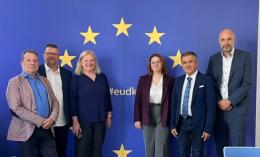
On 9-10 June 2026, the Fundamental Rights and Rule of Law (FRRL) Group of the European Economic and Social Committee (EESC) concluded a two-day visit to Copenhagen.