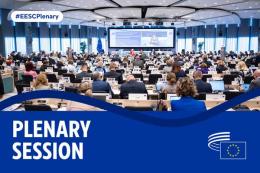
The EESC issues between 160 and 190 opinions, evaluation and information reports a year.
It also organises several annual initiatives and events with a focus on civil society and citizens’ participation such as the Civil Society Prize, the Civil Society Days, the Your Europe, Your Say youth plenary and the ECI Day.
Here you can find news and information about the EESC'swork, including its social media accounts, the EESC Info newsletter, photo galleries and videos.
The EESC brings together representatives from all areas of organised civil society, who give their independent advice on EU policies and legislation. The EESC's326 Members are organised into three groups: Employers, Workers and Various Interests.
The EESC has six sections, specialising in concrete topics of relevance to the citizens of the European Union, ranging from social to economic affairs, energy, environment, external relations or the internal market.
The European Economic and Social Committee (EESC) will host the third edition of Civil Society Week, from 2 to 5 March 2026, under the title People, Democracy, Resilience – Our Future! The programme also includes the annual European Citizens’ Initiative (ECI) Day, which returns on 3 March for its 14th edition.
The event will focus on tackling poverty, reducing social exclusion, involving the public and bridging divides across regions and generations to rebuild trust and foster lasting social cohesion. In this context, advancing diversity, civic engagement, equality and inclusion will be key pathways to renewing Europe’s social and democratic promise for future generations.
The four-day programme will feature sessions organised by the EESC Liaison Group with European civil society organisations and networks, the ECI Day, as well as sessions held by national economic and social councils and the EESC Ad Hoc Group on Fundamental Rights and the Rule of Law (FRRL Group). Participants will include youth representatives, journalists and civil society actors from candidate countries.
Registration will open on 2 February.
The full programme and registration link will be available soon on the event webpage.
On 19-20 March, the European Economic and Social Committee will host Your Europe, Your Say! (YEYS) 2026 under the theme ‘Meaningful Connections, Active Participation and Democratic Engagement’.
This year’s call for applications attracted more than 3 000 submissions, including over 2 500 from individuals and around 500 from secondary schools. From this pool, one school per country was selected to participate, representing the EU Member States, the nine candidate countries and the UK. More than 40 individual participants from all the above countries will also join, ensuring a diverse and inclusive exchange of views. The highest number of applications came from Italy, Romania and Ukraine.
Starting in mid-January, EESC members will visit the selected schools to present YEYS and explain the Committee’s role in shaping Europe’s future.
YEYS 2026 aims to be more than an event. It is a platform for young people to connect, actively engage and contribute to democratic life across Europe, and is expected to feed into broader discussions and consultation processes on the next EU Youth Strategy. You can find more information on the YEYS webpage.
The outlook for digital rights in the European Union had, until a few years ago, given reasons to breed optimism. Moving away from the wild west of data harvesting, the Digital Services and Digital Market Acts, along with further regulation on AI and data protection, set world-leading standards for a ‘human-centred approach’ to technological development, despite all their shortcomings, particularly in enforcement.
The outlook for digital rights in the European Union had, until a few years ago, given reasons to breed optimism. Moving away from the wild west of data harvesting, the Digital Services and Digital Market Acts, along with further regulation on AI and data protection, set world-leading standards for a ‘human-centred’ approach to technological development, despite all their shortcomings, particularly in enforcement.
However, regulation soon became the source of all the Union’s woes, real or imagined. A defective and biased reading of the Letta and Draghi reports on the one hand, and a generous dose of magical thinking on the other, framed Europe’s productivity gap and its lack of an adequate number of unicorn start-ups as the result of overregulation. Never mind the fact that in related fields, such as AI, the relevant regulation was not even in force at the time.
Now, in the hope that this will somehow magically spark a world-leading, energy-consuming and water-gutting word-salad generator with some statistical accuracy (namely, large AI models leaving an enormous environmental footprint and using vast amounts of water to cool data centres), the Commission has put forward two omnibus proposals that undermine the foundations of personal data protection ─ GDPR and ePrivacy ─ by enabling broader data use for AI training and dismantling protections and safeguards in the AI Act.
Given the fact that the emergence of tech unicorns appears, at the very least, uncorrelated with relevant regulation, and setting aside strong ideological assumptions about the supposed evils of consumer protection, civil society must reflect on the dangers of the ‘Digital fitness check’ before we become a data farm for US companies. Copilot, which invasively suggests summaries of this text, seems to agree.
Designers and developers of digital interfaces should be more aware of people’s varying information needs. Bart Simons of the European Blind Union (EBU) urges them to step into the shoes of people with disabilities ─ even if only for a moment ─ to make the digital revolution benefit us all.
Access to information is essential. Blind and partially sighted people have long been pioneers in developing technical tools to consult printed information, as this is crucial for an independent life. We were among the first to use scanners to read text from paper and even ten years ago we already had AI tools on our smart phones to describe our surroundings.
We are generally grateful that information and many processes are becoming available digitally. However, digitalisation must be implemented in a smart and inclusive way. There is great potential for designing and developing websites, apps, banking services, books and shopping platforms that are accessible to users with widely diverse needs. Legislation such as the European Accessibility Act is in place, standards have been developed and smartphones and computers can be personalised and equipped with assistive technologies so that everyone can use them.
However, we need more awareness among designers and developers of digital interfaces. They need to be trained so that the potential of digitalisation to meet our information-access needs becomes a reality.
We also want to check the amount we are paying before pressing the OK button on the payment terminal. We cannot drive cars yet so we rely on home delivery of groceries, but that only works if the shop's website can be used without a mouse. We want to read books released yesterday and find accurate information on the internet, but that requires sufficient colour contrast. In addition, information needs to be provided in text rather than just images.
Everyone involved in creating products and services with a digital interface can help unlock this potential by looking at things from different perspectives: how do I find the double espresso button on a touch screen when I close my eyes or forget my glasses? Can users order food from this kiosk when they are short, tall or seated? On an e-learning platform, can users answer questions without using a mouse? Is there an alternative to drag and drop? Are exercises designed not to rely solely on colour codes, image recognition or other sensory characteristics?
When products and services are designed and developed inclusively more customers are reached, and those customers will feel more independent and recommend them to others. Let us make the digital revolution a reality for all.
Bart Simons is accessibility expert and representative of the European Blind Union (EBU) at the European Consumer Voice in Standardisation (ANEC).