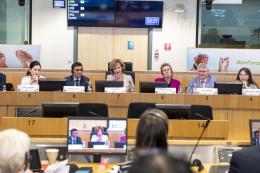
Civil society organisations (CSOs) are under attack across Europe and America. The EU must act now to defend them and safeguard democracy. At its plenary debate on the International Day of NGOs, the European Economic and Social Committee (EESC) sent out a clear message: CSOs are democracy's frontline defenders. With funding cuts threatening their survival, the EU must take immediate action to protect and support them.
Civil society organisations (CSOs) are under attack across Europe and America. The EU must act now to defend them and safeguard democracy. At its plenary debate on the International Day of NGOs, the European Economic and Social Committee (EESC) sent out a clear message: CSOs are democracy's frontline defenders. With funding cuts threatening their survival, the EU must take immediate action to protect and support them.
On 27 February, the EESC held a debate on The EU and Civil Society: Strengthening Democracy and Participation, giving representatives and experts from civil society organisations and Members of the European Parliament (MEPs) an opportunity to discuss and evaluate the role of the CSOs in this vital area.
Raquel García Hermida-Van Der Walle, MEP from Renew Europe, pointed out that CSOs often contribute to checks and balances. CSOs also provide different methods of social interaction, potentially replacing government services which may be lacking. As a result, CSOs are the first to be targeted, as they can prove politically inconvenient to some governments.
Nicholas Aiossa, director of Transparency International Europe, said 'there is an orchestrated political campaign in the European Parliament to discredit, defund and disrupt the role and function of the CSOs. No evidence of financial irregularities has been found.'
In January, the centre-right European People's Party (EPP) in the European Parliament accused environmental and climate NGOs of being funded by the European Commission to lobby the Parliament, other EU institutions and MEPs, sparking outrage among Europe's CSOs.
Criticism of CSOs is nothing new, but the recent attacks have been amplified by fake news and misinformation. As Brikena Xhomaqi, co-chair of the EESC Liaison Group put it, the situation is a wake-up call for all CSOs to stand together and make a change. 'People should know that most CSOs depend on volunteer work, so we do not waste taxpayers' money.'
The participants also called on the European Commission to speak out more strongly about this topic, and proposed a number of solutions to reinforce the role of CSOs.
Ms García Hermida-Van Der Walle said that she would push for the role of CSOs to be more acknowledged and strengthened in the rule of law report and the conditionality mechanism as an enabling condition.
Michał Wawrykiewicz, MEP from the EPP, said his mission was to raise awareness about these fundamental topics inside his group. Another point he raised was informing decision-makers that CSOs and NGOs are organisations operating on the ground, providing crucial services that directly affect people's lives.
EESC president Oliver Röpke embraced the positions of the CSOs representatives, stating: 'we must resist efforts to delegitimise these organisations or restrict their access to the resources essential for democratic participation. From funding constraints to increasing political pressures, it is clear that civil society organisations require stronger and more predictable support to continue their vital work.' (at)
The main task of the current Polish Presidency of the Council of the European Union will be to keep Europe united, move forward and take rapid decisions
The main task of the current Polish Presidency of the Council of the European Union will be to keep Europe united, move forward and take rapid decisions
At the February plenary session,the European Economic and Social Committee held a debate on the Polish EU Presidency priorities with Magdalena Sobkowiak-Czarnecka, Polish Undersecretary of State for European Union Affairs.
Referring to the EU’s external security and, in particular, to the war of aggression against Ukraine, Ms Sobkowiak-Czarnecka said: ‘Our objective is to keep the help to Ukraine going and maintain unity inside the EU.’ She mentioned the 16th package of sanctions against Russia as one of the initial achievements of the Polish Presidency.
EESC President Oliver Röpke stressed that Poland was taking over the rotating EU presidency at a time beset by difficult challenges such as geopolitical tensions and energy crises.
He added that ‘today’s debate has reaffirmed the critical importance of stability, resilience and unity in shaping the future of the European Union. The Polish Presidency’s priorities align closely with our collective ambitions, particularly in fostering a multi-dimensional approach to security. At a time of global uncertainty, our commitment to decisive and cooperative action remains unwavering.’
Following the slogan ‘Security, Europe!’, the Polish EU Presidency will work on seven dimensions of security – external, internal, economic, food, energy, health and information.
This proposal aims to postpone the application of certain reporting requirements under the Corporate Sustainability Reporting Directive (CSRD) and the transposition deadline and application of the Corporate Sustainability Due Diligence Directive (CSDDD). The objective is to simplify the reporting framework, reduce administrative burdens, and ensure a more proportionate approach to sustainability reporting and due diligence obligations.
Download — EESC opinion: Application and reporting deadlines/CSRD and CSDDD
More than 800 participants from citizens' organisations and stakeholders across Europe, including youth organisations, NGOs and journalists, are joining the Civil Society Week, held by the European Economic and Social Committee from 17-20 March 2025. The opening session signalled the protection of the civic space through legal action, reaffirming the key role of civil societies: hold power accountable, build bridges, support social resilience and give a voice to those who are too often ignored.