proposes that the preferred option for taxation of employee income is in the employer's country of residence. This approach aims to simplify taxation for employees and potentially be attractive for employers;
emphasises that teleworkers should not suffer any discriminatory tax treatment compared to cross-border workers who perform their work in the country of the employer. This recommendation aims to ensure fairness in taxation across different work arrangements;
suggests the implementation of a revenue sharing mechanism. This mechanism would likely require cooperation and agreements between countries to distribute tax revenues appropriately;
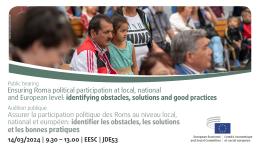
identifying obstacles, solutions and good practices
Location
EESC, Rue Belliard 99, 1040
Brussels
Belgium
Encouraging the Roma community's participation in political life at local, national and European level is one of the objectives of the EU Roma strategic framework 2020-2030. At an estimated 10-12 million, the Roma community constitutes the largest minority in Europe. Yet, in many countries the Roma are not part of the decision-making process, finding themselves in some cases deliberately excluded, intimidated or prevented from representing their rights and needs. Lack of information on the electoral processes itself, together with the vulnerability and difficulties presented by their segregated and poor living conditions, can also impact their possibilities for proper participation in the political scenario. The hearing will explore further the reasons behind the Roma's lack of participation in the political sphere, look into best practices and discuss possible actions that can help increase their participation.
In a recent public hearing, the European Economic and Social Committee (EESC) examined the European Commission’s Defence of Democracy Package aimed at increasing the transparency of interest representation, reinforcing the resilience of elections and improving civil and civic participation. Representatives of civil society supported the overall spirit of the proposal but raised concerns about the narrow focus of the Directive on foreign influence and its potential repercussions on civic space in Europe.
On 23 September, the European Commission announced the winners of the third edition of the EU Organic Awards. The European Economic and Social Committee (EESC) proudly welcomed the winners of three key categories: Best organic food processing SME, Best organic food retailer, and Best organic restaurant/food fervice.