The employment rate of persons with disabilities (PWDs) is much lower than the one of the rest of population. In addition, PWDs tend to be employed in low-skilled and low-pay jobs.
This has a cost for the individuals concerned in terms of economic and psychological wellbeing, for governments in terms of lost output and tax revenues and increased welfare payments, and for society in terms of the impact of social exclusion and discrimination on civic participation and public life.
The aim of the visit will be to look into good practice in the field of employment of PWDs in France, with a focus on disability - led businesses and social enterprises.
During the mission, the EESC delegation met representatives of national authorities, organisations representing persons with disabilities, private companies and enterprises employing PWDs.
Disability rights - Mission report from Country Visit to France
Since the European single market was established, harmonisation and mutual recognition of standards have enabled companies to sell their products in a market of over 450 million people. It accounts for 61% of intra-EU trade by companies, and is the basis of Europe's economic prosperity, thus benefitting its citizens, consumers, workers and companies. The European Commission estimates that 25% of the EU's gross domestic product is generated by the internal market.
Since the European single market was established, harmonisation and mutual recognition of standards have enabled companies to sell their products in a market of over 450 million people. It accounts for 61% of intra-EU trade by companies, and is the basis of Europe's economic prosperity, thus benefitting its citizens, consumers, workers and companies. The European Commission estimates that 25% of the EU's gross domestic product is generated by the internal market.
However, new developments, such as the digital transformation and the transition to a less carbon-intensive and more sustainable economy, require new adjustments, as do the changing needs of consumers, employees and companies and new geopolitical conditions.
The successful continuation of the single market requires improvements in several areas, including European energy and industrial policy, an energy union, a banking union, a more favourable framework for businesses large and small, and more public support for the European project, more efficient public services and improved infrastructure for IT, energy and transport.
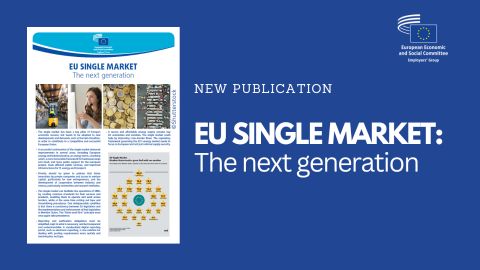
With two landmark reports by former Italian prime ministers, Enrico Letta ("Future of the Single Market") and Mario Draghi (on the future of European competitiveness) being published in the first half of 2024, the EESC's Employers Group has summarised its key messages for the successful future of the EU's internal market in its One Pager "EU Single Market: the next generation".