The seminar will provide an opportunity for an exchange between legal practitioners, national authorities (including Charter focal points), civil society organisations, human rights defenders, politicians and other stakeholders on how the effectiveness of legal protection and access to justice – whether through judicial or non-judicial remedies - can be effectively ensured and further improved across the EU.
Applications for partner events will be open between 4 and 17March, with events taking place between 29 May and 1 September.
Every year, the EU Green Week is accompanied by hundreds of partner events across Europe and beyond, organised by various institutions, NGOs, business representatives, academia, schools, and local, regional and national administrations, among many others.
The theme of the 2024 partner events will be water resilience. The objective is to stimulate an EU-wide conversation on the present and future of the EU's water, with an emphasis on fostering awareness and promoting positive, collaborative solutions.
All kinds of events are welcome, from workshops and public discussions to exhibitions and awareness-raising events for families. Activities can take place at local, regional, national or European level. More information and a timeline are available here.
As the EU Blue Deal is one of the EESC's flagship initiatives, choosing this theme for the partner events presents a good occasion to communicate the proposals presented in the October 2023 EU Blue Deal Declaration, which calls for a new and ambitious water strategy for Europe, on a par with the EU Green Deal. (gb)
The European Economic and Social Committee's call for an EU Blue Deal is garnering support from policy-makers and civil society. This momentum is driven by a growing recognition of the urgency of addressing water scarcity, and the Blue Deal's potential to provide a comprehensive solution.
The European Economic and Social Committee's call for an EU Blue Deal is garnering support from policy-makers and civil society. This momentum is driven by a growing recognition of the urgency of addressing water scarcity, and the Blue Deal's potential to provide a comprehensive solution.
A recent event at the European Economic and Social Committee (EESC) brought together key stakeholders to discuss the Blue Deal and its potential to transform water management practices across the continent, with a focus on river basins.
"We face a water crisis of unprecedented proportions", said EESC President Oliver Röpke. Referring to the upcoming European elections in June, he noted that water is a topic that concerns every citizen. "How will EU decision-makers address the issue of water and the challenges that lie ahead? It's time to ask these questions".
MEP Pernille Weiss, echoing the calls for a comprehensive solution, advocated for a dedicated water transition fund to support businesses and communities in transitioning to sustainable water practices. UN Special Rapporteur Pedro Arrojo-Agudo stressed that water scarcity and climate change recognise no borders, and called on the EU to lead the way in developing a global solution to the water crisis.
The EESC's call for an EU Blue Deal has resonated with a wide range of stakeholders, including Compagnie Nationale du Rhône (CNR), a French public interest company that manages the Rhône River. CNR's Director of Water Resources, Eric Divet, shared the company's successful track record in sustainable water management, including efforts to restore wetlands, improve river biodiversity and adapt to climate change.
The European Commission is expected to unveil its water resilience initiative in the coming months. The EESC stands ready to collaborate with the EU institutions and stakeholders to ensure that its proposals for an EU Blue Deal are part of the priorities of the next European Commission. (gb)
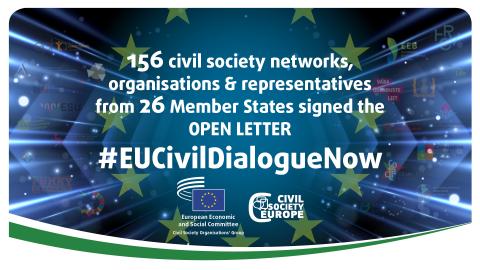
On 24 January, European civil society sent an open letter to the presidents of the European Commission and European Parliament, and to the Belgian Presidency of the Council of the European Union. The signatories of the letter urged the three main institutions of the European Union (EU) involved in EU decision-making to take concrete measures to implement an open, transparent and regular dialogue with civil society organisations, as set out in Article 11 of the Treaty on European Union, in all policy areas.
On 24 January, European civil society sent an open letter to the presidents of the European Commission and European Parliament, and to the Belgian Presidency of the Council of the European Union. The signatories of the letter urgedthe three main institutions of the European Union (EU) involved in EU decision-making to take concrete measures to implement an open, transparent and regular dialogue with civil society organisations, as set out in Article 11 of the Treaty on European Union, in all policy areas.
The open letter was initiated by the EESC's Civil Society Organisations' Group and Civil Society Europe, and includes specific proposals for implementation. The letter gained the support of a total of 156 signatories from 26 Member States. The signatories included 39 European networks, 85 national organisations and 60 Members of the EESC's Civil Society Organisations' Group.
Civil dialogue remains patchy and unstructured across the EU institutions, despite legal provisions. This is why the signatories of the open letter #EUCivilDialogueNow are calling on the EU institutions to:
initiate an inter-institutional agreement on civil dialogue;
establish within each institution leadership positions in charge of relations with civil society;
encourage and promote greater cooperation between civil and social actors.
These efforts must build on the recommendations of the Conference on the Future of Europe. As a first step, the signatories suggested a European Commission communication on strengthening civil dialogue at EU level.
Political decision-making must always have the concerns and well-being of citizens and workers at its core. They are important human factors that should be taken into account. It is the only way to ensure decent living conditions. Through policies that ensure these decent conditions for all we increase trust and widespread acceptance of current and future political measures and prevent popular disenchantment that provides a fertile ground for right-wing populism and extremism.
These concerns were the foundation of the Workers' Group priorities for 2023-2025, setting clear demands for future EU leaders to embark on a progressive agenda with a more social and human dimension at its core. After decades of crises, the costs of which have unequivocally been borne by European citizens and workers, we hope that the EU debate can again shift towards what really matters – social progress.
Our priorities outline the Workers' Group's vision of a Europe that is not only social and sustainable but that also upholds the rule of law, human rights, gender equality, solidarity and diversity. We need a Europe that prioritises tackling inequality, poverty and the climate emergency, ensures just green and digital transitions and secures decent work for all. It is the best way of empowering our democracy and society and every individual in it. We hope that this vision can be taken on board.
Europe is falling behind on competitiveness and needs to address the shortcomings of its single market urgently, but in a way that benefits both business and Europeans.
Europe is falling behind on competitiveness and needs to address the shortcomings of its single market urgently, but in a way that benefits both business and Europeans.
The EESC January plenary held a debate on European competitiveness and the future of the internal market. The EESC opinion at the centre of this debate was requested by the Belgian Presidency of the EU, which has pledged to use its six months to focus on competitiveness and the single market. The opinion will also help shape Enrico Letta's high-level report on the future of the single market, set to be presented to the European Council in March.
In it, the EESC stresses that the internal market needs to rise to the challenges of a very different world to the one for which it was created back in the 1990s. As a result, the EU is facing multiple pressures: maintaining a level playing field while subsidising its industries to help finance the green transition; keeping jobs in Europe while ensuring EU businesses stay competitive; and securing raw materials while upholding labour and environmental standards.
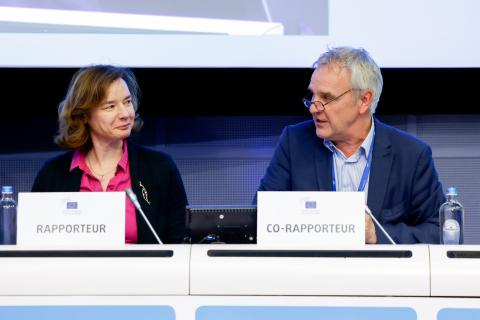
Rapporteur Sandra Parthie said: "The single market has helped make the EU one of the most powerful trading blocs in the world – but this powerful position is about to be eroded. What we propose in our opinion is to focus on the development of a European industrial policy that is not the sum of 27 national industrial policies, but rather a truly European view of our industrial potential".
Speaking at the debate, Markus Beyrer, Director General of Business Europe, said: "We have an issue with competitiveness. We are falling behind our global competitors, and the single market is one of the tools available to us to remedy this. The goal is to produce the margin we need to feed the European model as we know it, including the social aspects".
Ludovic Voet, Confederal Secretary of the European Trade Union Confederation (ETUC), stressed that the European social contract is the basis of the single market and that contract needs to be reinforced, saying: "In our competitive system, businesses have to pay fair salaries, offer good jobs and not harm the environment. Europe has to keep the momentum for a just green transition".
The EESC opinion includes a proposal to appoint a commissioner for services of general economic interest (SGEI) in the next Commission, with a five-year plan to develop secure, good-quality and sustainable SGEI. These account for 25% of EU GDP and 20% of total employment, and cover key sectors such as transport, energy, communications, access to water and sanitation. However, they are also very important in healthcare and social services. (dm)