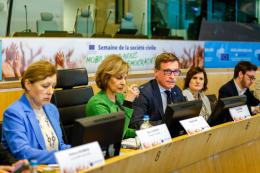
On 4 March, the European Economic and Social Committee (EESC) kicks off its first ever Civil Society Week, titled 'Rise Up For Democracy!'. This week-long event brings to Brussels more than 200 citizens' organisations and stakeholders from across Europe, including youth organisations, NGOs and journalists. They will be discussing the state of democracy, the challenges it faces, and the vital role civil society plays ahead of the EU elections, drawing up demands for the next EU leaders.
Over 55 million worldwide, many of them adolescents, suffer from eating disorders, impacting their mental and physical health. Stigma prevents many from seeking help. The project Telling Stories for Good, run by Italian organisation Animenta, aims to dismantle stereotypes, promote early recognition and provide support. Since 2021, they have reached over 10,000 pupils in Italy. We talked to Animenta's president and founder Aurora Caporossi.
Over 55 million worldwide, many of them adolescents, suffer from eating disorders, impacting their mental and physical health. Stigma prevents many from seeking help. The project Telling Stories for Good, run by Italian organisation Animenta, aims to dismantle stereotypes, promote early recognition and provide support. Since 2021, they have reached over 10,000 pupils in Italy. We talked to Animenta's president and founder Aurora Caporossi.
What prompted you to start your project?
Animenta was born of the need to give a voice to all people suffering from an eating disorder, but also to those who live next door. The association aims to ensure that people receive proper access to treatment for eating disorders, because it is possible for people to heal from an eating disorder if they are given the opportunity to heal themselves.
How has your project been received? Have you had any feedback from the people you helped? Do you have an example you can give us?
"Animenta is the place where I felt welcomed, I realised that I also suffered from an eating disorder even though I was not underweight." This is a message that came several months ago from our community which allowed us to understand the importance and impact of our work. Animenta was received with curiosity, but also with the hope that we could bring about change.
How will you use this specific funding to provide further help in the community? Are you already planning new projects?
We would like to invest more and more in the projects we carry out in schools to broaden our impact. Likewise, funds will be used to start self-help groups for those suffering from an eating disorder. Animenta's projects include Animenta Camps, which are six-day experiences in nature for people to rediscover their relationship with themselves, their bodies and food.
What advice would you give to other organisations in terms of achieving results with these kinds of activities and programmes?
Start with stories to learn about what the community you are addressing is experiencing. Ask for feedback, and give out questionnaires to understand what they need. But most of all put your face out there to tell the story of your struggle and the change you want to bring about. At the same time, it is crucial to network with others to create an efficient and effective support system.
In your opinion, are eating disorders today properly recognised as a serious mental health issue? Do people affected receive appropriate support and what should be done to improve this?
Today there is more talk about eating disorders, so we can say that there is more information. However, they are diseases that have a deep social stigma and very stereotypical representation. Some people, even today, believe that eating disorders are a lack of willpower or a whim. In reality, eating disorders are a complex psychiatric illness that needs proper treatment, which at the moment is not always available because there are not enough treatment centres and many people cannot access the treatment pathway.
Through its social engagement network AgeWell, the Irish charity Third Age Foundation is battling loneliness in old age. Its AgeWell Companions, themselves over 50, visit older people in their homes once a week, offering companionship but also monitoring the client's health and well-being with the help of a phone-based app questionnaire. The Third Age Foundation's Alison Branigan told us that to date, more than 500 people received the support in Ireland's Co. Meath, with some describing the service as a "lifeline" or even as "light at the end of a dark long tunnel."
Through its social engagement network AgeWell, the Irish charity Third Age Foundation is battling loneliness in old age. Its AgeWell Companions, themselves over 50, visit older people in their homes once a week, offering companionship but also monitoring the client's health and well-being with the help of a phone-based app questionnaire. The Third Age Foundation's Alison Branigan told us that to date, more than 500 people received the support in Ireland's Co. Meath, with some describing the service as a "lifeline" or even as "light at the end of a dark long tunnel."
What prompted you to start your project?
AgeWell was introduced in Co. Meath to support its growing older population, who had specific social, emotional, psychological, and physical care needs. Our health service is under immense pressure, our population is growing and ageing, and there are long waiting lists for services including home support. AgeWell provides a timely and practical response that compliments and enhances our existing health service by supporting older people who are isolated, lonely, frail, housebound, and at-risk to help them live better for longer in the place of their choosing, by providing them with social connections and ongoing health and well-being monitoring, and by identifying and reacting to emerging issues before they escalate into something more serious. AgeWell also fits well with the ethos of our organisation Third Age, which supports older people directly through innovative services and programmes, and creates unique volunteering opportunities where older people can support their peers and other community groups.
How was your project received? Did you have any feedback from the people you helped? (Can you give an example if you have any)
To date AgeWell has supported over 500 older people in Co. Meath. Many really appreciate the companionship aspect of the programme: they have built a special trust with their AgeWell Companions, which helps us to understand their needs and fears and thus enables us to better support them.
Comments from our clients include: “the service is a lifeline”, “I didn’t know I needed the support until I had it”, “I’m so grateful for the service and my companion, she brightens up my week”, “I was very lonely, I didn’t see anyone from one day to the next, I really look forward to my visits”. One client who found himself in a very dark place and admitted he had contemplated suicide several times said that “AgeWell came at the right time - it helped me to see light at the end of a long dark tunnel”; he also said “everyone should have access to this service”.
Our volunteer companions who are also older people have this to say: “I just love being a volunteer”, “It’s so nice to feel you are making a difference”, and “I’ve learned a lot about people and myself doing this job”.
Statistically we can prove that AgeWell improves well-being and social, emotional and informational support, reduces isolation and loneliness, improves self-rated health, and increases physical activity levels.
Other feedback includes peace of mind expressed by the family members of our clients, and recognition of our work from healthcare providers who continually refer clients directly to us.
What advice would you give to other organisations in terms of achieving results with such activities and programmes?
Know your audience, involve your participants in the process, and listen to their suggestions and their needs. Believe in what you know and what you can achieve, be brave, be creative, persevere: if your idea is good enough, you will find a way. Be open to working with others, and if you can get buy-in from the state or health service in terms of funding and/or support/promotion, that can add hugely to the programme's credibility, its impact and its success.
What is, in your opinion, the main trigger for worsening mental health in old age, apart from physiological factors? Can we, as a society, improve the mental health of older people?
Loneliness and isolation have always been factors that contribute to worsening mental health in old age; while this can be an issue in rural Ireland it is just as prevalent in bustling towns and cities. In recent years the effects of the pandemic, forced isolation, cocooning, and shielding, and the loss of social contact, access to activities and freedom have created an epidemic of fear, anxiety, depression, and mental health issues. Domestic and world events, including the rising cost of living, war and conflict, have also played a part. As people age their social circles can decrease, illness can affect their ability to get out and about, they may become housebound, or experience a loss of independence; all of these can affect esteem, self-worth, mood, and outlook. It is important that older people are not forgotten just because they may not be visible: we need to remember the importance of community, community interventions and the power of social contact and social prescribing initiatives.
On 26 February, farmers and their tractors blocked the streets of Brussels in protest, for the second time in a few weeks. In stark contrast with the usual array of suits and well-trimmed haircuts, the streets of the European district were taken over by trucks, tractors, hay and piles of burning tyres. The complex reasons behind the farmers' protest range from the CAP and environmental policies to completely unrelated issues.
The truth is, the European countryside is in a difficult situation, and has been for a long time. The Workers’ Group and the EESC as a whole have repeatedly warned that there would be no green deal without a social deal. And while it could be tempting to dismiss this as another by-product of Brussels jargon, it would be a grave mistake. The countryside is facing real problems. They include intermediaries paying producers a pittance but charging outrageous consumer prices; insufficient aid for undertaking environmental reforms; and (non-fair) free trade, harsh working conditions and climate change.
The response of the European Commission, which hastily ditched pesticide requirements, is even more worrying than the lack of proper consultation and engagement with social partners and the inaction at social policy level. As with environmental measures, abandoning these measures might buy our politicians a little time, but it will also push us beyond the point of no return with the environment.
On top of this, with the elections coming, the far right is trying to capitalise on the discontent and, to some extent, is succeeding in steering the protest against the SDGs, the Green Deal and Agenda 2030.
With the European elections in June 2024 holding the key to Europe's future, the EESC as the institutional partner of civil society is launching the first edition of its Civil Society Week.
Boosting long-term inclusive growth through reforms and investment