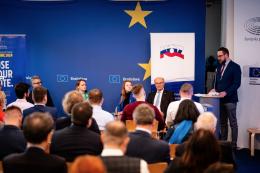
The Slovak project Crazy? So what?, run by the organisation Integra, brings together young students and people who have experienced mental health problems. During one full day of teaching, students learn first hand what it is like to overcome a mental health crisis and how to get help . Integra's director Jana Hurova told us that the project helps break down the stigma about people struggling with mental health and gives young people a precious spark of hope.
The Slovak project Crazy? So what?, run by the organisation Integra, brings together young students and people who have experienced mental health problems. During one full day of teaching, students learn first hand what it is like to overcome a mental health crisis and how to get help . Integra's director Jana Hurova told us that the project helps break down the stigma about people struggling with mental health and gives young people a precious spark of hope.
What prompted you to start your project?
For many years, our organisation has been supporting people with mental health problems. As a result of being ill, they have lost their jobs, homes, friends, sometimes their families too. Their whole world has been turned upside down. We set up Slovakia’s first community mental health services almost 30 years ago. Its aim was to ensure that that these people, after being treated in a psychiatric hospital, could receive support and get back to the regular lives they had before they were ill. We supported the emergence of patient organisations in Slovakia and carried out a number of programmes to destigmatise mental illness. There are people with severe mental health problems in our care, especially schizophrenia, many of whom have already managed to integrate and find meaning in their lives.
With all of our activities being carried out in a non-traditional way from the very beginning, working in partnership with our clients to best identify their needs, we applied a similar approach to the Crazy? So what! programme. Many of our clients have found a sense of purpose by meeting young people and, by drawing on their personal experience, talking about what they lacked at their age and what later triggered their mental health problems.
We see a growing need to highlight the importance of mental health. Knowing how to manage a personal crisis is a great strength.
We started the Crazy? So what! programme in Slovakia back in 2005, together with partners from Germany and Czechia. However, it is only recently that we have managed to put the programme on a more stable footing and to expand it. We have trained as coaches, we train up new teams and we visit new schools.
How has your project been received? Did you have any feedback from the people you helped? (Can you give an example if you have any)
It always makes a strong impression on young people when they are able to meet those who have overcome a mental health crisis and who they can ask about anything. It shows them that if they do have problems themselves, help is always available. The fact that it involves one full day of teaching, and that communication is on an equal basis, means that participants always come away with a positive impression.
People with personal experience of mental health problems can give young people the courage to do something about their own problems. In almost every class, there are students experiencing problems. Giving them a spark of hope is priceless. People with personal experience tell their own story as a way of feeling better themselves. They themselves decide how much to let the pupils into their lives. In this way, they feel that they are valuable and that people understand them.
We received many comments such as students saying they don't normally get the chance to meet people with mental health problems or that we should learn to accept such people and not condemn them for being different.
We also received feedback from people with personal experience of mental health problems who are involved in the programme. One person told us:
‘The programme gives me the courage to walk tall. I want to live at last! Talking to students is tough but rewarding. They are very open, and have hardly any fear of social contact. The most wonderful thing for me is that they show there is far more that unites us than divides us, that the image of “crazy people” is not true. It is great that I can help people to finally talk openly about mental health problems, so that no one has to be ashamed or to hide. ’
What drives us forward are young people. After each of these days, they talk about how important the Crazy? So what! programme is for them and that it should continue so that every young person in Slovakia can learn about how valuable their own mental health is.
Are you already planning new projects?
We would like there to be scope for all young people to receive this form of education so that we can further expand the programme to other regions of Slovakia. It has already been carried out in Germany (where it was first set up), Slovakia, Czechia and Austria. This year we also trained up the first teams in Ukraine.
In your opinion, how important is it to openly talk about one's mental health problems? What message are you sending with your project?
We want to spread the message that having mental health problems is not a source of shame. What is shameful, however, is not doing anything to promote our own health. Because there is no health without mental health.
The main idea behind the Crazy? So what! programme is to highlight in good time the importance of mental health, and, at the same time, to foster understanding of people with mental health problems.
We have found it is much better to prevent than to treat. And it is more effective too. We offer courage and motivation and are optimistic. Help is always available. Sometimes it is enough to have someone to talk to. Fighting for your dreams is never easy, but it is worth it.
During its February plenary session, the European Economic and Social Committee (EESC) took a firm stance in favour of creating a better business environment for Europe’s SMEs: EU legislation must “think small first” and cut superfluous red tape.
shows that reforms and investments in key social areas (particularly those that foster human capital) can have a positive impact on economic growth, productivity and competitiveness, while can reduce major future costs;
stresses the need for a more efficient use of financial resources, including public-private partnerships, and to discuss establishing an EU financial capacity by 2026 for common priorities like social investment and cyclical stabilisation, supported by EU-wide guidelines and funding;
insists that strengthening the social aspect of the European Semester is vital for overseeing economic and social policies in the EU. By aligning it with the European Pillar of Social Rights, we can better coordinate amongst Member States, improve transparency, and monitor national plans effectively;
Facts and figures about mental health in the EU do not paint a rosy picture but rather raise a call for action. The EESC advocates stronger measures to promote mental health at national and EU levels. It has also called for binding legislation to prevent psychosocial risks in the workplace. With the Civil Society Prize on mental health, it pays tribute to the continuing efforts of civil society to improve the wellbeing of Europeans.
Facts and figures about mental health in the EU do not paint a rosy picture but rather raise a call for action. The EESC advocates stronger measures to promote mental health at national and EU levels. It has also called for binding legislation to prevent psychosocial risks in the workplace. With the Civil Society Prize on mental health, it pays tribute to the continuing efforts of civil society to improve the wellbeing of Europeans.
The EESC decided to dedicate its flagship Civil Society Prize to mental health after reports that, in the aftermath of the COVID-19 pandemic, mental health disorders such as anxiety and depression spiked across Europe. According to the OECD, the share of young people with symptoms of anxiety more than doubled in several European countries. The pandemic also lowered the age of onset for eating disorders, particularly among adolescents. Even before COVID-19 hit, mental health problems affected at least 84 million people – around one in six – across the EU.
Around 4% of annual deaths in the EU are attributed to mental health and behavioural disorders. Poor mental health also has a huge economic impact, as the direct and indirect costs account for roughly 4% of GDP. More than a third of these costs stem from lower employment rates and falling productivity at work.
In 2020, 44.6% of the employed population aged 15-64 across the EU reported facing risk factors for their mental wellbeing at work according to Eurostat. Work overload or time pressure was the most commonly mentioned risk factor for mental wellbeing at work, reported by nearly a fifth of employed people in the EU.
Mental wellbeing has risen to the top of the political agenda in the EU. As a result, the Commission adopted a comprehensive approach to mental health in June 2023. Supported by EUR 1.23 billion in EU funding, this new approach aims to promote mental health in all EU policies, with a focus on three guiding principles: adequate and effective prevention; access to high-quality and affordable mental healthcare and treatment; and reintegration into society after recovery. Mental health is also a political priority for the EESC and is at the core of its work.
The EESC received as many as 105 applications from across the EU, covering a wide range of topics – from projects preventing psychosocial risks in the workplace or tackling issues such as substance abuse and cyberaddiction to combatting stigma around mental health and promoting community-led assistance. The EESC hopes that by honouring and showcasing these vital non-state efforts in supporting mental health it can also inspire others to do the same. (sg)
The EESC Civil Society Prize honours non-profit projects implemented by individuals, civil society organisations and companies. A different theme is chosen each year, covering an important area of the EESC’s work. The winner of the 14th Civil Society Prize, dedicated to mental health, is Ireland’s Third Age Foundation and its social engagement network AgeWell, which battles loneliness in old age.
The EESC Civil Society Prize honours non-profit projects implemented by individuals, civil society organisations and companies. A different theme is chosen each year, covering an important area of the EESC’s work. The winner of the 14th Civil Society Prize, dedicated to mental health, is Ireland’s Third Age Foundation and its social engagement network AgeWell, which battles loneliness in old age.
On 7 March, the European Economic and Social Committee (EESC) rewarded five non-profit organisations for their outstanding contribution to fighting mental health disorders, which have increased dramatically in the EU.
The EUR 50 000 prize was shared among the five winning projects.
5th place: Animentaorganisation, ITALY,for its project Telling Stories for Good
FIRST PRIZE WINNER
With its social engagement network AgeWell, the Irish charity Third Age Foundation helps older people who are isolated, frail and vulnerable. Their unique service is community-based, where people over 50 support at-risk and in-need older people. Using a combination of in-house visits and a smartphone-based mental health questionnaire, AgeWell thus offers companionship and emotional support and identifies health risks at an early stage.
OTHER WINNING PROJECTS
The second place went to the Finnish Pro Lapinlahti association and its community centre Lapinlahden Lähde or ‘The Spring of Lapinlahti’. The centre, built through the renovation of Helsinki’s Lapinlahti Hospital, organises various workshops and events related to mental health literacy, boasting 50 000 visitors each year. Declared a diagnosis‑free zone, it allows everyone to be who they are without being labelled, offering empowerment instead of paternalism.
Placed third is the Slovak organisation Integra, with its ‘Crazy? So what!’ initiative,whichbreaks down stereotypes by promoting a compassionate understanding of mental health among young people. It provides first-hand insight into what it is like to have poor mental health and into the road to recovery.
The winner of the fourth prize, the Finnish Lilinkoti Foundation, is on a mission to support mental health with its innovative and creative games called The World of Recovery. The games promote mental health recovery through goals that inspire a healthy self-image, personal autonomy and an active and meaningful life. While the first is a non-violent mobile game, the second is an award-winning table top role-play game. They target mental health and people in recovery from substance abuse, along with professionals, and are free to use.
The project Telling Stories for Good secured fifth place for Italy's non-profitorganisation Animenta. With the project, Animenta is rewriting stereotypical narratives on eating disorders, which affect more than four million people in Italy alone, two million of whom are adolescents. Its prevention and awareness-raising programmes are carried out by volunteer professionals online and in schools across Italy.
The EESC launched this year’s prize in July 2023. By dedicating it to mental health, it wanted to recognise the crucial role played by civil society in mental health treatment and prevention. The winners were chosen from over 100 applications from 23 Member States.
Past topics of the prize include youth and help for Ukraine, climate action, gender equality and empowering women and migration. In 2020, the EESC replaced its Civil Society Prize with a one-off Civil Solidarity Prize dedicated to the fight against COVID-19. (ll)
President of the European Economic and Social Committee Oliver Röpke
Organisation
European Economic and Social Committee
The EU has made big advancements towards gender equality, but there is still a long way to go.On this International Women's day, we celebrate the incredible achievements of women, and we reflect on how organised civil society can drive change both at EU and international levels.
Following last year's rare diseases conference in Bilbao, the European Economic and Social Committee and the European Commission are joining forces to deal with rare diseases at European level.
Display date
2 years 4 months ago
MFF: Changes to the amounts for certain programmes and funds