The EESC issues between 160 and 190 opinions, evaluation and information reports a year.
It also organises several annual initiatives and events with a focus on civil society and citizens’ participation such as the Civil Society Prize, the Civil Society Days, the Your Europe, Your Say youth plenary and the ECI Day.
Here you can find news and information about the EESC'swork, including its social media accounts, the EESC Info newsletter, photo galleries and videos.
The EESC brings together representatives from all areas of organised civil society, who give their independent advice on EU policies and legislation. The EESC's326 Members are organised into three groups: Employers, Workers and Various Interests.
The EESC has six sections, specialising in concrete topics of relevance to the citizens of the European Union, ranging from social to economic affairs, energy, environment, external relations or the internal market.
As the European Union advances its engagement with the Western Balkans, Ukraine and Moldova, one thing is clear: successful enlargement depends not only on funding and reforms, but on strong civil society ownership. Civil society and social partners must be placed at the heart of this process.
As the EU moves towards the creation of a real and sustainable circular economy, it has a key opportunity to reinforce its bioeconomy combining environmental sustainability, an efficient use of biomass, industrial competitiveness and territorial cohesion. Nature-based biodegradable materials can reduce pollution, complement recycling where technical practices are not effective, add value to agricultural waste and byproducts strengthening rural economies; and drive European innovation and competitiveness. In doing so, biodegradable materials would contribute to the transformation of a sector that, as noted by Enrico Letta, has the potential of growing from €31 billion, could grow to €100 billion by 2030, creating 0.5 million new jobs and saving 21 megatonnes of CO2 emissions.
The European Commission’s proposal to revise the Cybersecurity Act reflects this shift to move the European Union from a model of “cyber hygiene” towards one of cyber sovereignty. For employers across Europe, the implications are profound.
The European Economic and Social Committee’s latest evaluation of the Market Surveillance Regulation (MSR) confirms that the EU has built a robust legal foundation to ensure only compliant products enter the Single Market. This objective remains widely supported by stakeholders as essential for consumer protection and fair competition. However, the report highlights a growing disconnect between regulatory intent and real-world outcomes. Rapid digitalisation, globalised supply chains and the rise of e-commerce have fundamentally reshaped the market environment, putting increasing pressure on existing enforcement mechanisms.
Europe stands at a decisive moment for its innovation ecosystem. Yet, it is falling behind global competitors in transforming research excellence into market‑ready products and scaling successful companies. As our Opinion notes, “Europe needs to strongly reinforce innovation and research and has a lot of catching up to do when it comes to commercialising the product of this innovation.”
Almost 40% of young Europeans dream of becoming entrepreneurs. The European framework can provide a favorable context for the emergence of quality projects thanks to a range of financial support, guidance and mentoring, high-quality incubation and training programs, all aimed at addressing concrete and operational needs.
Minutes of the 239th TEN Section meeting on 9.4.26
How do we move away from ‘youth-washing’, where youth participation primarily produces a photo-op, rather than dialogue in which young people contribute effectively? The youngest EESC member, Laure Niclot, set out the prerequisites for the meaningful engagement of all young people, and not just the privileged few.
By Laure Niclot
Opportunities for youth participation at EU level are multiplying: youth dialogues with Commissioners; an EU youth dialogue soon entering its 12th cycle, which makes it the widest youth participation mechanism on the planet; participatory initiatives organised by different institutions (such as the EESC’s Your Europe Your Say); and even a direct advisory board to Ursula von der Leyen made up of young people.
Youth participation, in its institutional form, is there for youth organisations ready to make their voices heard. But once we have put in the work, time, and energy to contribute, what happens next? How are young people actually taken into account?
Too many youth participation experiences simply result in nice photos of young people next to politicians, along with empty promises. While any exercise in participation is valuable ─ because it allows young people who never thought they would set foot in an institution to experience what policy-making is and realise that they have every right to contribute ─ we have to underline how dangerous it might be to let ourselves slide towards ‘youth-washing’. If we let the initial experience of policy participation be more of a communication exercise than one of dialogue, how are we going to continue to ask young people to contribute to the institutional game, or simply to vote?
And let’s be honest: youth organisations, like all NGOs, are underfunded and understaffed. We do it because we believe in the value of defending youth rights, of defending our right to live in a world that’s worth hoping for, and of defending our liberties and freedoms in the face of authoritarianism. As those who will enjoy (or suffer) the consequences of the decisions we make today, I’d say we have earned our seat at the table.
So how do we step away from youth-washing and create the conditions for meaningful engagement?
I would say three ingredients are key here, including structural follow-up (which requires the necessary means) and actual representation.
Structural follow-up means organising forms of youth participation not as one-off events but as tools that are there to support meaningful, long-lasting contributions. In that regard, the EESC’s youth test is one of the best examples in the EU. And of course, to support that, we need to ensure that young people are supported, both technically and financially.
Because youth participation that only allows the representation of socio-economically privileged young people is definitely not satisfactory: there is no such thing as ‘youth’, but rather ‘individual young people’. Young people come from rural and urban areas; they are pupils, students, young workers, or somewhere in between; they come from different socio-economic backgrounds and have different migration- and gender-related experiences; their voices echo the diversity of our societies. We need to make room for all young people, and that means not just having one token young person in the room.
Youth participation is one of the ways we can open the door for the next generation of decision-makers. Let’s be careful to keep these doors actually open for all, and not feed the idea that contributing is meaningless unless you’re already in a position of power.
Cybersecurity is becoming a cornerstone of the European Union’s digital market. Recent data show that more than one fifth of EU businesses have already suffered cybersecurity incidents with tangible consequences, including data loss and service disruption. At the same time, the wider adoption of cybersecurity measures points to growing awareness of systemic risks in the digital environment.
This development reflects a broader transformation. Cybersecurity can no longer be understood merely as a technical or regulatory matter. As emphasised by the European Economic and Social Committee (EESC), it must be regarded as a key component of economic security and geopolitical resilience in the European Union. The smooth functioning of the digital market increasingly depends on trust, and that trust is directly linked to the ability to protect data, systems, and supply chains.
In the digital marketplace, users often lack the ability to judge how secure products and services really are. This information asymmetry makes cybersecurity not a background function, but a central mechanism for trust-building. In this context, the European cybersecurity certification framework plays a crucial role. Its purpose is to ensure that digital products and services meet harmonised security standards across Member States, strengthening confidence in the single market.
The EESC underlines that certification must be practical, transparent, and usable under real business conditions, particularly for cross-border operators. The principle of ‘one certification valid everywhere’ should become the norm, reducing market fragmentation and supporting the competitiveness of European companies.
Another critical issue is the security of supply chains. Cyber risks increasingly originate not within a single organisation, but across interconnected networks of suppliers and partners. Cybersecurity must therefore be addressed as an ecosystem challenge. At the same time, regulatory measures must remain proportionate, predictable, and sensitive to the capacities of small and medium-sized enterprises, which form the backbone of the European economy.
Human capital also plays a decisive role. The EESC highlights that cybersecurity resilience depends on skills, training, and organisational culture. Strengthening digital literacy and raising public awareness are therefore essential components of the overall framework. A well-informed society is more resilient by default and better able to reduce systemic vulnerabilities.
In this regard, civil society organisations play a unique and indispensable role. Working at the intersection of institutions, markets, and citizens, they translate complex policy frameworks into practical realities. In cybersecurity, their role goes beyond awareness-raising: they help ensure that policies reflect the lived experiences of businesses and individuals, improving both legitimacy and effectiveness.
For businesses, cybersecurity is increasingly becoming a matter of competitiveness. Companies that can ensure data protection and communicate their security practices clearly are better positioned to build customer trust and strengthen their market position. By contrast, cybersecurity incidents lead not only to financial losses, but also to serious reputational damage.
The future of the digital market will therefore not be shaped solely by technological innovation, but also by the ability to build and sustain trust. Cybersecurity is evolving into a comprehensive framework that connects regulation, economic performance, and communication. In the digital economy, one principle remains fundamental: without trust, there is no functioning market.
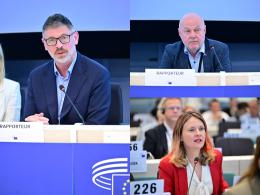
Cyberattacks are no longer rare: one fifth of EU businesses report incidents with serious consequences, including data loss and service disruption. We asked Miroslav Hajnoš, rapporteur of the EESC opinion on Cybersecurity Act, why cybersecurity must be treated not only as a technical or regulatory issue but also as a foundation for trust in the digital economy.