On 25 June, the European Economic and Social Committee (EESC) organised an event as part of European Public Diplomacy Week, held for the first time by the European External Action Service (EEAS). The participants highlighted a fundamental dimension of European action: the contribution of civil society to public diplomacy, from international trade to water, through enlargement.
On 25 June, the European Economic and Social Committee (EESC) organised an event as part of European Public Diplomacy Week, held for the first time by the European External Action Service (EEAS). The participants highlighted a fundamental dimension of European action: the contribution of civil society to public diplomacy, from international trade to water, through enlargement.
During Public Diplomacy Week, which took place in Brussels from 23-27 June 2025, different institutions engaged in discussions and presented public diplomacy and international people-to-people initiatives. As such, the event From trade to water: civil society's soft diplomacies, organised by the EESC's External Relations section, brought together EESC members and experts from trade, water and enlargement to talk about the engagement of civil society in these three areas.
Opening the event, EESC Vice-President for Communication Laurenţiu Plosceanu said: 'When official diplomacy has limited outreach due to political or other issues, civil society can provide added value.'
In her keynote speech Vesna Kos, EU Ambassador to the Council of Europe, described civil society as an engine of soft power shaping diplomacy in real time, where power should not only be measured in tanks, tariffs and treaties, but in the trust built by civil society.
Civil society's soft power in the area of trade agreements is undeniable, but, as Tanja Buzek, EESC member and Vice-President of the EESC’s International Trade Follow-up Committee, pointed out 'there is a gap for civil society to engage during the negotiations and this is a gap that needs to finally be closed.'
Discussing how civil society can play an active role in EU accession, the participants stressed that enlargement is not merely a technical process of legislative harmonisation. It is a human dynamic, a rapprochement between citizens, workers and organisations that share the same democratic and social values. In this process, the involvement of civil society is crucial, as enlargement also means transformation of societies.
The event concluded with the panel on the theme of tackling water scarcity together with the Global South.
EESC member Milena Angelova, rapporteur on Blue Diplomacy, and Thomas Rebermark, Director of the Swedish Water House at the Stockholm International Water Institute (SIWI), mentioned that water can become an instrument for peace and development, because civil society organisations are the connective tissue in the global water and climate landscape, ensuring that water resource management is rooted in the realities of those most affected by water scarcity and climate change. (at)
The European Economic and Social Committee (EESC) has announced the finalists to be honoured in the 2025 EU Organic Awards, spotlighting innovation and sustainability in three key categories: best organic SME, best organic retailer and best organic restaurant/food service. These awards recognise impactful contributions that connect organic production with everyday consumer experiences.
The European Economic and Social Committee (EESC) has announced the finalists to be honoured in the 2025 EU Organic Awards, spotlighting innovation and sustainability in three key categories: best organic SME, best organic retailer and best organic restaurant/food service. These awards recognise impactful contributions that connect organic production with everyday consumer experiences.
Finalists include outstanding projects from Austria, Romania, Spain, Germany, Slovenia and Greece which range from artisan bakeries and local farmers' markets to organic restaurants and dairy producers in rural communities.
Part of the EU’s push for more sustainable food systems, the awards aim to boost visibility for organic best practices and support the goal of 25% of EU farmland being farmed organically by 2030.
The winners will be announced at the official ceremony in Brussels on 23 September 2025, during EU Organic Day.
For full details of the finalists, the award categories and the upcoming ceremony, visit the EU Organic Awards webpage. (ks)
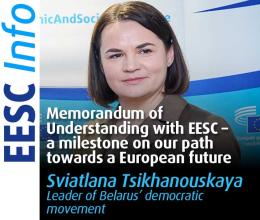
The European Economic and Social Committee reaffirmed its unwavering support for a democratic Belarus by signing a Memorandum of Understanding with Belarusian democratic forces, represented by Sviatlana Tsikhanouskaya. This new Memorandum of Understanding formalises a new phase of structured collaboration to support Belarusian civil society and its European aspirations.
The European Economic and Social Committee reaffirmed its unwavering support for a democratic Belarus by signing a Memorandum of Understanding with Belarusian democratic forces, represented by Sviatlana Tsikhanouskaya. This new Memorandum of Understanding formalises a new phase of structured collaboration to support Belarusian civil society and its European aspirations.
At its June plenary session, the European Economic and Social Committee (EESC) hosted a debate on the Democratic future of Belarus with Sviatlana Tsikhanouskaya, the leader of the Belarusian democratic movement, Maksim Pazniakou, acting chair of the Belarusian Congress of Democratic Trade Unions, and Andrey Gnyot, Belarusian journalist and filmmaker. The Memorandum of Understanding (MoU), which was signed during the plenary debate, formalises the cooperation between the EESC and Belarusian civil society.
The EESC’s support for Belarusian civil society was commended by Ms Tsikhanouskaya, who said: ‘We are delighted to sign this Memorandum of Understanding with the European Economic and Social Committee. This partnership marks an essential milestone for Belarus on its path towards a European future.’
In the same vein, EESC president Oliver Röpke underlined the Committee’s engagement and support for Belarusian civil society, saying: ‘Today’s plenary debate and the signing of the Memorandum of Understanding are a clear expression of the EESC’s deep and lasting commitment to the democratic future of the country and its people. This is not just about symbolic gestures; it is about giving space, voice and visibility to those who are silenced at home.’
The MoU will focus on the implementation of joint initiatives and events to raise awareness of the internal situation in Belarus with respect to human rights violations, with more than 1200 people currently in prison. Another of the main objectives of the agreement is support for and promotion of independent media representatives and journalists.
‘Preventive arrests for contact with dissidents are common under this regime. The regime destroys the ties between those who escaped and those who stayed,’ MrGnyot said, adding: ‘People inside the country face arrest just for talking to those who have managed to escape. But they do not turn away from their friends or beliefs. They still find secret ways to stay in touch.’ (at)
On 11 June, the European Economic and Social Committee (EESC)'s Section for Transport, Energy, Infrastructure and the Information Society (TEN) and the European Commission's Directorate-General for Energy (DG ENER) joined forces to hold a Conference on Delivering affordable energy in Europe in Brussels.
On 11 June, the European Economic and Social Committee (EESC)'s Section for Transport, Energy, Infrastructure and the Information Society (TEN) and the European Commission’s Directorate-General for Energy (DG ENER) joined forces to hold a conference on Delivering affordable energy in Europe in Brussels.
The event emphasised that the EU must be able to produce energy more inclusively and affordably and Europeans must be able to play an active role, including in rural areas. To this end, the EU must focus on consumer engagement, protection for vulnerable people and sustainable investment.
Speaking at the conference, TEN president Baiba Miltoviča said: ‘People at risk of poverty or social exclusion are confronted with disproportionate challenges in accessing energy. In recent years, the vulnerability of our energy system has become more than evident. Our aim is to boost Europe’s strategic autonomy and competitiveness and achieve a greener and more sustainable economy and society. We are committed to developing a strategy for affordable, secure and sustainable energy that promotes the active role of consumers and ensures fairness for the most vulnerable.’
The EESC has been working on these issues for a long time and has held an annual conference since 2021 to take stock of the situation.
Energy poverty remains a major concern for Europeans, although in 2024 EU measures resulted in a fall in the number of Europeans unable to keep their homes warm enough for the first time since 2021. According to Eurostat, in 2024 energy poverty impacted 9.2% of Europeans, compared to 10.6% in 2023, 9.3% in 2022 and 6.9% in 2021.
To try to protect vulnerable consumers from having their electricity supply disconnected, the European Commission presented the Affordable Energy Action Plan in February 2025 as part of the Clean Industrial Deal. The plan focuses on reducing energy prices for citizens, businesses and communities across the EU and proposes a series of measures to lower energy bills, fast-track cost-saving and step up structural reforms for our energy system.
Conference of the EESC Civil Society Organisations' Group in the framework of the Danish Presidency of the Council of the European Union, Copenhagen, Danish Society of Engineers (IDA), 2 July 2025
believes that the EU must strengthen its diplomatic and institutional responses to address the impacts of climate on peace and stability, especially in the new geopolitical order;
recommends that EU should invest in multilateralism and continue to lead globally in the call for climate action, especially considering the withdrawal of the United States from any reasonable responsibility on this issue;
believes that a renewed diplomatic strategy must be rooted in three key principles: integrating climate considerations into conflict prevention, strengthening multilateral cooperation and Investing in Green Development as a Peace Mechanism.