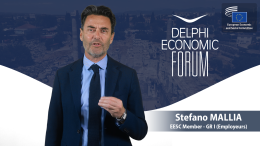
From 9 to 12 April 2025, an EESC Employers' Group delegation participated in the Delphi Economic Forum in Greece, becoming an institutional partner of this distinguished event that brings together leaders from politics, business, academia, and civil society to discuss and shape the policies for the future of Europe and the world, including related to competitiveness, geopolitics, sustainability and global trade.
This year’s prize attracted 58 applications from individuals, private businesses and civil society organisations across many European Member States, reflecting a broad geographical distribution.
This year’s prize attracted 58 applications from individuals, private businesses and civil society organisations across many European Member States, reflecting a broad geographical distribution.
They cover a large variety of topics, ranging from youth engagement and empowerment to social cohesion and inclusion, from media literacy and misinformation to human rights and gender equality.
Many initiatives tackle the problem at its roots and contribute to preventing polarisation.
Initiatives such as EUth Voices for Social Change, run by the non-profit organisation Youthmakers Hub in Greece, aims to empower young people tocultivate positive change in their communities. These projects tackle harmful polarisation, building a culture of tolerance by encouraging people to engage in constructive dialogues and to resist divisive narratives, for example through digital literacy training and podcasting.
Other projects combat polarising narratives and radicalisation. They bridge cultural, ethnic and generational gaps, address societal divisions, foster mutual understanding and cooperation, protect fundamental rights and inspire social cohesion.
DEMDIS Digital Discussion, an initiative launched by DEMDIS in Slovakia, created a new software platform to host fair digital discussion — even on controversial topics. Users vote on statements and are placed into separate opinion groups. By finding common ground, the project builds bridges between these polarised camps.
The Baltic Human Rights Society’sHuman Rights Guide is one example of the way civil society can work to uphold fundamental rights. The Guide works as a platform for human rights education, offering multilingual explanations about how human rights can and should work in specific situations in daily life.
This year’s submissions also contained several cultural and artistic approaches to tackling polarisation, such as Arty Farty’s Atlas géopolitique de la culture et des médias indépendants en Europe. This initiative highlights priority themes for a network of independent cultural and media organisations across Europe, such as inclusion, the reduction of territorial divides or the need to combat disinformation. These projects demonstrate that culture and media can play a transformative role in depolarising society.
Food, housing, energy, healthcare, education...how can Europeans maintain their standard of living these days? The cost of living is, more than ever, the primary concern of our fellow citizens, especially among young people.