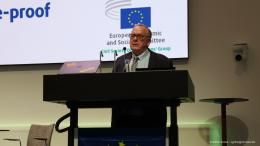
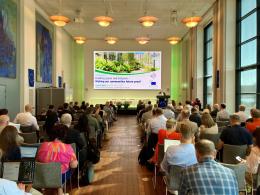
Conference of the EESC Civil Society Organisations' Group in the framework of the Danish Presidency of the Council of the European Union, Copenhagen, Danish Society of Engineers (IDA), 2 July 2025
believes that the EU must strengthen its diplomatic and institutional responses to address the impacts of climate on peace and stability, especially in the new geopolitical order;
recommends that EU should invest in multilateralism and continue to lead globally in the call for climate action, especially considering the withdrawal of the United States from any reasonable responsibility on this issue;
believes that a renewed diplomatic strategy must be rooted in three key principles: integrating climate considerations into conflict prevention, strengthening multilateral cooperation and Investing in Green Development as a Peace Mechanism.
believes the EU must work towards a common defence policy within the broader framework of its foreign and security policy and establish a strong European Defence Pillar. To this end, the necessary legislative and financial measures must be taken urgently;
Calls for greater support for SMEs and closer collaboration with research institutions to meet defence needs and safeguard strategic autonomy;
stresses the importance of expanding international defence cooperation, particularly with key global partners, to enhance Europe’s security stance.
provides guidance for an ambitious TCA review, recommending integral roles for EU and UK DAGs due to their practical insights and experience of the agreement's impacts;
calls for an enhanced regulatory cooperation on non-tariff barriers which will provide the biggest opportunity to improve the bilateral trade relations – closer alignment of regulatory systems reduces frictions and yields considerable benefits;
calls for mutual recognition of standards and improved mobility for services to reduce border friction, lower trading costs, and boost fair market access, growth and job creation on both sides;
insists on a ‘future-proof TCA’ by incorporating the youth perspective, progressively removing barriers to seizing new opportunities.
Domestic violence against women remains alarmingly widespread in the EU, with Eurostat data showing that one in three of the 228 million women are affected. The European Economic and Social Committee (EESC) has long championed efforts to combat this abuse, first raising the issue in a 2006 opinion. More recently, it helped shape the EU’s first-ever law to protect women from domestic violence and continues to play an active role in the UN Commission on the Status of Women, reinforcing its global commitment to ending this form of violence.
Reimagining the design of cities, communities and housing is essential to face the current challenges. Civil society organisations have a key role to play in steering this transformation. Sustainability and the right to housing must be at the heart of future strategies. The EU could contribute to this by increasing European funding for affordable housing and supporting the social economy.