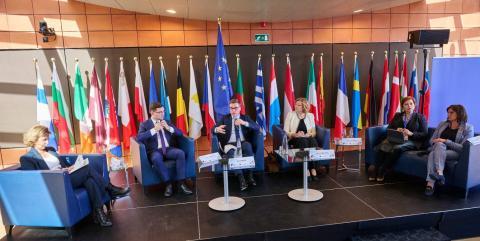
The EESC's flagship Civil Society Prize has been awarded 15 times to date. It rewards projects that take a particularly creative and innovative approach to issues that are very relevant to the EU.
The EESC's flagship Civil Society Prize has been awarded 15 times to date. It rewards projects that take a particularly creative and innovative approach to issues that are very relevant to the EU.
Applications can be submitted by any civil society organisations officially registered within the European Union and acting at local, regional, national or European level. The prize is also open to individuals who reside in the EU, as well as to companies registered or operating within the EU, provided that their projects are strictly not-for-profit.
All eligible initiatives and projects have to be carried out in the EU. They must have already been implemented or be ongoing before the closing date for applications.
The aim of the prize is to raise awareness about civil society's outstanding contribution to creating a European identity and citizenship and promoting the common values that bolster European integration.
A different topic is chosen each year. In 2023, it was projects that focused on mental health. In 2022, the EESC exceptionally awarded a prize for two topics: youth and Ukraine. In 2021, the prize honoured climate projects promoting a just transition. In 2020, the EESC replaced its Civil Society Prize with a one-off Civil Solidarity Prize dedicated to the fight against COVID-19. Other topics in the past have included gender equality and women's empowerment, European identities and cultural heritage, and migration.
In October 2024, the EESC launched its 15th Civil Society Prize on combating harmful polarisation of European society.
The theme of polarisation is more urgent than ever. Amid multiple overlapping crises — including the COVID-19 pandemic, Russia's war in Ukraine and widespread social and economic instability — mistrust in public institutions and authorities has grown, breeding harmful polarisation.
Civil society plays a key role in combating this mistrust and monitoring hotbeds of online and offline polarisation, improving social cohesion and upholding democratic ideals. Together with public authorities and civil society, it may help protect liberal democracy from authoritarian trends.
For this reason, the EESC has decided to award its latest Civil Society Prize to non-profit initiatives that intervene effectively by implementing preventive, early-warning and (where needed) de-escalation measures which ensure that democratic values are upheld, polarisation does not become harmful and one-sided narratives do not lead to acts of violence.
The weight of strengthening cohesion to depolarise societies falls on the shoulders of civil society organisations, who have the strength and the motivation to protect civic and democratic spaces. This was the key message from Civil Society Week, hosted for a second year by the European Economic and Social Committee (EESC) to discuss the alarming trend of widespread polarisation across EU societies.
The weight of strengthening cohesion to depolarise societies falls on the shoulders of civil society organisations, who have the strength and the motivation to protect civic and democratic spaces. This was the key message from Civil Society Week, hosted for a second year by the European Economic and Social Committee (EESC) to discuss the alarming trend of widespread polarisation across EU societies.
Over 800 people, including representatives from civil society organisations (CSOs), NGOs and youth groups, as well as stakeholders and journalists, gathered at the EESC from 17 to 20 March in honour of Civil Society Week to share views and discuss how to strengthen cohesion and participation in polarised societies.
Civil Society Week hosted 14 sessions organised by EESC Liaison Group members and European Citizens’ Initiative Day (ECI) partners, including the EESC Civil Society Prize award ceremony. Participants drew up a comprehensive set of actionable steps and key demands for more cohesive societies' including:
Strengthen cohesion through education and culture;
Provide affordable and sustainable housing;
Strengthen public participation through the ECI;
Secure an inclusive just transition and green-blue growth;
Build a strong European strategy for civil society;
Reinforce support and funding for civil society organisations;
Engage young people in shaping a stronger, more resilient Europe;
Boost innovation and technology for the common good.
At the closing session, EESC President Oliver Röpke said: ‘As we conclude this second edition of Civil Society Week, I am deeply inspired by the energy, resilience and commitment of civil society actors from across Europe. This week has demonstrated that when civil society comes together, we can forge solutions that strengthen our democracy, foster social cohesion and build a Europe that truly works for its people.’
From the European Commission, Henna Virkkunen, Executive Vice-President on Tech Sovereignty, Security and Democracy, emphasised the crucial role that CSOs play in navigating societies using core European values.
Victor Negrescu, Vice-President of the European Parliament, made a strong call to action, asking CSOs to show their strength and react to aggressive rhetoric: ‘We need a strong civil society and a real partnership between civil society and decision-makers in order to jointly build on a consistent society with real impact on people’s lives.’
Representatives from CSOs stressed that civil societies are more than service providers; they are an essential part of democracy and participation. Nataša Vučković, Secretary General at Serbia’s Centre for Democracy Foundation, expressed her optimism that civil society can play a vital role in fighting the root causes and the spread of anti-democratic and anti-European narratives, both in the EU and in candidate countries. This can be done by decoding the European Union and ensuring its benefits reach all citizens in their everyday lives. (at)
The European Economic and Social Committee (EESC) has welcomed the European Commission's new 'Vision for Agriculture and Food', a reform roadmap aiming to strengthen farmers' positions and build sustainable food systems. However, the EESC urges greater ambition in the Common Agricultural Policy (CAP).
The European Economic and Social Committee (EESC) has welcomed the European Commission's new 'Vision for Agriculture and Food,' a reform roadmap aiming to strengthen farmers' positions and build sustainable food systems. However, the EESC urges greater ambition in the Common Agricultural Policy (CAP).
The vision, debated at the EESC plenary on 27 March, includes measures to boost farmers' bargaining power, increase supply chain transparency and improve food policy dialogue. EU Agriculture Commissioner, Christophe Hansen, described it as a 'targeted response to calls for a competitive, fair and resilient agri-food sector,' and stressed the importance of working closely with all stakeholders, including civil society.
EESC President, Oliver Röpke, noted that the vision reflects many of the EESC's priorities. 'It recognises the key role of all agri-food actors in ensuring sustainability and competitiveness,' he said, adding that EESC recommendations had, in some areas, gone further than the Commission's proposals.
EESC members welcomed initiatives to strengthen producers' roles in negotiations and contracts. 'Written contracts with renegotiation clauses will boost transparency and farmer bargaining power,' said Stoyan Tchoukanov, rapporteur for the EESC's opinion Amendment of the Common Markets Organisation (CMO) Regulation on strengthening producers' position in the negotiation and conclusion of contracts.
The Commission also plans to enhance cooperation across the food system, promoting sustainable production and healthier diets. Emilie Prouzet, rapporteur for the EESC's opinion New rules on cross-border enforcement against unfair trading practices, sees this as a first step to support farmers while avoiding legal uncertainty.
The vision includes a commitment to a new EU-wide risk and crisis management system, aligning with the EESC's calls for stronger tools to handle environmental, market and climate-related shocks. A future strategy for generational renewal is also expected, which would support young farmers with land access, investment skills and rural infrastructure.
Despite broad support, concerns remain. Debate participants noted challenges in discussing post-2027 CAP reform without clarity on the next EU budget. The EESC also calls for stronger enforcement of social conditionalities and warns that the vision does not fully address issues like market concentration and financial speculation affecting food prices.
The EESC reaffirmed its role as a key partner in turning the Commission's vision into policy. It pledged continued collaboration to ensure the interests of farmers, producers, workers and consumers are upheld in shaping the future of EU agriculture. (ks)
The 12th meeting of the EU Domestic Advisory Group (DAG) under the EU-Japan Economic Partnership Agreement (EPA) took place on 10 April, 2025 at the EESC.
Display date
1 year 4 months ago
Amendment to the Capital Requirements Regulation - prudential requirements
On 26 March 2025, the Employers' Group held a debate with representative from the EU institutions and EU security and defence industry. President Stefano Mallia opened the debate underlining that in the face of global uncertainties, the EU's commitment to strengthening its defence capabilities opens new horizons for innovation, job creation and economic growth.
As the EU is looking to expand its circle of key partners against a backdrop of uncertainty over transatlantic relations, India seems a perfect ally, being the largest formal democracy in the world, with market and economic growth (including in green technology) that represent a valuable opportunity for EU companies. The World Bank expects India to overtake Japan and Germany and emerge as the world’s third-largest economy by 2030.