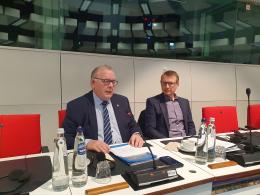
Conference on the 'Launch of the EAPN 2024 Poverty Watch Report', a partnership event by the European Anti-Poverty Network (EAPN) and the European Economic and Social Committee's Civil Society Organisations' Group on 8 April in Brussels.
Display date
1 year 3 months ago
The role of quality public services in tackling the high cost of living
On 8 April, the European Anti-Poverty Network (EAPN) launched its latest Poverty Watch Report, entitled Towards a systemic approach to social protection.
On 8 April, the European Anti-Poverty Network (EAPN) launched its latest Poverty Watch Report, entitled Towards a systemic approach to social protection.
The report, presented for the first time at an event co-organised with the EESC’s Civil Society Organisations’ Group in Brussels, addresses the challenges that need to be overcome to secure strong and resilient social protection systems. This is particularly relevant in the current context, as EU welfare states grapple with growing financial constraints caused by national spending limitations and rising defence and security expenditures.
The report, drawing on findings from 19 EAPN national member organisations, demonstrates that achieving a systemic approach to comprehensive and effective social protection requires policies embedded in integrated, long-term strategies that align economic, social and environmental dimensions. These policies must be based on robust evidence, data and the meaningful participation of people experiencing poverty.
EAPN’s national networks are voicing apprehension about cuts in social spending. Additionally, indicators such as high levels of non-take-up of social benefits continue to raise concerns about the efficiency of policies that are failing to reach those who are in need of and eligible for social benefits.
According to the report, the response to a fast-changing world marked by digitalisation, war, an ageing population and climate change has been inadequate, highlighting the need to re-establish a systemic approach to social policies.
Juliana Wahlgren, EAPN’s Director, highlighted the urgency of the issue, stating: ‘The EU needs to protect the welfare state and prioritise social spending. To that end, the Poverty Watch Report provides recommendations on the minimum income, the housing crisis and the energy transition, among other things. Efficiency and adequacy are essential. Next year, the European Commission will launch the EU Anti-Poverty Strategy, but it can only succeed if Member States adopt a truly systemic approach to social protection. With more than 20% of the EU population at risk of poverty, we cannot afford to continue with fragmented policies – social protection must be strong, coordinated and effective.’
Séamus Boland, President of the Civil Society Organisations’ Group, said: ‘The eradication of poverty requires unrelenting action by all Member States. Much of the poverty experienced in the EU is intergenerational and can be particularly harsh on the lives of children and older people. In the areas of education, housing and high-cost energy, special measures that target the system’s weaknesses must be introduced. Otherwise, the EU as a political entity will struggle to retain the confidence of its citizens.’
Krzysztof Balon, Vice-President of the Civil Society Organisations’ Group and rapporteur of the EESC opinion on the first-ever EU Anti-Poverty Strategy, which was announced in the Political guidelines for the European Commission 2024-2029, said: ‘An effective EU Anti-Poverty Strategy must build on the experiences of people facing poverty and address their needs. It should also support civil society organisations and involve them in designing and implementing appropriate projects and measures to combat social exclusion.’