Proposal for a DIRECTIVE OF THE EUROPEAN PARLIAMENT AND OF THE COUNCIL on the registration documents for vehicles and vehicle registration data recorded in national vehicle registers and repealing Council Directive 1999/37/EC
Proposal for a DIRECTIVE OF THE EUROPEAN PARLIAMENT AND OF THE COUNCIL on the registration documents for vehicles and vehicle registration data recorded in national vehicle registers and repealing Council Directive 1999/37/EC
Proposal for a DIRECTIVE OF THE EUROPEAN PARLIAMENT AND OF THE COUNCIL on the registration documents for vehicles and vehicle registration data recorded in national vehicle registers and repealing Council Directive 1999/37/EC
Proposal for a DIRECTIVE OF THE EUROPEAN PARLIAMENT AND OF THE COUNCIL on the registration documents for vehicles and vehicle registration data recorded in national vehicle registers and repealing Council Directive 1999/37/EC
a substantial increase in the size of the next MFF in real terms to meet the EU’s growing challenges. It also recommends revising the inflation adjustment mechanism to preserve the MFF's real value and reshaping the budget into a strategic investment tool that can deliver European public goods and long-term priorities.
a simplification of current funding rules and a streamlining of overlapping programmes to reduce bureaucracy. It advocates for a shift towards performance- and impact-based funding, better monitoring, and improved access to EU funds for local-level actors, civil society, and businesses.
reinforcing investment in areas of clear European interest—such as defence, innovation, infrastructure, and social cohesion—through tools like joint borrowing and co-financing mechanisms. It also calls for the creation of a ‘Democracy Shield’ to protect democratic values and support civil society, independent media, and the rule of law across the EU and in candidate countries.
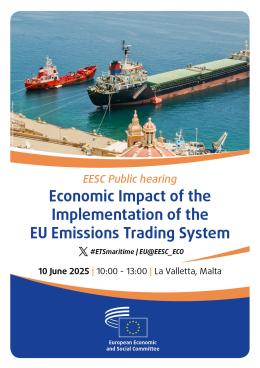
The European Economic and Social Committee (EESC) is organising a public hearing to assess the economic impact of extending the EU Emissions Trading System (ETS) to the maritime sector.
The hearing will focus on the risks of carbon and business leakage, and how these developments may affect port competitiveness and trade flows- particularly in smaller and peripheral EU Member States. The event will provide a platform for maritime stakeholders, economic experts, and EU institutions to discuss real-world implications and explore fiscal and strategic solutions to mitigate negative effects.
Speakers will include representatives from DG CLIMA, maritime and port organisations, as well as leading economists and policy analysts.
Malta’s strategic location and role in European maritime logistics make it an ideal setting for this timely discussion.
The European Economic and Social Committee (EESC) is calling for a comprehensive EU strategy to speed up the move away from fossil fuels and the adoption of cleaner, renewable and affordable alternatives. This change will help the environment, make Europe more energy-independent, and create new business opportunities and jobs.