On 15 and 16 May 2025, the EESC Employers' Group will hold an Extraordinary Group meeting in Warsaw (Poland) with a focus on EU strategic autonomy and competitiveness.
We would all like to see the position of farmers in the supply chain being strengthened. To this end, bolstering the authorities’ enforcement capacities when it comes to unfair trading practices is a first step. Without real enforcement, it’s pointless introducing more and more rules.
COP16 began in Cali in October 2024 and ended at the end of February 2025 during a second session in Rome. Negotiations were once again very complicated, but nevertheless resulted in a compromise on biodiversity finance.
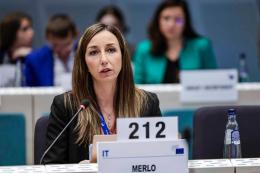
In this interview, Nicoletta MERLO (NAT member) talks to us about the creation of the EESC Youth Group - of which she's vice-president - and of the progress achieved so far, including the implementation of the Youth Test for EESC opinions.
Under daily bombardments, when their main goal is to stay alive, young Ukrainians cannot afford to think about the distant future, says 18-year-old Yevheniia Senyk, YEYS 2025 participant and youth activist from Ukraine. She shares how the war has affected youth organisations in her country and why it is important to give them a voice on the European stage.
Under daily bombardments, when their main goal is to stay alive, young Ukrainians cannot afford to think about the distant future, says 18-year-old Yevheniia Senyk, YEYS 2025 participant and youth activist from Ukraine. She shares how the war has affected youth organisations in her country and why it is important to give them a voice on the European stage.
How do you think your organisation has been impacted in the last three years by the war in Ukraine, and how have your operations changed?
Formed in 2013, the goal of SD Platform is to protect values such as freedom, solidarity, equality and justice because we believe that these are the most important values to create a progressive future in Ukraine. We also have a lot of foreign branches to maintain the engagement of Ukrainian youth abroad who have been forced to leave their homes.
First of all, the war has impacted the work of the regional branches because we have a lot of branches, for example, Odessa and Zaporizhzhia, that are very close to the front-line areas and the people there experience bomb shelling every day. It's hard for them to think about organising events when their main goal is just to stay alive. Daily bomb shelling affects youth all over the country because you can't afford to think about the distant future, because you don't know what will happen tomorrow or even what will happen in two hours.
Also, because of the war, the financial situation in Ukraine is unstable, resulting in a lack of employment for young people. Young people must find a job while also trying to study and to be involved in youth organisations, it's a difficult balance to achieve.
After the full-scale invasion, many young people started to fight against Russian aggression with weapons in their hands instead of through youth councils or youth organisations. As a result, young people do not have political experience. It will be hard in the future to make sure that everyone is able to participate in politics properly.
At SD Platform, we provide free, non-formal, political education to make sure that young people know how they can influence politics at regional and national levels.
Why do you think it's important for youth organisations or representatives of these organisations to come to events such as YEYS?
First of all, these international events show Ukrainians that Europe has not forgotten about us. It's important for us to be here, to have a voice, to ask others about their experiences and to bring new ideas back to our country.
Also, it shows that we are able, and we are committed to becoming part of the European Union because if we are here, then European youth can listen to us and we can listen to them. It's like a partnership between all of us.
What do you think young people need as support, as help, to encourage them to stay involved in youth work and youth activism?
I think it's very important for the European Union to consult with Ukrainian youth. I think if the European Union continues to provide us with these opportunities to have a voice in shaping EU policy, we will reach common conclusions that will be beneficial for both sides because we are part of Europe, so it must be a common conclusion in all policy areas. Also, if the European Union continues to provide financial support to Ukrainian youth to participate in events such as this one, it will encourage them to stay engaged in politics as the financial burden will not pose such a big barrier to participation.
Yevheniia Senyk is a youth activist with SD Platform, a member organisation of the National Youth Council of Ukraine. She is an international relations student at Lviv Polytechnic National University.
Bridging divides: How civil society can combat harmful polarisation
At a time when our societies face growing polarisation and trust in democratic institutions is waning, civil society must rise to the challenge. Polarisation, in itself, is not always negative; democratic debate thrives on different viewpoints. However, when polarisation leads to hostility, disinformation, and division, it threatens the very foundations of our democracies.
Bridging divides: How civil society can combat harmful polarisation
At a time when our societies face growing polarisation and trust in democratic institutions is waning, civil society must rise to the challenge. Polarisation, in itself, is not always negative; democratic debate thrives on different viewpoints. However, when polarisation leads to hostility, disinformation, and division, it threatens the very foundations of our democracies.
During this year’s Civil Society Week, we have seen remarkable examples of initiatives that fight harmful polarisation. The EESC Civil Society Prize has highlighted organisations working on media literacy, countering disinformation, and fostering intergenerational dialogue. These are the types of projects that must be supported if we want to build resilient, cohesive societies.
Across Europe, we are witnessing increasing societal fragmentation. The challenges are numerous: economic inequalities, social exclusion, digital misinformation, and political extremism. The recent rise of populist movements across Europe, shrinking media pluralism, and declining trust in institutions illustrate how polarisation fuels discontent. These trends weaken democratic structures and erode social cohesion. In such times, civil society is not just a participant in the democratic process—it is a guardian of its resilience.
Civil society organisations have long been at the forefront of defending democratic values. They act as mediators, bringing diverse voices to the table, countering misinformation, and fostering informed public debates. They provide a platform for those who feel unheard, advocating for inclusive policies that bridge divides rather than deepen them. Through civic engagement, fact-based discussions, and initiatives that promote tolerance, civil society actively combats the forces of division.
The EESC firmly believes that strengthening participation and dialogue is the only way forward. We see this in our work every day—our members, representing employers, trade unions, and NGOs, engage in robust debates, yet always with the goal of finding common ground. Our strength lies in consensus, and this is the model that must be expanded across Europe.
Civil society must be empowered to play its full role in addressing polarisation. This means ensuring their access to funding, protecting their ability to operate freely, and fostering an environment where their contributions to democratic life are recognised and valued. Participatory mechanisms, whether through citizen consultations, grassroots initiatives, or deliberative democracy tools, must be reinforced to ensure people feel included in decision-making.
The future of Europe depends on its citizens feeling represented, engaged, and heard. Civil society is not an accessory to democracy—it is its backbone. As we navigate an era of division, we must equip it with the tools, recognition, and space it needs to continue safeguarding our democratic values. By fostering dialogue, promoting social inclusion, and countering extremism, civil society can be the force that turns polarisation from a source of conflict into a driver of constructive debate and social progress.
Let us work together to ensure that division does not define our future. Instead, let’s build a Europe where diversity of opinion strengthens our unity, where engagement rebuilds trust, and where civil society leads the way in bridging divides.