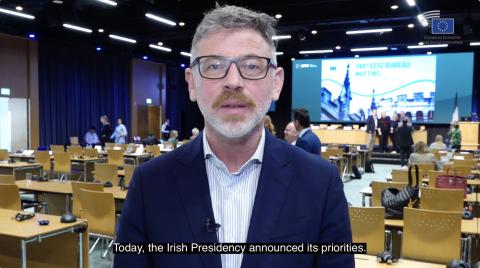
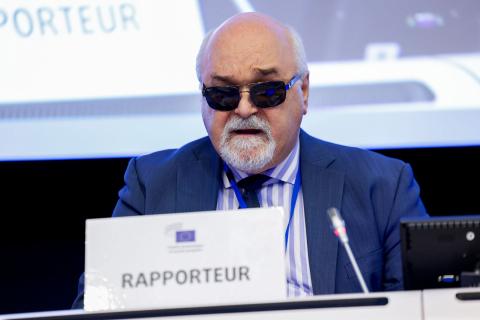
In its opinion on the new MFF 2028-2034, adopted in January 2026, the EESC warned that the Commission’s proposed increase falls short of what is needed, calling instead for a substantial boost in real resources. EESC Info spoke to the three rapporteurs for the MFF opinion ─ Konstantinos Diamantouros, Dominika Biegon and Luca Jahier ─ about the key political priorities for ensuring a sound EU budget that will secure Europe’s strategic autonomy, while remaining decentralised and strongly anchored at regional level.
In its opinion on the new MFF 2028-2034, adopted in January 2026, the EESC warned that the Commission’s proposed increase falls short of what is needed, calling instead for a substantial boost in real resources. EESC Info spoke to the three rapporteurs for the MFF opinion ─ Konstantinos Diamantouros, Dominika Biegon and Luca Jahier ─ about the key political priorities for ensuring a sound EU budget that will secure Europe’s strategic autonomy, while remaining decentralised and strongly anchored at regional level.
The Committee’s message is clear: the EU’s ambitions cannot be delivered on the cheap, and the MFF is ultimately a political choice about Europe’s future. What should be the guiding political priorities to ensure that the next EU budget strengthens cohesion, competitiveness and citizens’ trust in the European project?
Konstantinos Diamantouros (EESC Employers' Group): According to the Draghi report, achieving the goals of the digital and green transitions requires an additional EUR 750-800 billion of investments per year. While most of this will come from the private sector alongside improvements to the framework conditions for businesses operating in Europe, public investment will nevertheless play an important role.
At a time when Europe is facing growing geopolitical and economic headwinds — and when new priorities such as defence have emerged alongside traditional ones — the EESC is convinced that the next MFF must be significantly strengthened for the 2028–2034 period.
This means, amongst other things, preserving the central role of cohesion policy in the next MFF, with a dedicated budget, and ensuring that the conditionalities linked to the disbursement of funds under the National and Regional Partnership Plans are strictly aligned with the objectives of regional policy, rather than being macroeconomic in nature.
It is also paramount to maintain the focus on competitiveness by safeguarding the proposed budget increases for industrial development (European Competitiveness Fund), research and innovation (Horizon Europe) and cross-border energy and transport interconnections (TEN-T and TEN-E).
And finally, new own resources must strike the right balance: increasing revenues without undermining the EU’s competitiveness.
The EESC stresses that cohesion, good governance, and strong social rules are essential to making EU funding effective and future-proof. How can the next MFF be designed to strengthen these principles, while avoiding the risk that simplification leads to centralisation and weaker regional involvement?
Dominika Biegon (EESC Workers' Group): We must ensure that public funding serves public purposes. Social conditionality is a key tool in achieving this. The EESC suggests introducing provisions to ensure that only companies meeting social criteria are eligible for EU funding. These could include site retention and employment guarantees, education and training measures, and respect for collective agreements. Good examples already exist in some Member States. The EU should lead by example. The future EU budget should uphold social dialogue and create quality jobs. This is how we can increase acceptance of the green and digital transitions.
Another key aspect of making EU funding more effective is the partnership principle. The European Commission is proposing a more centralised structure for cohesion funds, giving Member State governments greater control over cohesion policy. This represents a fundamental departure from the previous bottom-up approach, under which regions and the social partners played a leading role in designing and implementing cohesion funds.
Together with the Committee of the Regions, the EESC strongly criticises this shift in power from the regional to the national level. To ensure that the EU budget delivers on the ground and remains visible in the regions, the partnership principle must be strengthened. The EESC calls for its genuine application at all stages — from drafting NRPP chapters to project selection, management and monitoring — as well as increased resources for social partner capacity-building and binding co-determination rights, including veto rights on key decisions in monitoring committees.
The EESC warns that the EU cannot respond to global competition, climate change and security challenges with a budget designed for the past. In your view, what specific steps are needed to ensure that the next MFF provides sufficient real investment capacity to turn the EU’s strategic autonomy from a slogan into reality?
Luca Jahier (EESC Civil Society Organisations' Group): The proposed next MFF is clearly not fit for the many and growing challenges Europe is facing. The EESC was the first to say this — a position now echoed by the European Parliament.
The Draghi report, published one year before the MFF proposal, called for an additional EUR 800 billion in investment per year over ten years, with 60% coming from private capital. One and a half years later, Draghi revised this figure to EUR 1.2 trillion per year over the next decade, with at least 60% now expected to come from public funding and investment instruments. This is mainly due to rising crisis-related costs, the acceleration of the energy and technological transitions, and increased defence spending.
We consider it unacceptable that, once inflation and NGEU repayments are taken into account, the marginal increase in the Commission’s proposal amounts to only around +0.1–0.2%, while significant cuts are made to traditional policies (CAP, cohesion, social funds and others) to free up resources for competitiveness and global Europe priorities. Pending the Council's 'negotiating box', a group of so-called ‘frugal’ capitals is even pushing for further reductions, while still failing to agree on crucial own resources. That we welcome, but resources need to be increased.
The first priority must be to transform what is currently a survival budget into a genuinely political one. This could be achieved through several concrete measures:
Exclude the EUR 149 billion allocated to NGEU repayments (0.11% of EU GNI) from heading 1, placing it above the budget ceiling and financing it through dedicated new own resources, as originally foreseen under the RRF regulation.
Adopt a comprehensive and ambitious set of new own resources, replacing the most contested ones (such as the CORE proposal) with alternatives, including a digital services tax.
Use part of the budget to leverage private capital, building on the success of the Juncker Plan (EFSI I and II).
Resort to specific new EU borrowing to finance EU common goods, mainly linked to competitiveness and security priorities, thus significantly increasing the final budget.
Accelerate the Capital Markets Union to increase the volume of EU private capital invested in the EU and attract new placements and investments from abroad, as a secure option in times of high turbulence. The creation of a solid EU fiscal space, through a stable market for EU bonds, could accelerate this process.
In July 2025, the European Commission unveiled its proposal for the Multiannual Financial Framework (MFF) 2028-2034, setting out the EU’s spending priorities for the coming years. For the European Anti-Poverty Network (EAPN), this proposal fails to reflect the reality faced by the 92.7 million people experiencing poverty across the EU. Rather than prioritising poverty eradication and social investment, it places competitiveness, defence and security at the heart of the EU budgetary agenda.
In July 2025, the European Commission unveiled its proposal for the Multiannual Financial Framework (MFF) 2028-2034, setting out the EU’s spending priorities for the coming years. For the European Anti-Poverty Network (EAPN), this proposal fails to reflect the reality faced by the 92.7 million people experiencing poverty across the EU. Rather than prioritising poverty eradication and social investment, it places competitiveness, defence and security at the heart of the EU budgetary agenda.
by Jessica Machacova, European Anti-Poverty Network
Following the launch of the first-ever EU Anti-Poverty Strategy by the European Commission on 6 May 2026, EAPN stresses that proper funding is essential for any policy to deliver meaningful results. Poverty cannot be effectively eradicated, or even, reduced, if the policies designed to tackle it are not backed by sufficient financial resources. While the strategy is an important step forward, its potential impact is seriously undermined by the absence of dedicated funding to support its implementation.
The MFF is a crucial instrument for translating the EU’s political commitments into lasting, tangible improvements in people’s lives. Yet without a budget explicitly focused on protecting social rights and reducing inequalities, how can the EU realistically achieve its objective of eradicating poverty by 2050?
This objective was first announced by European Commission President Ursula von der Leyen in her 2025 State of the Union address and later confirmed in the EU Anti-Poverty Strategy. However, it is still not supported by adequate budgetary resources or a clear policy roadmap outlining how poverty eradication will be achieved.
From EAPN’s perspective, the European Commission’s proposal for the MFF moves in the opposite direction: social rights and social justice barely feature while competitiveness, security and defence are the priorities that dominate the political debate.
These priorities are also reflected in the proposed budget allocations. A threefold increase on the 2021–2027 MFF in funding for migration and border management is proposed, with a fivefold increase in the budget for defence and space.
By contrast, the level of investment dedicated to poverty eradication remains uncertain. No standalone budget has been identified for the European Social Fund (ESF). Moreover, the proposed minimum earmarking of 14% for social objectives within the National and Regional Partnership Plans (NRPPs) is not linked to achieving either the 2030 Porto poverty reduction target or the 2050 poverty eradication objective. It also fails to guarantee targeted support for marginalised groups.
Recent experience shows why such safeguards are necessary. During the mid-term review of the MFF 2021-2027, Member States were allowed to reallocate unused cohesion funds to other priorities. More than three-quarters of these reallocated funds were channelled into competitiveness and defence-related objectives while less than a quarter supported housing, access to water and sanitation and decarbonisation. This illustrates the fact that, when given flexibility, Member States tend to prioritise competitiveness and defence over social investment.
EAPN's analysis shows that marginalised groups will bear the cost of these political choices. Existing earmarking requirements for social inclusion and material deprivation have been removed from the proposed ESF for 2028–2034. The ESF, which currently represents one of the few reliable guarantees of dedicated support for those most at risk of poverty and exclusion, would allocate very little space to targeted funding for marginalised groups. Homeless people, women and Roma communities are mentioned solely in the recitals while undocumented people, migrants, single-parent families, racialised communities and LGBTIQA+ people do not feature at all. Without stronger commitments and robust safeguards, there is a real risk that these groups will receive little or no support from the NRPP funding allocated to Member States.
In short, the MFF 2028–2034 challenges the dominant narrative that the EU can both prioritise competitiveness, defence and security and adequately fund poverty eradication and social investment at the same time. While the former continue to dominate the political agenda, the latter are becoming increasingly invisible.
As negotiations continue, EAPN is engaging with both the European Parliament and the Council of the EU to ensure that sufficient resources are dedicated to poverty eradication, including through stronger ESF earmarking and safeguards for marginalised groups.
Ultimately, how the EU chooses to spend its money in the coming years is a political decision. That decision must place poverty eradication, social rights and the wellbeing of all people at the heart of the European project.
Jessica Machacova is Senior Policy and Advocacy Officer at the European Anti-Poverty Network (EAPN). For the past 14 years, she has worked to advance human rights and social justice at EU level, in both civil society organisations and the EU institutions. Her experience includes roles at Equinet – European Network of Equality Bodies, the Red Cross EU Office, the European Commission and the European Parliament.
One of Europe's biggest challenges today is tackling the 'triple planetary crisis' – climate change, pollution and biodiversity loss – which is largely driven by increased resource consumption. Despite years of policy effort, the European Union remains off track to meet its circularity targets.
One of Europe's biggest challenges today is tackling the 'triple planetary crisis' – climate change, pollution and biodiversity loss – which is largely driven by increased resource consumption. Despite years of policy effort, the European Union remains off track to meet its circularity targets.
The forthcoming Circular Economy Act offers a unique opportunity to change direction. It must go beyond fine‑tuning and implementing existing rules and instead set a clear course towards an economy that respects planetary boundaries while strengthening Europe’s resilience and competitiveness. Circularity should no longer be viewed as solely environmental policy, but must be considered as economic and geopolitical strategy.
A necessary shift: reducing demand, not just waste
For too long, policy has focused on efficiency: recycling more and producing better. These efforts are necessary, but they are no longer sufficient. If overall consumption continues to increase, efficiency gains will simply be outweighed.
The EESC therefore calls for a fundamental shift: reducing resource use must become a central objective. This means complementing recycling with strong demand‑side measures that directly address overconsumption.
In other words, Europe must move from 'using resources better' to 'using fewer resources'.
Setting clear limits
This transition requires clear direction. The Committee recommends introducing material footprint targets aligned with planetary boundaries, providing a framework similar to climate targets.
Such targets would offer predictability for businesses, guide investment and ensure accountability — anchoring Europe’s economy within ecological limits.
Making circularity economically viable
Circular solutions will only scale if markets support them. Today, recycled materials often struggle to compete due to price gaps, fragmented regulation and quality concerns.
The Circular Economy Act must create a genuine single market for secondary raw materials. Removing barriers and establishing clear standards will allow circular business models to thrive and deliver both environmental and economic value.
Putting people at the heart of circularity
This transition must work for everyone. Workers, consumers and SMEs will experience the shift differently, and their concerns must be addressed from the outset. This is why the EESC positions civil society as a key actor in designing and implementing circular solutions on the ground.
A circular economy is not just about materials; it is about people. It must create opportunities, support adaptation and ensure that no group is left behind.
A strategic choice for Europe
Ultimately, the Circular Economy Act is about more than sustainability. It is about Europe’s ability to reduce dependence on imported resources, strengthen its competitiveness and build resilience in an uncertain world.
The EESC’s message is clear: the transition must be systemic, ambitious and fair. With the right choices now, Europe can lead the way towards an economy that thrives within planetary boundaries — and delivers lasting benefits for its citizens.
The European Commission says its proposal for the next long-term EU budget will make EU funding simpler, more flexible and better equipped for the future. But for people with disabilities and other vulnerable groups, it raises a fundamental concern: that simplification is becoming a cover for weakening disability rights and removing elements of social protection, writes EESC member Ioannis Vardakastanis.
The European Commission says its proposal for the next long-term EU budget will make EU funding simpler, more flexible and better equipped for the future. But for people with disabilities and other vulnerable groups, it raises a fundamental concern: that simplification is becoming a cover for weakening disability rights and removing elements of social protection, writes EESC member Ioannis Vardakastanis.
By Ioannis Vardakastanis
On 16 July 2025, the European Commission proudly launched its proposal for the EU’s next long‑term budget: the Multiannual Financial Framework. It came with bold claims: a record-breaking EUR 2 trillion for 2028–2034, a simplified budget structure, streamlined funding rules, and the promise of keeping the EU competitive and secure in an unstable world.
The promises aren’t quite all that they seem
It didn’t take long for the public to question these claims. The supposed generosity of this 'record-breaking' budget quickly showed itself to be misleading. Eight percent of the entire budget will go towards repaying COVID‑related debt. And because the EUR 2 trillion figure is expressed in current prices after years of high inflation, the real purchasing power of the budget is essentially unchanged from the previous cycle.
The promised simplification has been delivered, but at a cost. Several long‑standing pillars of EU cohesion policy, such as the European Social Fund, the Regional Development Fund and the Common Agricultural Fund, have been merged into one giant fund. Member State allocations will be planned through new National and Regional Partnership Plans. Meanwhile, the legal texts themselves have been stripped back, raising serious concerns for marginalised groups, including people with disabilities.
What does this simplification mean for people with disabilities?
The first casualties of simplification have been the Enabling Conditions. These currently set out clear eligibility criteria for using EU funds, including the obligation to implement the UN Convention on the Rights of Persons with Disabilities (UNCRPD). In the new proposal, Enabling Conditions have been replaced by a lighter set of Horizontal Principles. And while reference to the EU Charter of Fundamental Rights has been retained, reference to the UNCRPD is no longer explicitly included.
This omission is baffling in view of the EU’s own data. Eurostat shows a decade of stagnation in outcomes for people with disabilities in employment, education and poverty reduction. Eurofound research also highlights a worsening trend of institutionalisation, an area where EU funds could be transformative.
We are already facing the problem of EU money flowing into segregating settings, particularly residential institutions, often due to overly flexible interpretation of the rules. The disability movement has long called for clearer, more explicit safeguards to ensure that EU funds promote inclusion and respect rights. Instead, the new simplified text risks opening the door to even looser controls.
What changes for EU spending on social objectives?
Merging the European Social Fund into the Partnership Plans raises further issues. The Commission has been inconsistent in explaining how much money will actually go towards social objectives. While the regulation states that at least 14% of funding should support social actions, it remains unclear from what amount this 14% will be taken. The Commission has struggled to provide a definitive figure.
The scope of what counts as social investment has also widened. The current ESF+ clearly defines eligible measures, but the new rules allow broader interpretation. Social spending may now include infrastructure projects with a social element, such as housing. While valuable, such projects can absorb large amounts of funding. A social budget that is, in real terms, no larger than today’s ESF+ will now be expected to cover costly building projects previously funded by the Regional Development Fund.
There is a real risk that infrastructure could consume almost the entire social envelope. This is because earmarking – i.e. protected minimum shares for specific objectives – has been removed. Under ESF+, at least 25% of social spending must support social inclusion, including for the most marginalised groups. People with disabilities have relied heavily on this guarantee.
The Commission has now removed these protections, giving Member States far more freedom. Countries already committed to disability inclusion will likely continue to invest, but those lagging behind will likely further underinvest. The gap between Member States will widen, undermining the very purpose of EU cohesion policy.
What are we asking for?
The European disability movement is clear about this: simplification cannot come at the expense of our rights. EU policymakers in the Parliament and Council, who now hold the pen, must reverse the Commission’s decision to downgrade disability rights in the legal texts.
EU funding regulations must provide precision and clarity. There must be no ambiguity about ensuring sufficient investment in the inclusion of people with disabilities, and no doubt that this investment must fully respect the rights set out in the UN Convention.
Ioannis Vardakastanis is a member of the EESC's Civil Society Organisations' Group. He is president of the National Confederation of Disabled People of Greece (ESAMEA) and former president of the European Disability Forum (EDF).
Everybody seems to be talking about the next long-term budget, but one question is missing: who will still be able to see where the money goes and whether it works? For Elena Calistru, president of the EESC’s Section for Economic and Monetary Union and Economic and Social Cohesion (ECO), the real story of the next MFF is not just about figures or priorities, but about a shift that could make EU spending less transparent, less accountable and further removed from the people it is meant to serve.
Everybody seems to be talking about the next long-term budget, but one question is missing: who will still be able to see where the money goes and whether it works? For Elena Calistru, president of the EESC’s Section for Economic and Monetary Union and Economic and Social Cohesion (ECO), the real story of the next MFF is not just about figures or priorities, but about a shift that could make EU spending less transparent, less accountable and further removed from the people it is meant to serve.
By Elena Calistru
Most of the conversation about the next MFF has been about numbers – how big it should be and who gets what slice of defence, cohesion, competitiveness or climate. Fair enough; that’s where the money is. But underneath those arguments is a change I find more interesting, and that I hear almost no one discussing: how far the decisions about this money will sit from the people it is meant to reach.
The proposal folds fourteen funds into national plans, with money released as governments hit targets they’ve agreed with the Commission. It is pitched as a turn toward results and on paper it does look tidier – fewer programmes, cleaner reporting, more or less a finance minister’s dream. What it also does is pull the centre of gravity upward, away from regions and local actors and toward national capitals, and further from the places where a renovated school or a retrained worker is the only evidence most people will ever have that Europe did anything for them.
That distance has a cost we tend not to name. The people closest to a project – a city hall, a local NGO, a trade union branch – are usually the only ones who can say whether a target met actually ‘achieved’ or changed anything in real life, or just produced a very persuasive report. Their presence is what keeps the system honest, which matters rather more than the ‘consultation’ box it normally gets filed under. Take them out of the room and Europe doesn’t end up with a clearer view of its own spending; it ends up more sure of itself.
And this should worry the whole Committee, not only those of us who stand for organised civil society. The European project runs on consent – on people half-believing it does something for them where they actually live. A budget that’s harder to see, and harder to check, can be perfectly efficient and still disappear from view in exactly the places that decide whether Europe holds together. By all means, let’s fight over the numbers. I’d just rather we didn’t win that argument and lose the point of it.
Elena Calistru is the president of the European Economic and Social Committee’s Section for Economic and Monetary Union and Economic and Social Cohesion (ECO) and a member of the EESC’s Civil Society Organisations’ Group.
Culture contributes to democracy, social cohesion, health and the economy. But these wider benefits happen only if we support culture for its own sake, Luiza Moroz - Head of Policy at Culture Action Europe - told EESC Info. In the next EU budget, culture must have a clear place, visible identity and dedicated funding.
Culture contributes to democracy, social cohesion, health and the economy. But these wider benefits happen only if we support culture for its own sake, Luiza Moroz - Head of Policy at Culture Action Europe - told EESC Info. In the next EU budget, culture must have a clear place, visible identity and dedicated funding.
EU funding in the cultural sector often favours large, well-established institutions with the capacity to handle complex applications. To support emerging artists and first-time applicants, the Culture Action Europe proposal suggests introducing a 'micro-grant fast-track'. How can the next MFF help lower these barriers and ensure that the next generation of European cultural talent can access funding?
First, the issue is one of resources. The Commission has proposed a budget of EUR 1.8 billion for the Culture strand of AgoraEU over seven years. This corresponds to approximately EUR 260 million per year — roughly equivalent to the annual budget of the French National Library. Culture Action Europe is calling for an increase with a concrete proposal: top up AgoraEU with digital fines imposed on big tech under EU digital legislation. For example, the EUR 120 million fine imposed on X for breaching the Digital Services Act could be channelled towards supporting creators.
Second, funding needs to be made more accessible. The European Parliament's draft report on AgoraEU proposes useful tools: operating grants (support the organisation itself rather than a single project), two-stage applications (a full application is developed only after the concept note has been accepted, which saves applicants' resources), more cascading grants redistributed among smaller organisations, and a the possibility of a 100% co-funding rate, under which EU funds would cover the full cost of a project. At present, the requirement for co-financing often disadvantages smaller organisations with limited resources.
Finally, AgoraEU should also make greater use of private funding from foundations and other third parties, as envisaged in Article 12 of the proposal.
A major structural change is the merging of Creative Europe into the new 'AgoraEU' programme, with the aim of increasing efficiency. However, there are concerns that culture could lose its distinct identity or be overshadowed by other priorities. How can the EU ensure that culture remains a visible, standalone priority in future MFFs?
The Culture strand within AgoraEU must be autonomous and clearly visible. In practice, this means a strand with a fixed percentage of the budget for culture (we are calling for at least 25%), its own work programmes, indicators and logo.
The visibility of culture also depends on artistic freedom: the freedom to be unconventional, radical, experimental and uncomfortable. In many Member States, this freedom is being restricted, often under austerity arguments. Culture Action Europe is part of a civil society coalition drafting a Blueprint for the European Artistic Freedom Act. In addition, we are calling for EU funding to national governments to be made conditional on respect for artistic freedom.
Underpinning both demands is a call to support culture's intrinsic value. Of course, culture contributes to democracy, social cohesion, health and the economy. However, these wider benefits can only materialise if culture is supported for its own sake. Only then can culture create space for the unconditional imagination that allows societies to rethink themselves and envision new futures. At Culture Action Europe, we say: Ask, Pay, Trust the Artist. Embrace the unpredictability of the arts. We deliver results, even if we do not always tick every box.
Your analysis highlights that culture is often mentioned only marginally in other major funds. What specific structural changes would you propose to ensure these broader funds actively support the cultural sector, rather than treating it as an afterthought?
We should recognise that the current EU budget includes some good examples of culture mainstreaming: Horizon Europe has a dedicated space for culture under Cluster 2, and the EU intends to allocate around EUR 5.3 billion for culture from cohesion funds. The first priority is to keep and strengthen these entry points in the next budget.
To make this structural, culture needs a clear place: dedicated policy windows, pillars, calls, budget lines. If culture appears only as a horizontal principle, it is too easy to overlook. This is why our current campaign on Horizon Europe and the European Competitiveness Fund is called ‘Name, Place, Fund’: culture should be named, placed in the architecture, and backed by funding.
Governance is key to achieving this. Culture sector representatives need to be involved in designing and monitoring broader funds. Take the bodies set up under the AI Act: the Scientific Panel, the Advisory Forum, the EU AI Board. Culture has no strong presence in any of them. Nor were cultural experts part of the high-level group shaping the future of Horizon Europe. Perhaps this is why culture is often neglected in AI and research policies. The answer is to include culture in decision-making early on!
The new National and Regional Partnership Plans will determine local spending, yet there is no mandatory requirement to fund culture in these plans. If this remains voluntary, what mechanism would you recommend to guarantee that every region invests in its cultural future?
During the pandemic, the European Parliament and cultural networks called for at least 2% of each national recovery plan to be allocated to culture. While this target was never included in the official regulation, in practice it was met. This time we should not rely on political goodwill. The target needs to be in the National and Regional Partnerships legal base.
If the Commission already proposes to earmark 14% for social objectives, why not 2% for culture? Regional funding is important because it reaches communities directly and makes culture more accessible for Europeans, through local cultural infrastructure and socially engaged arts.
For that to happen, we need pressure from the local level: cultural organisations, communities, mayors, all making the case that culture belongs in these plans. At Culture Action Europe, we are encouraging our members to write to their ministries and municipalities to push for exactly that.
Luiza Moroz is Head of Policy at Culture Action Europe, a major Brussels-based European cultural advocacy network. She leads the organisation’s advocacy on EU funding for culture, the Culture Compass and artists’ working conditions. Previously, she worked at Ukraine’s Ministry of Culture, where she helped introduce the concept of creative industries into the government agenda and establish the sector’s analytical and statistical framework. A philosophy graduate of Taras Shevchenko National University of Kyiv, she also holds an MA from the College of Europe and has worked on European integration in culture.