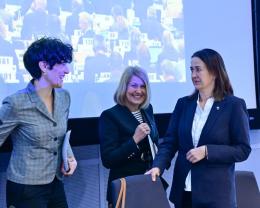
According to an EESC opinion adopted at the January plenary, the EU key funding instrument should be reinforced with EUR 20 billion to make the implementation of cross-border investments in energy and transport a reality. This is essential to urgently strengthen the EU’s resilience and increase security.

According to an EESC opinion adopted at the January plenary, the EU key funding instrument should be reinforced with EUR 20 billion to make the implementation of cross-border investments in energy and transport a reality. This is essential to urgently strengthen the EU’s resilience and increase security.

The opinion, drafted by Mateusz Szymański and Tomas Arvidsson, underlines that the funding planned for energy and transport in the new Connecting Europe Facility (CEF) is insufficient and should be increased to at least EUR 100 billion for the period 2028-2034.

In addition, the EESC points out that the CEF programme should prioritise investments in regions with significant infrastructure gaps both in transport and energy. The objective is to ensure territorial cohesion and full use of the single market.

In order to ensure equal access, transparency and predictability of the CEF programme, the new legislation should clarify which projects will be prioritised. On this matter, the Committee recommends introducing eligibility criteria which highlight projects enabling the urgent development of the EU’s capacity to build resilience and preparedness against threats, including from hostile countries.

CEF funding should be granted to projects which fulfil social and environmental criteria and create added value for the European Union. For geopolitical reasons, the EESC views shorter supply chains as a sensible goal to pursue. (mp)

The European Economic and Social Committee (EESC) hosted a debate on how Europe can maintain its industrial edge amid rising energy costs, fragile supply chains and the rapid expansion of artificial intelligence.

The European Economic and Social Committee (EESC) hosted a debate on how Europe can maintain its industrial edge amid rising energy costs, fragile supply chains and the rapid expansion of artificial intelligence.

The debate was organised by the EESC’s Consultative Commission on Industrial Change (CCMI), which examines how industrial transformation is reshaping Europe’s economy, jobs and communities. As its president Alain Coheur explained, the CCMI aims to act as a ‘laboratory for strategic foresight’, developing practical proposals to help European industry adapt to ongoing change.

EESC President, Séamus Boland, highlighted the stakes: ‘In these times of industrial change, geopolitical upheaval and shrinking civic space, the CCMI’s foresight mission has never been more vital’.

Former European Commissioner for Jobs and Social Rights, Nicolas Schmit, said that Europe must be ready for economic, technological and geopolitical disruptions, and be deliberate in its investment choices. ‘Europe is operating in a world of uncertainty, where old assumptions no longer hold’, Mr Schmit said. ‘Industrial policy can no longer be business as usual. It must combine investment, innovation and quality jobs, if Europe wants to remain competitive and protect its social model’.

Mr Schmit also cautioned against reading Europe’s competitiveness gap solely through comparisons with the US, noting that their headline productivity figures are heavily shaped by the dominance of a small number of technology giants and do not necessarily reflect a more balanced or resilient economic model.

Digitalisation and AI featured prominently in the discussion, with speakers stressing that innovation without parallel investment in skills and fair working conditions risks widening social and economic gaps. The main takeaway was clear: Europe’s competitiveness has become one of the EU’s most urgent economic challenges, demanding long-term strategies rather than short-term fixes.

The proposals discussed will feed directly into the EESC’s work in the coming months, informing EU decisions on industrial policy, competitiveness, and jobs. (gb)

EU Life Science Strategy and Research and Tech Infrastructures Rare Diseases Focus

Document Type
AS

Energy connectivity, electricity grids

Document Type
AS

Proposal for a DIRECTIVE OF THE EUROPEAN PARLIAMENT AND OF THE COUNCIL amending Directive 2007/2/EC as regards simplification of certain requirements for the establishment of the Infrastructure for Spatial Information in the Union

Download — COM985-2025_PART1_EXT — (NAT/0978)
RAICES: Preserving Tradition, Driving Innovation
-
VMA22
Presentation by
Iani Ivanov
Organisation
Permanent Representation of Bulgaria to the EU
  • Ivanov - Bulgarian euro debate
Statement by
Martin Bijsterbosch
Organisation
European Central Bank
  • Bijsterbosch - Bulgarian Euro debate
Presentation by
Paul Kutos, Director
Organisation
DG Economic and Financial Affairs | European Commission
  • Kutos - Bulgarian Euro debate