As Europe faces a rapidly evolving geopolitical landscape, a key question arises: how can the European Union ensure its security in an increasingly uncertain world? In the opinion Defence funding in the EU, the EESC presents a comprehensive roadmap to strengthen the EU’s security and prepare for both current and future challenges.
As Europe faces a rapidly evolving geopolitical landscape, a key question arises: how can the European Union ensure its security in an increasingly uncertain world? In the opinion Defence funding in the EU, the EESC presents a comprehensive roadmap to strengthen the EU’s security and prepare for both current and future challenges.
This opinion arrives at a time when security threats are escalating. At the heart of the EESC’s stance is a call for a unified and robust EU defence funding mechanism. The current funding structures are inadequate, and change is necessary. Without a more coordinated approach to defence funding, the EU risks falling behind in protecting its interests. Among the concerns mentioned in the opinion is the fact that '78% of the EUR 75 billion spent by EU countries on defence procurement went to non-EU suppliers', as stated in the Commission's report The future of European competitiveness. This growing dependence on external providers cannot be ignored.
However, it is not just about spending more—it is about spending wisely and efficiently. The EESC recommends strengthening EU-NATO coordination, increasing funding for initiatives like the European Defence Fund (EDF) and the European Peace Facility (EPF), and focusing on joint acquisitions to streamline resources and reduce costs. Moreover, the EESC advocates for European NATO members to commit at least 2.5% of their GDP to defence, a step that would strengthen Europe’s response to current geopolitical threats. This higher spending target ensures that NATO’s European members contribute more effectively to collective security, while retaining full sovereignty over their armed forces.
Furthermore, initiatives such as the Act in Support of Ammunition Production (ASAP) and the European Defence Industry Reinforcement through Common Procurement Act (EDIRPA) are essential in strengthening the EU’s defence capabilities. These efforts will allow Europe to pool resources effectively, ensuring both military and civil preparedness.
Technological advancements, including artificial intelligence, drones and cybersecurity, are becoming increasingly vital to national security. The EESC stresses the importance of investing in these areas to stay ahead of emerging threats. Public-private sector collaboration is key to driving innovation, particularly in AI, drones and cybersecurity systems.
The opinion also calls for a resilient European defence-industrial ecosystem, encouraging stronger cooperation between enterprises, SMEs and governments. Fostering innovation and ensuring Europe remains competitive will reduce reliance on external suppliers, building a more self-sufficient defence industry.
Furthermore, we should not forget about regional initiatives within the EU. Strengthening regional collaborations will help tailor defence strategies to address the specific security challenges faced by different Member States. This approach ensures that regional concerns are adequately addressed within the broader EU framework.
Strengthening the EU’s defence is not just about security—it is about upholding EU values. We believe that by following the roadmap outlined in our opinion, the EU can secure its future and safeguard its peace and economic interests.
EESC member Marcin Nowacki, rapporteur of the opinionDefence funding in the EU, lists the EESC's recommendations for strengthening the EU's security. With security threats rising and alliances shifting, the EESC is calling for a unified and robust EU defence mechanism. Europe can no longer rely so heavily on non-EU arms suppliers, as is currently the case. But it is not just about spending more—it is about spending wisely and efficiently.
EESC member Marcin Nowacki, rapporteur of the opinion Defence funding in the EU, lists the EESC's recommendations for strengthening the EU's security. With security threats rising and alliances shifting, the EESC is calling for a unified and robust EU defence mechanism. Europe can no longer rely so heavily on non-EU arms suppliers, as is currently the case. But it is not just about spending more—it is about spending wisely and efficiently.
The ReArm Europe plan was presented by European Commission President Ursula von der Leyen and endorsed by the 27 Member States at a special summit on 6 March. It contains five main proposals; they are certainly interesting, but also worthy of further discussion.
The ReArm Europe plan was presented by European Commission President Ursula von der Leyen and endorsed by the 27 Member States at a special summit on 6 March. It contains five main proposals; they are certainly interesting, but also worthy of further discussion.
The first proposal is flexibility in the Stability and Growth Pact.
The Commission is proposing to activate the escape clause of the Stability and Growth Pact, which would allow Member States to increase defence spending by 1.5% of GDP without risking the opening of an excessive deficit procedure. The expected savings? ‘Close to EUR 650 billion’ over four years. Europe needs to ‘significantly step up its defence spending’, argues Ursula von der Leyen.
The second proposal is a new defence lending instrument.
This instrument would be worth EUR 150 billion, financed through loans from the EU budget under a system similar to macro-financial assistance. It is intended to be used in priority areas where there are serious shortcomings: air and missile defence (the German European Sky Shield initiative), artillery systems, missiles and ammunition, drones and anti-drone systems, strategic enablers, critical infrastructure protection (including in relation to space), military mobility, cyber, artificial intelligence and electronic warfare.
To speed up the process, the Commission proposes to use Article 122 of the Treaty: used in exceptional circumstances, this simply requires the agreement of the Member States within the Council of the EU, with the European Parliament just being informed. That is a circumvention of the democratic process that could be disputed. The plan to bolster Europe’s defence was endorsed at the Versailles summit in March 2022 – three years ago! It seems difficult to justify calling this ‘urgent’.
The third proposal is to dip into regional funds.
In the short term, the Commission insists, the European Union ‘can do more’ with the European budget by redeploying funds from certain budget headings. It proposes giving the Member States the option ‘to use cohesion policy programmes to increase defence spending’, and wants to ‘facilitate the process for voluntary transfers to other EU funds with a defence objective’.
This represents a major cut in the current multiannual budget plan (2021-2027). The question is: should we sacrifice social or regional cohesion for the sake of defence? It’s up for debate.
At the same time, the STEP platform for strategic technologies could be further mobilised by extending it to all technologies in the defence sector. Another possibility, according to the Commission, is relaxing existing restrictions, such as competition rules or pre-financing and co-financing rules.
The fourth proposal is EIB loans.
The European Investment Bank (EIB) and its shareholders (the Member States) have repeatedly voiced their opposition to any further move towards lending to the purely military sector, preferring the dual sector. The Commission is therefore insisting on changing the EIB’s policy.
The fifth proposal is mobilising private capital.
The aim is to give defence companies ‘the best possible access to capital, to finance’ – a recurring problem for the industry. This idea should be included in the communication on a ‘Savings and Investment Union’.
Our surprise guest is Nicolas Gros-Verheyde, a journalist, author and expert in defence and foreign politics. He breaks down the five proposals of the ReArm Europe plan, recently presented by the European Commission to beef up European defence amid rising concerns about the US commitment to the European security.
Our surprise guest is Nicolas Gros-Verheyde, a journalist, author and expert in defence and foreign politics. He breaks down the five proposals of the ReArm Europe plan, recently presented by the European Commission to beef up European defence amid rising concerns about the US commitment to the European security.
Nicolas Gros-Verheyde has been a journalist since 1989. He worked for Ouest France, ARTE, LCI and France Culture as EU and NATO correspondent. He is known and respected in European circles for his extensive knowledge of European affairs and foreign and defence policy. He is editorial director of B2, which was founded in 2008 and is the leading and most comprehensive media outlet on European defence and diplomacy. It is managed by a non-profit association in the form of a cooperative of journalists, and funded by subscriptions.
Author of the books Défense européenne à l'heure de la guerre en Ukraine, La politique européenne de sécurité et de défense commune. Parce que l'Europe vaut bien une défense, and Europe de la défense, and political news pundit on LN24, France-Info and RTBF.
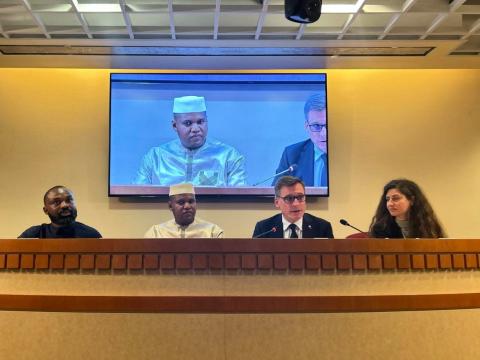
On the occasion of the 69th session of the United Nations Commission on the Status of Women (CSW69) in New York, the European Economic and Social Committee (EESC) and the African Union Economic, Social and Cultural Council (AU ECOSOCC) reaffirmed their unwavering commitment to advancing gender equality and women’s empowerment.
On the occasion of the 69th session of the United Nations Commission on the Status of Women (CSW69) in New York, the European Economic and Social Committee (EESC) and the African Union Economic, Social and Cultural Council (AU ECOSOCC) reaffirmed their unwavering commitment to advancing gender equality and women’s empowerment.
As the international community marks 30 years since the adoption of the Beijing Declaration and the Platform for Action, the EESC and AU ECOSOCC acknowledge both the progress achieved and the ongoing challenges that continue to hinder full gender equality.
Their second joint declaration highlights key priorities, including increasing women’s leadership through gender quotas, ending gender-based violence via international conventions, bridging the digital gender divide, and promoting women’s economic empowerment.
The declaration urges stronger policies on unpaid care work, women’s inclusion in peace efforts, and data-driven policy-making. It also emphasises global cooperation to dismantle systemic inequalities and uphold women’s rights. The EESC also calls on the EU to combat gender-based violence, ensure gender parity, and defend civil society’s role in advancing equality.
EESC president Oliver Röpke, said:‘As we commemorate 30 years since the Beijing Declaration, we must turn words into action. Gender equality is not a privilege but a fundamental right, and its achievement is critical for sustainable and inclusive societies. The EESC stands firm in its commitment to breaking barriers, ensuring women’s full participation in decision-making and fostering economic empowerment. Now is the time for governments, institutions and civil society to act decisively – there is no equality without accountability.’
The Commission on the Status of Women is the main international and intergovernmental body fighting for gender equality. This was the second time that the EESC took part in the UN’s largest annual gathering on women’s empowerment. (tk)
by Andris GOBIŅŠ (LV), Member, Civil Society Organisations’ Group - President, European Movement in Latvia (EKL)
In today’s turbulent times, including those in US policy, that title might sound somewhat strange, but in fact Ukraine’s candidacy for EU membership is an opportunity for – and obligation on – us in the EU to grasp, if we ourselves do not want to experience severe suffering like the people living in Ukraine. ...