The EESC issues between 160 and 190 opinions, evaluation and information reports a year.
It also organises several annual initiatives and events with a focus on civil society and citizens’ participation such as the Civil Society Prize, the Civil Society Days, the Your Europe, Your Say youth plenary and the ECI Day.
Here you can find news and information about the EESC'swork, including its social media accounts, the EESC Info newsletter, photo galleries and videos.
The EESC brings together representatives from all areas of organised civil society, who give their independent advice on EU policies and legislation. The EESC's326 Members are organised into three groups: Employers, Workers and Various Interests.
The EESC has six sections, specialising in concrete topics of relevance to the citizens of the European Union, ranging from social to economic affairs, energy, environment, external relations or the internal market.
EESC President Séamus Boland reflects on his first 100 days in office and outlines his priorities for 2026. His vision is of a Union of opportunities, security and resilience, grounded in strong civil society. The early months of his mandate have convinced him that civil society must be central to shaping Europe’s future.
President Boland warns that in the drive for competitiveness, defence and security, the EU must not lose sight of its values or social model. Exclusion, shrinking civic space and growing economic divides risk undermining democracy and fuelling extremism. Listening to workers, small businesses and communities is therefore essential to building effective and legitimate policies.
In his first months, he has met the Presidents of the European Council and Parliament, Commissioners, MEPs, ministers and ambassadors, and visited the Baltic countries to demonstrate solidarity. A private audience with Pope Leo XIV underscored shared concerns on poverty, dignity and defending democratic space. These discussions have made clear that competitiveness and security must be underpinned by strong social policies.
For 2026, sustainable competitiveness will remain a core priority. This includes tackling affordable housing, promoting a unified energy market, improving gender equality in the labour market, and ensuring AI development remains human‑centred. The EESC will contribute to the EU’s anti‑poverty strategy and host a high‑level conference in October.
The mental health of young people will be highlighted through a dedicated plenary debate, while the Youth Test will continue ensuring policies consider future generations. Enlargement will stay central, particularly through the Enlargement Candidate Members mechanism, which strengthens the accession process by involving civil society directly.
Throughout 2026, President Boland will continue to defend democracy, human rights and civic space – essential pillars of peace and stability – and ensure the voices of ordinary citizens reach the heart of Europe.(lm)
By Dr. Guillaume Lafortune, Vice President and Head of the Paris Office of the UN Sustainable Development Solutions Network (SDSN)
The SDGs are not being achieved – neither in Europe nor globally. This is not because the goals and targets set in 2015 were poorly designed or impossible to reach, but largely due to failures in global and national governance systems.
The Doomsday Clock of the Bulletin of the Atomic Scientists – which tracks humanity’s proximity to self‑annihilation through nuclear war, climate change, biological events, and disruptive technologies – was updated in January 2026 to 85 seconds before midnight, the closest point since its creation after World War II. The inability to prevent, manage, and resolve geopolitical crises in a timely and effective manner remains a major obstacle to advancing the long-term sustainable development agenda agreed upon a decade ago.
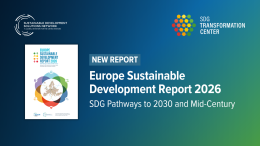
In Europe, the latest edition of the Europe Sustainable Development Report (ESDR), prepared in collaboration with the EESC and released on 26 February 2026, shows that SDG progress has stalled. Many environmental and social indicators are stagnating or even moving in the wrong direction. Finland tops this year’s SDG Index for Europe, followed by Sweden, Denmark, Austria, and Norway. Yet none of these countries are on track to meet all the goals and all face significant challenges in environmental areas, particularly regarding international spillovers, and in implementing the SDGs’ ‘Leave No One Behind’ principle. Some socio‑economic indicators, such as material deprivation, have worsened. Trust in government remains low in France, Germany, and the United Kingdom and is generally below pre‑2022 levels.
At the EU level, attention to the SDGs has decreased. The European Commission’s Work Programmes for 2025 and 2026 no longer explicitly reference the SDGs or the 2030 Agenda. Since the escalation of the war in Ukraine in 2022, the Commission’s narrative has shifted toward strategic autonomy, simplification, defence, and competitiveness. It is increasingly unclear whether the European Green Deal, adopted in 2019 as Europe’s growth strategy and long-term commitment to climate neutrality, still serves as a coherent guiding framework.
Meanwhile, most UN member states remain committed to sustainable development and the Paris Agreement. Of the 193 UN member states, 190 have submitted Voluntary National Reviews (VNRs). The majority supported the June 2025 Seville Commitment on financing for sustainable development. Globally, cities and regions are also accelerating action through Voluntary Local Reviews (VLRs).
What is often called the ‘Global South’ is, demographically and politically, the ‘Global Majority’, the majority of the world’s population and countries that continue to support the SDGs. The United States stands out as a notable exception. It has not submitted a national sustainable development plan, has openly opposed the SDGs at the federal level, withdrew from the Seville negotiations in 2025, and exited 66 UN organizations in January 2026. Although the US wields major global influence, it represents less than 5% of the world’s population.
As Europe reassesses its alliances in a more multipolar world, the SDGs offer a common language that supports Europe’s strategic interests at home and abroad. For example, reducing dependence on fossil fuels by investing in renewable and clean energy strengthens European autonomy and security.
Since 2019, SDSN and its partners have been advancing the concept of SDG/Green Deal Diplomacy as a framework for strengthening strategic partnerships with Africa, China, India, Latin America, Eurasia, and other regions. Europe holds significant advantages, including a large single market, a well‑educated population, and substantial savings. These could be mobilised to scale up investments in digital and green technologies—provided Europe can overcome persistent fragmentation in its capital markets.
To reinforce its global role, the EU must articulate a clear, coherent voice and translate it into consistent international action. This requires demonstrating unwavering support for UN‑based multilateralism, including the systematic condemnation of violations of international law covering all wars of choice and all covert or overt regime‑change operations prohibited under the UN Charter. Article 2(4) clearly states that the use of force or threat of force against the territorial integrity of a state is illegal.
In a fragmented multilateral landscape, the SDGs provide a pathway for Europe and other medium‑sized economies seeking balanced development, global cooperation, and a rules‑based international trading system. Europe could reaffirm its commitment through a joint declaration by the Council, Parliament, and Commission similar to the early years of SDG implementation. The EU could also commit to presenting a second Union‑wide Voluntary Review by July 2027, ahead of the September 2027 SDG Summit. This review could address the challenges highlighted in the seventh ESDR, including international spillovers, environmental sustainability, and socio‑economic convergence, while outlining a clear vision and concrete proposals for an ambitious post‑2030 sustainable development framework.
As the world’s largest network of scientists and researchers dedicated to the SDGs, the SDSN stands ready to support European leadership in advancing sustainable development domestically and internationally by 2030 and beyond.
Dr Guillaume Lafortune Vice President and Head of the Paris Office, UN Sustainable Development Solutions Network (SDSN)
In today’s environment of geo-economic competition, rising protectionism and multiple security risks, the European Semester must focus on clarity of priorities and on the credibility of country-specific recommendations, especially those that remove barriers to growth. In other words, it should support Member States in shaping a predictable, business-friendly environment that boosts productivity and employment, with a view of a strong European economy capable of sustaining the European social model and safeguarding the Union’s resilience and international influence.