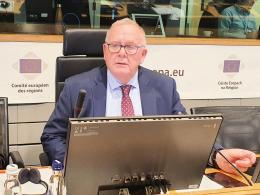
On 4 December, the Civil Society Organisations' Group of the European Economic and Social Committee has elected Séamus Boland as its designated candidate for the next EESC Presidency. At the first meeting of the renewed EESC in October 2025, the entire EESC assembly will be called upon to elect its president for the term 2025-2028.
Take part in the dialogue on key issues shaping Europe's future. On the agenda: the priorities of the upcoming presidency of the Council of the European Union; democracy in Africa, the current situation and future perspective; EESC Housing Forum linked to our opinion on social housing in the EU; the International Day of Persons with Disabilities and celebration of the Olympic spirit. Throughout the plenary, our members will also be voting on opinions covering a wide range of topics like water politics, the just transition, the cost of non-Schengen for Bulgaria and Romania's Single Market integration, among others.
The 11th meeting of the EU Domestic Advisory Group (DAG) under the EU-Vietnam FTA took place on 4 December 2024. The objective of the meeting was to follow up on the Joint Forum and plan the work of the DAG forward.
The opinion focuses on the legislative proposal for the establishment of a single digital declaration portal for companies providing services and temporarily sending workers to another Member State, known as ‘posted workers'.
Oliver Röpke, President of the European Economic and Social Committee, Dimitris Dimitriades, President of the EESC's Section for External Relations, EESC Fundamental Rights and Rule of Law Group Presidency
Organisation
European Economic and Social Committee (EESC)
The European Economic and Social Committee (EESC) is deeply concerned about the draft law submitted to the Serbian Parliament on 29 November 2024, proposing the establishment of a registry for "agents of foreign influence". The proposed legislation would require organisations receiving foreign funding to register with the Ministry of Justice as “foreign agents”, imposing severe penalties for non-compliance.
The conference on disinformation, held by the European Economic and Social Committee (EESC), showcased that a horizontal approach leveraging on citizens in the fight against disinformation is moving in the right direction. The participants also pointed out that regional press can be a role model for big media platforms to rebuild the trust lost with their audiences.