The European Economic and Social Committee (EESC), as the institutional partner of civil society, proudly returns with the second edition of Civil Society Week!
The European Economic and Social Committee (EESC), as the institutional partner of civil society, proudly returns with the second edition of Civil Society Week!
By Stefano Mallia, EESC Employers' Group President
"Unlocking Competitiveness for Shared Prosperity" is the core objective of our Group's newly adopted priorities.
In the face of current global challenges, prioritising competitiveness and creating a business-friendly environment must be at the forefront of the political agenda, supported by concrete policy actions.
In a business-friendly EU, competitiveness is based on excellence and sound competition instead of subsidies or protectionism, and businesses have competitive access to all necessary production resources.A business-friendly EU also means having a regulation that is conducive to business and productivity, where the administrative burden is minimised, and wherethe Single Market is fully functioning. In addition, solid trust between enterprises and policymakers is key to attracting investment, just as it is necessary to safeguard the interests of EU businesses in relation to international competitors.
This is why we are calling for 10 sets of business-friendly policy actions as top priorities:
Radical reform of the regulatory approach
Productive Innovation Systems focusing on investment and innovation
High Technological Capacity in defence, security and the green transition and support for technology start-ups
Strong Industrial Base
Integrated Financial Markets by developing the Capital Markets Union and the Banking Union
Adequate Access to Labour
Effective Energy and Transport Systems
Equal Trading Conditions
Business-oriented Green Transition
Efficient Public Finances
These actions are urgent if we want to harness the positive impact of competitive businesses on a robust economy and a globally influential EU.
The Letta and Draghi's reports were a wake-up call: either the EU restores its competitiveness, or it may face difficult trade-offs on welfare, environmental standards and core freedoms.
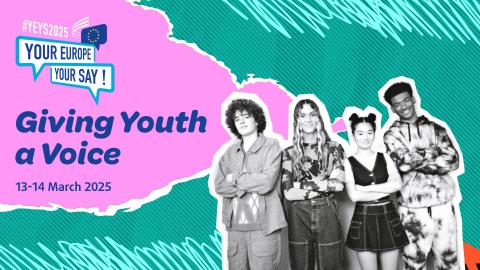
For this year's Your Europe, Your Say (YEYS), the EESC has received hundreds of applications from secondary schools across the EU, the candidate countries and the UK.
For this year's Your Europe, Your Say (YEYS), the EESC has received hundreds of applications from secondary schools across the EU, the candidate countries and the UK.
The YEYS organisers carefully examined and assessed all the applications, selecting 36 secondary schools which will take part in YEYS 2025 on 13 and 14 March!
YEYS, which is the EESC's flagship annual youth event, will this year bring together nearly 100 students and 37 teachers. To be held under the title "Giving Youth a Voice" and taking place over 1.5 days, YEYS will focus on the role young people can play in shaping a resilient future. It aims to empower them to take part in civic action and actively contribute to participatory democracy, both in their communities and beyond.
As the EESC prepares to welcome all the YEYS participants, EESC members will visit the selected schools in early 2025 to meet and exchange with them ahead of the main event.
The opening and closing sessions on 14 March 2025 will be live streamed. The link to watch will be published on the EESC website, on the YEYS 2025 official webpage Your Europe, Your Say! 2025 | EESC, where you can also find more information and updates about the event.
Directed by Latvian filmmaker Gints Zilbalodis, this critically-acclaimed animated film is a co-production between Latvia, France and Belgium. It has garnered global recognition, winning the Golden Globe Award for the Best Animated Feature and top prizes at festivals such as the Annecy International Animation Film Festival, the New York Film Critics Circle Awards and the European Film Awards.
Follow the journey of Cat, a solitary survivor of a post-apocalyptic flood, as he navigates a new reality and learns to collaborate with fellow animals on a lifeboat.
The event is part of the EESC's ongoing film screening series, organised in partnership with the European Parliament's LUX Audience Award, with the goal of promoting cultural diversity and sparking dialogue on pressing social issues.
Thousands of copies of the latest edition of the EESC´s popular brochure, European Democracy Passport, are nowbeing distributed across Europe. You might be wondering if the European Democracy Passport is also available in electronic format. The answer is yes!
Thousands of copies of the latest edition of the EESC´s popular brochure, European Democracy Passport, are nowbeing distributed across Europe. You might be wondering if the European Democracy Passport is also available in electronic format. The answer is yes!
The interactive online version, featuring videos, quizzes, maps and much more, is already available in 13 languages, with additional language versions in the pipeline! Check it out and discover how you can truly make a difference!
On the occasion of the 20th anniversary of the EESC's Liaison Group, the founders and current members of the Group called for active steps to defend European democracy, open public space and a just Europe.
On the occasion of the 20th anniversary of the EESC's Liaison Group, the founders and current members of the Group called for active steps to defend European democracy, open public space and a just Europe.
On 11 December, the European Economic and Social Committee (EESC) hosted the 20th anniversary of its Liaison Group with European civil society networks, the only permanent body for political dialogue and structured cooperation between civil society organisations (CSOs) and the EU institutions. Over its two decades of existence, the Liaison Group has played a major role in amplifying the voice of organised civil society and bringing its concerns to the European agenda. The group comprises 45 civil society networks active at European level, fully embodying the principles enshrined in Article 11 of the Treaty.
'As we celebrate 20 years of the EESC Liaison Group, we honour not only its remarkable achievements but also the enduring partnerships that have shaped participatory democracy in Europe. Over two decades, the Liaison Group has grown into a vibrant platform, amplifying civil society voices and fostering collaboration between diverse stakeholders. As we look to the future, let us continue to stand together to strengthen democratic values, expand civic space, and create a Europe that truly serves all its people,' said EESC President Oliver Röpke in his opening address.
'Our journey has not been easy,' explained Brikena Xhomaqi, Co-chair of the Liaison Group, 'but we have learned to trust each other. And I hope we will strengthen our cooperation to fight together for a coherent European civil society strategy'.
In her keynote speech, Katarina Barley, Vice-President of the European Parliament, responsible for relations with civil society organisations declared that 'As the European Parliament, we are ready to strengthen our cooperation with the Liaison Group. We need increasingly structured cooperation with civil society organisations. Together, we must do more to counter the threats to democracy in the European Union, which are greater than at any time in the EU's history,' adding that, when it came to the Liaison Group, 'If it didn't exist, it would have to be created.'
The vibrant event marking the 20th anniversary of the Liaison Group was attended by more than one hundred invitees, including several key figures of the civil society sector. They included representatives of civil society organisations from Serbia and Moldova, in line with the EESC's policy of inviting representatives of EU candidate countries to participate in its work. Also in attendance were four former presidents of the EESC, Staffan Nilsson, Henri Malosse, Luca Jahier and George Dassis. Mr Jahier emphasised that the EESC has the responsibility to establish and maintain a platform for civil dialogue, while Mr Dassis stated that 'the main thing is to have peace, and to achieve peace we must be strong and stand together.'
Were you unable to attend? Catch up with the recording of the event, the joint statement by the Liaison Group presidency, the wrap-up video, pictures and press release on the event page here. (lm)
The European Economic and Social Committee’s latest publication features a series of 11 stories about its recent achievements.
They show how the EESC has worked to ensure that key economic and social issues, identified by social partners and civil society, are discussed and addressed at European level.
These stories also demonstrate how, through its consultative work, the EESC influences EU legislation and monitors that it is properly implemented.