Phasing out fossil fuel subsidies while ensuring European competitiveness, mitigating the cost-of-living crisis, and promoting a just transition

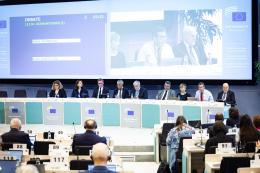
On Friday, 24 January 2025, from 09:30 to 11:30 (CET), the European Economic and Social Committee will host a public hearing on the topic of Phasing out fossil fuel subsidies while ensuring European competitiveness, mitigating the cost-of-living crisis, and promoting a just transition.

23 January 2025

Screening of Flow, a contender for the 2025 LUX European Audience Film Award

3 February 2025

Social justice in the digital era

18 February 2025

Road to the Global Disability Summit: For disability-inclusive development and humanitarian action

26-27 February 2025

EESC plenary session

23 January 2025

Screening of Flow, a contender for the 2025 LUX European Audience Film Award

3 February 2025

Social justice in the digital era

18 February 2025

Road to the Global Disability Summit: For disability-inclusive development and humanitarian action

26-27 February 2025

EESC plenary session

Europe in the face of climate insecurity: Rethinking the protection of citizens – Partnership
-
VMA22

The EESC's Permanent Group on disability Rights is organising a hybrid public hearing on "Road to the Global Disability Summit: For a disability- inclusive development and humanitarian action" on 18 February 2025 from 9:30 am to 1 pm.

During the event, we will discuss with relevant stakeholders existing good practices as well as obstacles to guarantee the inclusion of disability rights in development cooperation and humanitarian action

By the EESC Workers' Group

Europe's industry is facing many different challenges, including extremely high energy prices, difficulty attracting skilled workforce and access to funding. In 2023, the EU put forward the Green Deal Industrial Plan, focused on achieving carbon neutrality. 

By the EESC Workers' Group

Europe's industry is facing many different challenges, including extremely high energy prices, difficulty attracting skilled workforce and access to funding. In 2023, the EU put forward the Green Deal Industrial Plan, focused on achieving carbon neutrality. In her presentation of political guidelines last autumn, President Ursula Von der Leyen mentioned a 'Clean Industrial Deal' for competitive industries and quality jobs, in the spirit of Draghi's report.

Industry is an essential part of the green and digital transitions, and of our economic system. But what does this new deal mean for workers? Having a strong, unionised workforce, well paid and with good working conditions, is not just a question of trade unions, but of society at large, democracy and social stability, and productivity of companies too.

Without proper guidance and sufficient public funding, this deal could end up relying on the parts of Draghi's report and competitiveness agenda that are most in favour of deregulation. This could jeopardise the European social model by promoting a harmful competition model that fuels a race to the bottom in wages and working conditions.

To address this concern, on 14 February, the EESC Workers' Group and the European Trade Union Confederation (ETUC) are organising a joint conference on the European industrial policy for quality jobs at the EESC premises. We welcome all parties interested in the discussion to mark their calendars and join the discussion. 

Copyright: CMEDIA CORPORATION

In December, the EESC held a screening of the film Under the Grey Sky, about Belarusian journalists who have paid a terrible personal price for reporting on political turmoil in their country


In December, the EESC held a screening of the film Under the Grey Sky, about Belarusian journalists who have paid a terrible personal price for reporting on political turmoil in their country

Under the Grey Sky, a debut feature film by Belarusian-Polish filmmaker Mara Tamkovich, tells the heartbreaking story of Lena, a Belarusian journalist who ends up in prison after livestreaming the government crackdown on peaceful demonstration at the Square of Changes in Minsk. The year is 2020 and an unprecedented wave of protests sweeps Belarus following the rigged elections which saw Aleksandr Lukashenko re-elected for the sixth time.

Lena and her camera operator Olya are arrested after they continue filming the protests despite being tracked down by a police drone. In a plot twist of Kafkaesque absurdity, Lena is first accused of ‘organising riots and disrupting public transport’ only to see her accusations changed into high treason. What was supposed to be a seven-day administrative detention turns into an eight-year prison sentence following a secret trial. Her colleague gets two years. Lena’s husband Ilya, himself harassed by the regime’s police, is desperately trying to get her out of jail, even trying to persuade Lena to plead guilty in exchange for freedom. But Lena cannot do it.

The film is inspired by the true story of Belarusian Belsat TV journalists Katsiaryna Andreyeva, her husband Ihar Iljash and her colleague Darya Chultsova. Whereas Darya completed her two-year sentence, Katsiaryna and Ihar are currently in prison, with her serving a prolonged prison sentence of eight years and three months. They are far from being the only ones: at the end of 2024, the Belarusian Association of Journalists put the number of media workers who are still behind bars at 45. Many face the pressure even after fleeing abroad.

The film had its world premiere at Tribeca festival in New York in June 2024.

On 13 December, Under the Grey Sky was screened at the European Economic and Social Committee (EESC) in the presence of Ms Tamkovich and as part of a seminar on the role of Belarusian independent media in fostering a resilient and democratising society.

EESC Info spoke with Ms Tamkovich about the film:

How accurately does the film follow the real-life events and fate of Katsiaryna Andreyeva? Did you use some actual footage from the 2020 protests and Ms Andreyeva’s case?

The actual footage is used in the film several times. The protest the characters are broadcasting at the beginning of the film was actually filmed by Ms Andreyeva and Ms Chultsova; those are the real images we have incorporated into an acted scene. The detention of Raman Bandarenka the characters see on their laptop also is real footage (op.ed. activist Raman Bandarenka was beaten to death by masked thugs after he tried to stop them from cutting down red and white ribbons symbolising Belarus’s flag before Soviet occupation). At the end of the film, as sort of an epilogue I show a montage of Katsiaryna’s livestreams from the protests.

The basic plotline is strongly connected to reality: the way the journalists were arrested and prosecuted and the punishments they got. But my goal was not to give an exact breakdown of events, but rather to provide the emotional truth of the choices people had to make and the painful choices they had to face. The characters have different names to put some distance between them and their real-life inspirations, but also to invite the audience to think about that story as one of many, as a metaphor for what had happened to the entire nation. 

Does the wider public in Belarus know what happened to Ms Andreyeva and other journalists like her? Do you know how many people suffered the same or a similar fate to hers?

Political arrests and repression have occurred on such a broad scale in Belarus that it is hard not to be aware of the situation. At least 130 000 people have suffered different forms of repression and around 500 000 left the country after 2020. It is simply too massive to be hidden.

The official count of political prisoners (those accused or convicted on criminal charges) in Belarus has held steady at around 1 300 people for the past several years, but you have to understand that hundreds if not thousands have already served their punishment, some have been granted earlier releases and a lot of newly convicted are afraid to claim political prisoner status. It is a factory chain of repression that is in constant motion, with new prisoners replacing those who are released. 

What was the main motivation for you to make this film? What are you hoping to achieve with it?

As a Belarusian I felt the urge to do something when the Belarusian regime brutally cracked down on the protest of 2020. As a former journalist I could strongly relate to the perspective of my characters. As a filmmaker I saw a strong, deeply moving story that I just had to tell. 

What do you hope a viewer will take away as the main message or emotion after watching your film?

I really hope people will think a bit about what freedom actually is, how much it can cost and whether they actually appreciate what they have. I do hope they think of Kacia and Ihar and every person who is behind bars, as freedom is something a lot of people here in Europe take for granted. 

What should the EU – its institutions, civil society, journalists’ and human rights associations and national governments – do to help?

I urge the EU not to forget about Belarus and not to write it off as a lost cause. The EU’s support is what allows our culture, our media and civil society to survive under this tremendous pressure and, although it might feel like a long-term investment, it will be worth it. (ll)


Minutes of the 223th meeting of the REX Section of 19 December 2024

Download — EESC-2024-04355-00-00-PV-TRA — (Minutes)