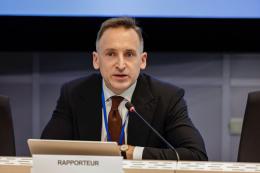
As Europe faces an increasingly volatile geopolitical landscape, the need for a strong, unified approach to defence funding has never been more urgent. In response to a request from the upcoming Polish Presidency of the Council of the EU and at a time of escalating security threats, the European Economic and Social Committee (EESC) has adopted an opinion calling for decisive action: strengthen EU defence through substantial investment in modern systems, deepen cooperation with NATO, and secure increased funding within the broader EU financial framework.
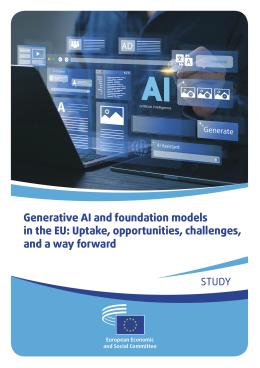
Exploring the evolving landscape of generative artificial intelligence (GenAI) within the European Union, this study delves into technological advancements, market dynamics, and regulatory challenges. It highlights the EU’s position in the global GenAI ecosystem, revealing significant US dominance, while uncovering sector-specific opportunities and risks across industries such as automotive, renewable energy, and education.
Cohesion policy has been key to European integration, fostering unity across the EU. As the post-2027 MFF develops, modernising it is crucial for efficiency, sustainability, and adaptability. The EESC urges a results-driven approach to ensure tangible benefits, reduce inequalities, and boost sustainable competitiveness.
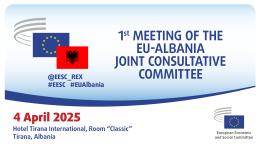
The first meeting of the EU-Albania Joint Consultative Committee (JCC) took place on 4 April 2025 in Tirana, Albania. This platform, established within the institutional framework of the EU-Albania Stabilisation and Association Agreement (SAA), will enable representatives from both the EU and Albanian civil society to monitor the country's accession negotiations, discuss issues of common interest, and highlight concerns to be addressed on Albanian's path towards the European Union.
emphasises the urgent need to enhance European competitiveness while maintaining sustainability and social cohesion. The EU must act decisively to stay competitive without compromising environmental sustainability, workers’ rights or regional balance. The EESC advocates for growth aligned with social and territorial cohesion;
calls for greater investment in key areas such as social infrastructure, digital transformation and energy transition. The EESC emphasises the need for substantial investments in modern infrastructure - education, research, digitalisation and renewables - to sustain Europe’s economic strength and competitiveness and tackle demographic, technological and climate challenges;
stresses the need for the EU to drive global economic transformation rather than just preserve past achievements. Europe is at a crossroads: it can either take a proactive role in global economic transformation or risk falling behind. The EESC therefore calls for the proactive adaptation of the single market, reduced reliance on non-EU supply chains and stronger strategic industries.