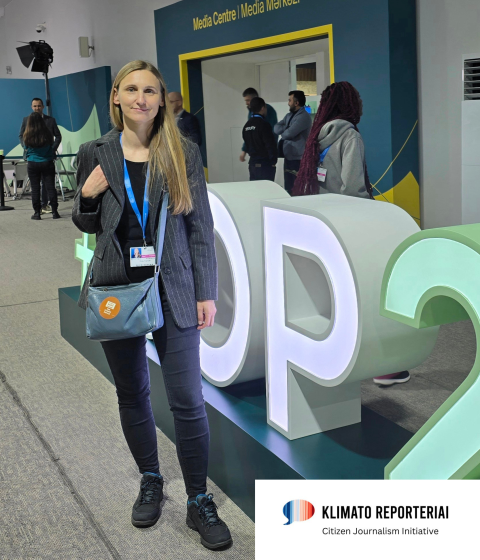
‘Climate Reporters’, Lithuania's brand-new climate news agency, aims to tackle fatigue in climate reporting and bring the topic of climate change back to the forefront of editorial agendas. In a shining example of citizen journalism, Climate Reporters combine communication and climate activism to educate people about climate change and give Mother Earth a voice during the environmental crisis.
‘Climate Reporters’, Lithuania's brand-new climate news agency, aims to tackle fatigue in climate reporting and bring the topic of climate change back to the forefront of editorial agendas. In a shining example of citizen journalism, Climate Reporters combine communication and climate activism to educate people about climate change and give Mother Earth a voice during the environmental crisis.
By Rūta Trainytė
The climate news agency ‘Climate Reporters’ started up this year in Lithuania. It is an initiative run by non-governmental organisations (NGOs) and an example of citizen journalism. The news agency aims to help journalists report on the various aspects of the environmental crisis. To that end, the agency’s team drafts texts and forwards them to editorial offices.
The agency’s work is carried out by a community of activists. The texts are written by journalists, public relations specialists, representatives of NGOs, activists and scientists – in short, people who care about what is happening and want social change. They also make up the board of ‘Climate Reporters’. The board ensures that the new initiative is trustworthy.
The ‘Climate Reporters’ are not new to the world of communication but have already gained considerable experience in public relations, in editing and in creating and maintaining web portals. Nor are we novices in climate issues. This is how the idea came about. We do what we do best and combine it with climate activism. We give Mother Earth a voice during this environmental crisis.
Of course, we are in contact with journalists. The dominant trend in editorial offices is to believe that climate news is not of interest to the public and does not generate clicks. They avoid publishing articles with headlines containing the terms ‘climate change’ or ‘climate crisis’. What does climate crisis denial mean? Is it a way to protect society from bad news and anxiety?
It might not be that bad. A vast amount of news floods editorial offices every day, which is physically difficult to process, even without producing climate-related news items. You also have to be familiar with the topic. This is where we come in. The next step that the ‘Climate Reporters’ are taking is to train journalists. We can see that journalists need to understand the issue to avoid spreading greenwashing.
Another idea is to teach certain groups about climate change in an attractive way. Above all, we want to reach out to young people, and we have realised that they respond well to humour. We are not sure yet what this will look like in the future, but we are already thinking in this direction.
The news agency has been operating for a good six months. We know from our own experience that we need patience. We persistently and purposefully knock on the doors of editorial offices with our news items. Our texts are already being published on major Lithuanian news portals, and we get invited onto radio shows.
To ensure that our editorial work is high-quality, it is very important that we receive considerable support from Lithuanian environmental organisations, that our organisations are members of international NGO networks, that our members participate in working groups at EU level and that they represent Lithuania in the EESC. This enables us to broaden our range of topics and stay up to date with current affairs.
Our connection with the EESC goes beyond the fact that one of the initiators of the project, Kęstutis Kupšys, is a member of the Committee. EESC members can share relevant experiences from their various countries to enrich the climate news published by ‘Climate Reporters’. In this regard, we recently spoke with EESC member from France Arnaud Schwartz on the fringes of the COP16 World Biodiversity Summit. The insights he shared with us directly from Cali led to a ‘Climate Reporters’ article. His thoughts were soon heard in the Lithuanian media. This model, whereby the expertise of EESC members is used to effectively communicate global news to local audiences, has proved its worth. We will therefore use it again in future.
Rūta Trainytė is the editor at the climate news agency ‘Climate Reporters’. The agency is part of the state-funded ŽALINK project. The project, which is run by the Consumer Alliance, the Development Cooperation Platform and the NGO ‘Circular Economy’, is funded by the Climate Change Programme of the Environmental Project Management Agency of the Republic of Lithuania’s Ministry of the Environment.
The winner of the Connecting EU 2024 photo competition is Martina Cikojević, editor and journalist at the Croatian Trade Union of Postal Workers. Her photo, Brussels Grand Place in the Moonlight, earned her a two-day stay in Brussels during the EESC's Civil Society Week in March 2025
The winner of the Connecting EU 2024 photo competition is Martina Cikojević, editor and journalist at the Croatian Trade Union of Postal Workers.
Her photo, Brussels Grand Place in the Moonlight, earned her a two-day stay in Brussels during the EESC's Civil Society Week in March 2025.
Ms Cikojević participated in Connecting EU 2024 seminar on 17 and 18 October in Brussels. The seminar brought together press and communication officers from EU civil society organisations as well as journalists. Held under the title A bastion of democracy: helping journalism survive and thrive, it focused on the unprecedented challenges journalists face in a world of rapidly evolving AI and mounting political pressures.
Participants also joined the networking session Working as a press or communication officer in the age of Instagram, TikTok and AI – how to get your message across which included two workshops. The photo competition was part of the workshop on Lessons on communication content, led by communication specialist Tom Moylan.
Ms Cikojević said her photo, showing the moon piercing through dark clouds and bringing light to the night, could also symbolically connect to the seminar's topic. No one can stop the moon from bringing light into darkness. Nobody should stop journalists from bringing the truth for a better, safer and fairer society, she said.
As the winner of the photo contest, Ms Cikojević will participate in the EESC’s second Civil Society Week, taking place from 17 to 21 March at the EESC's premises in Brussels. This year's topic is Strengthening Cohesion and Participation in Polarised Societies.
The EESC Press Unit congratulates Martina and thanks everyone who sent their photos.(ll)
In October, the EESC adopted an opinion proposing a fundamental rethink of how EU finances work. It called for more transparency and citizen participation across the EU, which would enhance democracy and public trust.
In October, the EESC adopted an opinion proposing a fundamental rethink of how EU finances work. It called for more transparency and citizen participation across the EU, which would enhance democracy and public trust.
To achieve this, the EESC recommended developing a common fiscal transparency framework, involving citizens in budgeting processes, and creating digital tools for clearer budget information.
'Just imagine being able to track every euro of EU funding – from Brussels through national governments down to your local community', said the rapporteur of the opinion, Elena Calistru.
In the EESC's view, a common framework for fiscal transparency will set clear and consistent standards for all EU-funded programs and ensure uniform reporting and easy access to financial data across Member States. The focus would be on promoting best practices rather than introducing new regulations.
Participatory budgeting would allow citizens to have a direct say in public spending decisions, particularly at local level, while incorporating participatory elements into EU-level budgeting processes.
The EESC called for a unified user-friendly digital platform offering real-time budget data, clear visualisations, and insights into how EU funds are delivering results. This would increase public understanding and engagement with financial information.
The EESC also stressed the importance of raising public awareness, ensuring stronger oversight, and aligning financial practices with EU goals such as cohesion and sustainability to foster cooperation and accountability.
'EU finances are not just about numbers. They are about trust and democracy and making Europe work for its citizens', Ms Calistru concluded. (tk)
As we confront the somber reality of 1000 days of relentless Russian aggression against Ukraine, and approach 4000 days since their occupation of Crimea, the European Economic and Social Committee reaffirms its unwavering solidarity with the Ukrainian people.
Social housing in the EU - decent, sustainable and affordable
Download — EESC opinion: Amendment - Forest reproductive material: ‘tested’ category, its labelling and the names of the authorities responsible for the approval and control of the production