How can the EU ensure that its industrial strategy brings tangible benefits for both businesses and citizens? EESC member Andres Barceló Delgado, rapporteur of the opinion on reindustralising Europe, gives the answers.
How can the EU ensure that its industrial strategy brings tangible benefits for both businesses and citizens? EESC member Andres Barceló Delgado, rapporteur of the opinion on reindustralising Europe, gives the answers.
The fragmentation of global supply chains directly impacts businesses and households through escalating costs and growing economic uncertainty.
Fragmented supply chains directly raise costs through increased tariffs, logistical disruptions and limited access to essential raw materials and intermediate goods. These issues affect sectors crucial for daily life, including pharmaceuticals, electronics and food production. Consumers ultimately bear these additional expenses, facing reduced purchasing power and restricted access to vital products. Moreover, these disruptions disproportionately affect lower-income households, exacerbating economic inequalities and social vulnerabilities across Europe.
It is essential to diversify supply chains to enhance economic resilience and maintain open trade channels. We must forge deeper economic partnerships with diverse global partners, particularly those aligned with Europe’s commitment to sustainable and equitable trade practices. Strengthening such relationships will reduce Europe’s vulnerability to single-source dependencies and external economic shocks.
Technological innovation must be the engine and the goal of all these efforts. Investing in advanced digital solutions, such as artificial intelligence and blockchain, can optimise supply chain efficiency, improve transparency and reduce operational costs. These technologies not only facilitate smoother trade operations but also bolster the competitive position of European industries globally.
Pursuing these objectives does not and must not mean renouncing sustainability. Aligning supply-chain strategies with sustainability objectives, such as supporting the circular economy and promoting local production networks, can further enhance long-term resilience and reduce environmental and social impacts.
Finally, regulatory simplification is essential. We need clear, effective rules that maintain robust protections for consumers, workers and the environment, and also enable European businesses, especially SMEs, to adapt swiftly and remain competitive amid global disruptions.
Disruptions in international trade networks contribute to the ongoing cost-of-living crisis affecting millions across Europe. Dimitris Dimitriadis, rapporteur of the opinion Fragmentation of supply chains and impact on the cost of living, lists the efforts that should be made to repair the broken supply flow. The opinion is part of a broader packageof EESC opinions that collectively address multiple facets of the cost-of-living crisis, offering comprehensive recommendations to European policymakers and civil society.
Disruptions in international trade networks contribute to the ongoing cost-of-living crisis affecting millions across Europe. Dimitris Dimitriadis, rapporteur of the opinion Fragmentation of supply chains and impact on the cost of living, lists the efforts that should be made to repair the broken supply flow. The opinion is part of a broader packageof EESC opinions that collectively address multiple facets of the cost-of-living crisis, offering comprehensive recommendations to European policymakers and civil society.
From the Sahel to Syria, from Gaza to Ukraine, the European Union is encircled by crises that continue to drive mass displacement. These are not distant emergencies and protracted crises – they are Europe’s front yard. For EU policymakers, the takeaway is clear: delivering aid to find solutions for populations on the move and investing in regions facing extreme fragility risks is not just a moral duty, it is a strategic imperative. And the next Multiannual Financial Framework (MFF) must reflect that.
From the Sahel to Syria, from Gaza to Ukraine, the European Union is encircled by crises that continue to drive mass displacement. These are not distant emergencies and protracted crises – they are Europe’s front yard. For EU policymakers, the takeaway is clear: delivering aid to find solutions for populations on the move and investing in regions facing extreme fragility risks is not just a moral duty, it is a strategic imperative. And the next Multiannual Financial Framework (MFF) must reflect that.
No less than 26 countries affected by these crises surrounding Europe are currently under acute strain – grappling with war, economic collapse, climate shocks and other aspects of fragility. Nearly half the world’s refugees live in or near these conflict and volatile zones. Nationals from these countries now account for one-third of asylum claims in the EU – and that’s without counting the 4.3 million Ukrainian refugees already residing in the Union.
Migration pressures are growing, and Europe’s response must evolve. The projected drop in global official development assistance – from €200 billion in 2024 to under €150 billion by 2026 – is, in this respect, a short-sighted decision. While security and business competitiveness rightly receive increased budgets, underinvesting in stability and resilience beyond EU borders is a political gamble Europe cannot afford. While some argue that assisting displaced communities and their hosts is a matter of values and solidarity, it is also fundamentally about Europe’s long-term stability and prosperity.
Managing population movements must begin long before people reach European borders. Deterrence at borders – whether through fences or legal hurdles – does not stop those fleeing bombs, persecution or desperation. If Europe wants migration that is orderly, predictable and manageable, it must engage upstream – addressing root causes such as poverty and armed violence; supporting and protecting internally displaced persons in their own country before they feel forced to cross a border; and, finding solutions for refugees in countries immediately neighbouring these hot spots.
This is not about idealism; it is about realpolitik. Aid policy should serve the Union’s geopolitical goals – reducing instability, strengthening economic and trade partnerships – and ultimately, preserving EU credibility on the global stage. Being a thought leader for which solidarity still means something, while ensuring benefits for its own people, is what sets it apart from other nations.
The EU’s swift and well-funded response to the war in Ukraine and the mass displacement it triggered – both internally and across its border – showed that the Union has learned key lessons from the 2015 Syria crisis. But the current scale, proximity and complexity of the belt of crises now unfolding around Europe demand an equally strategic and sustained response. Mounting security concerns and economic pressures make this even more urgent. EU Member States must meet the moment by equipping the Union with the necessary financial means to deliver on its ambitious but unavoidable goals. That begins with agreeing to an overall budget that exceeds the current 1% of Gross National Income (GNI), so that the EU can act decisively and sustainably in response to today’s realities.
This is why calculated, forward-looking decisions on the next MFF are so critical. UNHCR recommends concrete measures to ensure that investment to address forcible displacement is fully aligned with EU priorities:
Secure a minimum of €2.3 billion annually for humanitarian aid so that when crises emerge, one can immediately respond and stop the suffering.
Ring-fence at least 10% of the next international partnerships instrument for displacement and migration to stabilise people on the move closer to their home, especially in Mediterranean countries, before people feel forced to embark on dangerous journeys across the sea.
This is not only about spending more, but about spending with foresight – allocating resources in ways that reduce downstream costs of having to deal with a power vacuum, missed economic investment opportunities and increased populations on the move.
With adequate resources, third countries that host displaced people will meet their needs – offering solutions pending a return home. External aid geared towards refugees has often been an opportunity to develop public services and to create jobs for underserved local populations in host countries. Europe’s whole-of-route approach requires investments as early as possible – in countries of origin and of transit. The goal is not just to reduce movements for the sake of it, but to find durable solutions for those on the move. This will directly serve European interests of curbing irregular – or what most refer to as illegal – arrivals at its border. But it will also reduce the risk of people to fall prey to traffickers or embark on perilous journeys.
An integrated, well-resourced EU approach to forced displacement is not about philanthropy, it is about making an investment for Europe’s own future. When crises go unaddressed, they do not ‘just’ create human suffering. They destabilise regions and undermine trade and other partnerships. Having people compelled to move to Europe for their own safety are foreseeable outcomes of us having neglected situations earlier on.
At UNHCR, we have embraced the EU’s current pivot toward making aid more transactional and mobilising private capital for development through the Global Gateway initiative. We have long recognised that public finance must be used to mobilise private capital in providing sustainable responses to forced displacement. The Global Gateway can be transformative if displaced people and host communities are built into its design, not added as an afterthought.
The international system is evolving, and the housekeeping starts at home. With the Humanitarian Reset and UN80 on the horizon, we have a real opportunity to reform how aid is delivered against its promise – making it more efficient and effective at the same time. The EU is right to push for more accountability and better results. But without proper financial support, we will for sure fail on both counts.
The choices made in the next MFF will shape the Union’s ability to manage its borders humanely, safeguard its internal cohesion and be a partner of choice for third countries. External aid must remain a strategic priority. It is the foundation for a more stable and prosperous Europe.
UNHCR’s latest recommendations for the next MFF are available here.
An integrated, well-funded EU approach to forced displacement is not an act of philanthropy – it is an investment in Europe’s own future. With complex crises unfolding at its borders, Europe will need to come up with a bold and strategic response. As talks on the next EU budget begin, the choices made in the next multiannual financial framework (MFF) will shape the Union’s ability to manage its borders humanely, safeguard its internal cohesion and be a partner of choice for third countries, writes our surprise guest Jean-Nicolas Beuze, the UNHCR country representative to the EU.
An integrated, well-funded EU approach to forced displacement is not an act of philanthropy – it is an investment in Europe’s own future. With complex crises unfolding at its borders, Europe will need to come up with a bold and strategic response. As talks on the next EU budget begin, the choices made in the next multiannual financial framework (MFF) will shape the Union’s ability to manage its borders humanely, safeguard its internal cohesion and be a partner of choice for third countries, writes our surprise guest Jean-Nicolas Beuze, the UNHCR country representative to the EU.
Jean-Nicolas Beuze is the UNHCR country representative to the EU, Belgium, Ireland, Luxembourg, The Netherlands and Portugal, having previously served as country representative in Iraq, Yemen and Canada. He has over 27 years of experience working for the UN in the field and at the headquarters in the areas of human rights, peacekeeping and child protection.
Across Europe and around the world, water is becoming a defining issue of our time. Droughts, pollution, overuse and ageing infrastructure are placing our societies under mounting pressure. Yet despite the evidence, water still does not receive the strategic attention it so urgently needs.
Across Europe and around the world, water is becoming a defining issue of our time. Droughts, pollution, overuse and ageing infrastructure are placing our societies under mounting pressure. Yet despite the evidence, water still does not receive the strategic attention it so urgently needs.
The European Economic and Social Committee was the first EU institution to identify this gap, and responded with a call for an EU Blue Deal. Water is not simply an environmental concern. It is a cross-cutting issue that affects the economy, public health, agriculture, energy and long-term security. If water fails, all other systems will follow.
Since the launch of the EU Blue Deal, we have seen some encouraging movement. The European Commission is now preparing a water resilience strategy, and for the first time in history, we have a Commissioner for water policy. These are steps in the right direction, but the scale of the challenge demands much more.
Across the EU, vast volumes of water are still lost every day due to leaky and outdated networks. Many Member States lack the investments needed to modernise their infrastructure, and several key economic sectors – including many industries, agriculture and the energy sector – remain unprepared for a future defined by scarcity and volatility.
This is why we are calling for a Blue Transition Fund. It would serve as a unified financing mechanism to support the full range of water-related needs, upgrading infrastructure and ensuring access to water for all, deploying new technologies, boosting innovation, reskilling workers and helping regions and industries adapt. Water resilience must be a shared European priority, backed by serious, long-term investments, starting with the next multiannual EU budget.
Effective coordination is essential. No Member State can face this alone. Water crosses borders, and so too must our policies. We need stronger collaboration between the national, regional and EU levels, informed by civil society and based on clear, common objectives. Moreover, we urge the Commission to ensure that water considerations are integrated into all EU policies in a coherent manner. This view is also shared by the European Parliament, who, echoing our EU Blue Deal recommendations, calls on the EU to mainstream the water dimension into EU internal and external policies to ensure long-term water resilience, sustainability and security.
The EESC is also contributing to global discussions on the topic. Ahead of the UN Ocean Conference in Nice, we are working to highlight the interdependence between freshwater and marine ecosystems. These must no longer be addressed in isolation. The science is clear, and our governance models must catch up. We will also contribute to the 2026 UN Water Conference, where we expect the EU to lead with its new vision for water resilience, and with the strong involvement of employers, workers and civil society to ensure the success of the strategy on the ground.
Water is the foundation of everything we value: life, stability and prosperity. To ignore it is to gamble with the future. Europe must lead, and it must lead now.
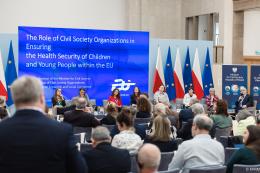
The topic of the conference, held on 15 May, was the mental and physical condition of young Europeans and the role of civil society organisations (CSOs) in supporting it. The event was organised in the framework of the Polish Presidency of the Council of the European Union, on the initiative of the Polish Minister for Civil Society, Adriana Porowska, and the Civil Society Organisations’ Group at the EESC.
The topic of the conference, held on 15 May, was the mental and physical condition of young Europeans and the role of civil society organisations (CSOs) in supporting it. The event was organised in the framework of the Polish Presidency of the Council of the European Union, on the initiative of the Polish Minister for Civil Society, Adriana Porowska, and the Civil Society Organisations’ Group at the EESC.
The conference welcomed representatives of Polish and other EU Member States’ civil society organisations, as well as scientists, practitioners and other stakeholders engaged in the broad field of child and youth development.
The event’s theme was directly aligned with the Polish Presidency’s overarching motto: security.
The goal of the meeting was to exchange experiences and raise awareness among EU and Member State decision-makers about the potential and role of CSOs in health-related activities for children and young people, including areas such as education, prevention, physical activity and early response to threats.
A panel addressed global issues such as environmental pollution and climate change, as well as societal challenges like childhood cancer.
“The unpredictability and volatility of new threats raise questions about society’s and administrations’ ability to protect their youngest [members] from harm and to provide them with optimal conditions for stable development”, Ms Porowska said before the event.
“We are witnessing the long-term effects of the pandemic and the war in Ukraine on our society – trauma, family separation and displacement. Many Polish families are suffering from poverty and extreme hardship. Each of these brings immense difficulties and consequences for the mental well-being of younger generations. In this context, we must also focus on digital security. Protecting children from harmful or fake content, including climate disinformation, is just as important as safeguarding their physical health”, emphasised Deputy Minister Marek Krawczyk, representing Ms Porowska at the conference.
“Health security must be a key strategic priority at European and national level. Investing in the well-being and health of children and young people, notably in their mental health, means investing in a sustainable future. Prevention, early intervention, education, social networks and community-based initiatives play a crucial role. This is why civil society organisations must be more involved in defining, evaluating and monitoring health security priorities. We all experienced the added value of their activities during the COVID-19 crisis, and the power of civil-society-driven innovations has been presented again here today,’ said Séamus Boland, President of the Civil Society Organisations’ Group at the EESC.
The topic of the conference, held on 15 May, was the mental and physical condition of young Europeans and the role of civil society organisations (CSOs) in supporting it. The event was organised in the framework of the Polish Presidency of the Council of the European Union, on the initiative of the Polish Minister for Civil Society, Adriana Porowska, and the Civil Society Organisations’ Group at the EESC.
The current cost-of-living crisis, worsened by recent events but with roots that go much further back, cannot be understood without looking at decent work – or more precisely, the absence of it. Decoupled from inflation almost everywhere, wages have not just stagnated but, in many cases, have actually decreased over time.
Cheap industrial mass production abroad, often carried out with complete disregard for labour, environmental or human rights, has enabled a relatively high level of consumption to coexist with this reality. In many European countries, a lack of savings, rising indebtedness and the inability of young people to move out of their parents’ homes have helped sustain these consumption levels among younger generations. Whether due to unemployment or poor working conditions, many have turned to platform work as either a supplementary income source or a way out.
As the EESC determined, platform jobs can indeed be flexible and worthwhile employment alternatives in certain situations. However, they must be clearly distinguished from genuine self-employment and require strong protection of workers’ rights, safeguards around data protection and access to management algorithms for social partners. The Workers’ Group also commissioned a study for the EESC, building on the idea of a comprehensive definition of worker and a presumption of an employment relationship.
The Platform Work Directive, once fully transposed, will mark another important step in the right direction. There are many reasons why this is important, but two stand out in particular: first, allowing working conditions to worsen in one sector will eventually affect others; and second, the absence of decent work, combined with the deepening cost-of-living crisis, is fuelling the fires of the populist far right, threatening the future of Europe and democracy itself.