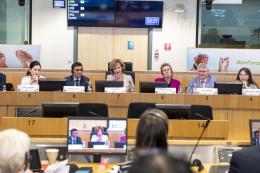
This proposal aims to postpone the application of certain reporting requirements under the Corporate Sustainability Reporting Directive (CSRD) and the transposition deadline and application of the Corporate Sustainability Due Diligence Directive (CSDDD). The objective is to simplify the reporting framework, reduce administrative burdens, and ensure a more proportionate approach to sustainability reporting and due diligence obligations.
Download — EESC opinion: Application and reporting deadlines/CSRD and CSDDD
More than 800 participants from citizens' organisations and stakeholders across Europe, including youth organisations, NGOs and journalists, are joining the Civil Society Week, held by the European Economic and Social Committee from 17-20 March 2025. The opening session signalled the protection of the civic space through legal action, reaffirming the key role of civil societies: hold power accountable, build bridges, support social resilience and give a voice to those who are too often ignored.
By Michal Pintér, delegate of the EESC’s Consultative Commission on Industrial Change (CCMI)
The recently unveiled Clean Industrial Deal (CID) acknowledges the strategic importance of energy-intensive industries for the EU economy and correctly identifies their key challenges. While it includes noteworthy ideas like green lead markets, circular economy support and funding for decarbonisation, the measures lack the necessary urgency and boldness to reverse the decline of Europe’s energy-intensive industries (EIIs).
By Michal Pintér, delegate of the EESC’s Consultative Commission on Industrial Change (CCMI)
The recently unveiled Clean Industrial Deal (CID) acknowledges the strategic importance of energy-intensive industries for the EU economy and correctly identifies their key challenges. While it includes noteworthy ideas like green lead markets, circular economy support and funding for decarbonisation, the measures lack the necessary urgency and boldness to reverse the decline of Europe’s energy-intensive industries (EIIs).
In its recently adopted opinion The future of EU energy-intensive industries (EIIs) in the face of high energy prices and transition costs, the European Economic and Social Committee recognised a significant competitiveness gap between EIIs in the EU and those of global competitors. The Commission has correctly named energy prices as the main culprit. However, the Deal and the Action Plan for Affordable Energy propose no reform of the electricity market design. Marginal pricing worked while the EU was benefitting from relatively cheap and stable piped gas from Russia. Unfortunately, the reality has changed, as we are now exposed to expensive and volatile LNG supplies, and likely will be for years to come. In spite of an increasing share of low-cost, fossil-free electricity in the EU energy mix, fossil fuel prices continue to set the tone for electricity price formation.
Policy efforts to increase renewable energy sources are welcome, but they do not lower electricity bills due to the current market design. Immediate measures are needed to transfer the cost benefits of renewable electricity to industries and assess all price mitigation options, including electricity price decoupling.
The Deal also recognises loopholes in the Carbon Border Adjustment Mechanism (no export solution, resource shuffling and circumvention) and trade protection instruments. However, it tells us regrettably little about how the EU market will be protected, leaving EIIs unsure in a global trade war.
The EESC urges the EU institutions to implement decisive measures in sector-specific action plans, in order to prevent further deindustrialisation and maintain the EU’s capacity for industrial transformation.
REWIND – Relaunching Enterprises through Workers' Innovation and New Dynamics