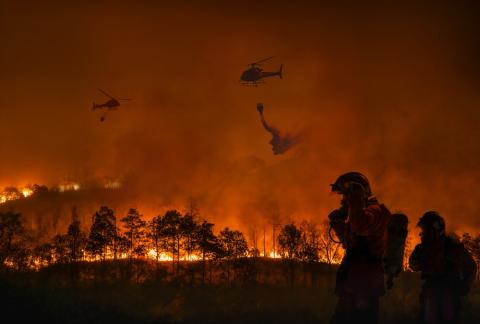
This summer, the debate on 'preparedness' and 'readiness' has once again been brought down to earth by the harsh reality of wildfires. Beyond the obscure jargon of the EU, hard truths about our societies remain and they concern real, pressing issues.
This summer, the debate on 'preparedness' and 'readiness' has once again been brought down to earth by the harsh reality of wildfires. Beyond the obscure jargon of the EU, hard truths about our societies remain and they concern real, pressing issues.
Climate change has already shown its effects, and its impacts are becoming self-reinforcing. The 38.68 Mt of CO₂ emitted from the fires so far is equivalent to more than eight million cars' worth of emissions in one year. This shows once again that climate change policies are not optional – the consequences are already here.
The issue, nevertheless, goes beyond climate change: years of austerity and budget cuts, short-sightedness and political bickering have left EU countries ill-prepared to deal with even normal wildfire conditions (let alone the extraordinary challenges that are alarmingly quickly becoming the norm). While the solidarity shown at EU level through resource sharing is very positive, the level of political fragmentation within Member States, the lack of resources and manpower, and constant political infighting have seriously weakened the capacity of emergency services to operate.
As climate change worsens and budget debates intensify – particularly around defence expenditure – it is more important than ever to recognise the need for adequate staffing levels and resources for firefighters and all emergency workers. Over and over, they prove vital in times of crisis (as we saw during the pandemic), yet too often they receive only lip service and are forgotten once the crisis passes.
The EESC has adopted two complementary opinions aimed at building a more resilient and financially empowered Europe. By backing the Commission’s plan for a Savings and Investments Union (SIU) and calling for a major push on financial literacy, the Committee stresses that integrated markets and citizen empowerment must go hand in hand.
The EESC has adopted two complementary opinions aimed at building a more resilient and financially empowered Europe. By backing the Commission’s plan for a Savings and Investments Union (SIU) and calling for a major push on financial literacy, the Committee stresses that integrated markets and citizen empowerment must go hand in hand.
One opinion, led by rapporteur Petru Sorin Dandea, supports the Commission’s strategy to mobilise Europe’s untapped wealth, more than EUR 10 trillion in bank deposits, and channel it into investments for businesses, innovation and infrastructure. The EESC calls for stronger supervision, harmonised tax and insolvency rules, and safe, transparent and cost-effective investment products, alongside a reinforced European Securities and Markets Authority.
The second opinion, by rapporteur Giuseppe Guerini, focuses on financial literacy as the missing link for the SIU. With only 18% of Europeans demonstrating a high level of financial literacy, many citizens lack the tools to manage their money, avoid scams and plan for the future. The EESC sees financial education as a social right and calls for it to be taught in schools, supported through adult education, and targeted at vulnerable groups, young people, the elderly and new entrepreneurs.
The Committee warns that without trust and understanding, citizens will not participate in financial markets. With digitalisation fuelling new risks such as online ‘finfluencers’ and AI-driven scams, the EESC calls for a clear regulatory framework and stronger action against fraud. Financial literacy is also key to preparing for ageing societies, ensuring people can navigate pensions, long-term care and savings.
Better financial education, the EESC argues, promotes inclusion by reducing inequality and empowering groups often left behind. To measure success, it recommends Key Performance Indicators such as increased retail investment and reduced costs.
In the EESC’s view, Europe must invest not only in capital, but also in people. Without financial literacy, there is no inclusion, and without inclusion, the SIU cannot succeed. (tk)
recommends adopting one definition at EU level for climate-induced migration;
calls on the European Commission to develop a compendium of relevant case law and highlights the need to encourage the use of the Practical Toolkit on International Protection for people displaced across borders in the context of climate change and disasters;
calls for efforts to encourage the creation of synergies between the EU’s environmental and migration policy by integrating the Humanitarian Development-Peace nexus further into climate mobility policy and embedding migration as adaptation in its approach to climate mobility;
recommends encouraging and funding further research of projects, recognising the complexity and multi-faceted aspect of migration, and to investigate the possibility of amending data collection protocols for people entering countries of destination;
calls on the European Commission to further shape its cooperation with partner countries, to facilitate access to international funds to support partner countries in climate resilience and preparedness, and to pursue the commitments made.
calls for the identification and removal of gender-related structural barriers in education, labour markets, and entrepreneurship, alongside awareness-raising campaigns to promote the benefits of diversity and to highlight female role models and achievements;
recommends encouraging girls and women to pursue STEM fields and acquire digital and financial skills, leveraging online and mobile learning to reduce regional disparities and improve equal access to training and education in remote areas;
calls for improving working conditions and opportunities for young people and women, preventing discrimination and harassment, and enabling their participation and leadership in politics, business, and civil society;
stresses the necessity of providing women and young entrepreneurs with proper access to finance, infrastructure, natural resources, legal ownership rights, and networks, including innovation ecosystems and entrepreneurial hubs, to enable their success.