In a debate with Commission Vice-President and Commissioner for Democracy and Demography Dubravka Šuica, the EESC called for a strategy on civil dialogue as a first step towards strengthening the role of civil society and increasing citizen participation in EU policy-making
Article by Antonello Pezzini, Delegate of the EESC Consultative Commission on Industrial Change
Last January, European Commissioner for Internal Market Thierry Breton reiterated the need to consolidate an internal defence market to ensure our security. ‘We started with munitions for Ukraine’, he stated. ‘We now need to broaden this approach to include a large-scale European defence industrial programme capable of supporting the expansion of the European industrial base and developing the infrastructure needed to protect contested areas’.
The European Economic and Social Committee has had the opportunity to reiterate, on numerous occasions, the need to support the launch of a European Defence Industrial Development Programme (EDIDP) aimed at creating an interoperable and integrated common defence system.
A group of TEN Section members was sent in a study visit to the European Maritime Safety Agency (EMSA) on 1 February 2024. A very fruitful and interesting discussion took place on the EESC opinions on the Maritime Safety Package adopted in September 2023, the decarbonization of maritime transport, and working conditions of seafarers.
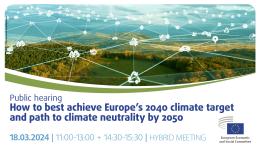
On Monday, 18 March 2024, the NAT Section organized a public expert event entitled "How to best achieve Europe's 2040 climate target and path to climate neutrality by 2050" to feed into the opinion on the Communication on Securing our future - Europe's 2040 climate target and path to climate neutrality by 2050 building a sustainable, just and prosperous society.
Country Report - Gender Equality - Netherlands (2023)
This report on gender equality in the Netherlands (2023) looks into how have EU rules concerning gender equality been transposed into national Dutch law. It covers the period from 1 January 2022 to 1 January 2023.
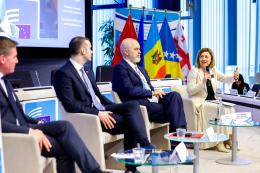
Today, the European Economic and Social Committee (EESC) officially launched its initiative to welcome civil society representatives from EU candidate countries. A total of 131 'Enlargement Candidate Members' (ECM) were selected to make up the pool of civil society experts who will be participating in the Committee's work, thus making the EESC the first institution to open its doors to EU candidate countries. The initiative, a political priority of EESC President Oliver Röpke, sets new standards for involving candidate countries in EU activities, facilitating their progressive and tangible integration into the EU.