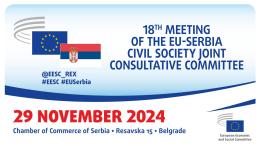
The EU-Serbia Joint Consultative Committee (JCC) held its 18th meeting on 29 November 2024 at the EESC in Belgrade, Serbia. It is a platform established within the institutional framework of the EU‑Serbia Stabilisation and Association Agreement (SAA), enabling representatives of both the EU and the Serbian civil society to monitor the country's accession negotiations, discuss issues of common interest and point out concerns to be tackled on the Serbian path towards the European Union.
This second part of the EU DAG meeting focused on the human rights situation. The UN Special Rapporteur on the right to development, reported on his recent visit to the country and presented his report, and the ILO made a presentation englobing the labour rights situation. The EEAS gave an update on general EU-Vietnam relations including the outcome of the annual joint meeting under the partnership and cooperation agreement (PCA). In the light of the above, the EU DAG members further discussed the implementation of the TSD chapter in the presence of the European Commission.
For the 19th time, the European Economic and Social Committee (EESC) and Montenegro held the Civil Society Joint Consultative Committee (JCC) in at the EESC in Brussels on 27 November 2024. The JCC is a civil society platform established between the EESC and Montenegrin civil society. It complements with a civil society point of view the EU institutional framework related to the Stabilisation and Association Agreement between the EU and Montenegro. This joint institution allows civil society organisations on both sides to monitor the country's accession negotiations. It is also a platform to discuss issues of common interest and to inform the public at large on the challenges ahead during the accession period.
Main topics of the 19th meeting of the EU-Montenegro JCC were:
Current state of play in EU-Montenegro relations: 2024 Enlargement Package and Montenegro Report, overview of the developments within the Berlin process
Reform Agenda (RA) for Montenegro and the implementation of the New growth plan for the Western Balkans
Montenegrin roadmap for fulfillment of the negotiation chapters’ closing benchmarks after the IBAR
Overview of the civil society situation in Montenegro, including social dialogue