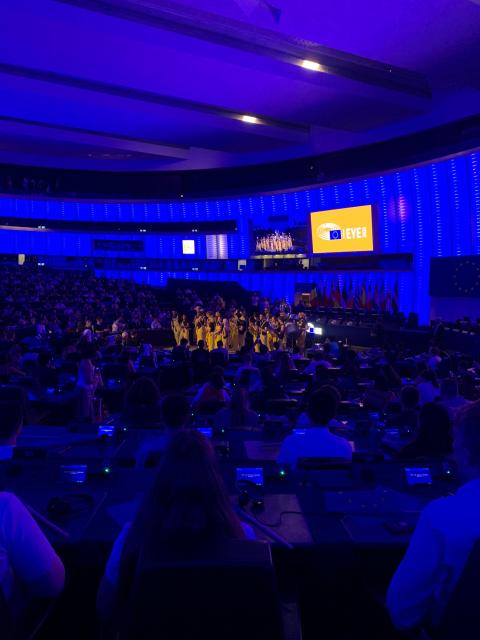
The European Economic and Social Committee (EESC) attended the European Youth Event (EYE2025), organised by the European Parliament in Strasbourg. With over 9,000 participants from 160 nationalities and more than 450 activities, EYE2025 was full of energy, ideas and youth-led action.
The European Economic and Social Committee (EESC) attended the European Youth Event (EYE2025), organised by the European Parliament in Strasbourg. With over 9,000 participants from 160 nationalities and more than 450 activities, EYE2025 was full of energy, ideas and youth-led action.
At the heart of the EESC's participation was a dedicated session on the EU Youth Test at the EESC, featuring Katrina Leitane, Youth Group president, and Chloe Cauchi, Board member of the European Youth Forum (YFJ). It focused on climate change and its economic impact, echoing one of the final recommendations from this year’s EESC flagship youth event, Your Europe, Your Say (YEYS): to develop a coherent strategy on climate change.
The session attracted young people from across the EU and candidate countries, including members of national youth councils, local organisations, and young people keen to have their say in EU decisions.
The Youth Test is designed to ensure that young people’s voices are heard when new EU laws and policies are developed. At EYE2025, young participants had the chance to learn about the Test, share feedback and explore how it could help shape the future. One participant even shared that he felt inspired to join his local youth council after the session—a true testament to the power of meaningful engagement.
Beyond its dedicated session, the EESC’s work was acknowledged in several high-level discussions throughout the event. Commissioner Glenn Micallef referenced the Youth Test during his Youth Policy Dialogue, while MEP Marcos Ros Sempere highlighted the EESC’s role in amplifying the voice of civil society during a panel on youth challenges in urban and rural areas. The EESC was also mentioned during the hemicycle session on fair employment pathways.
Throughout the event, participants joined sessions with EU leaders, including Vice-Presidents Sabine Verheyen, Nicolae Ştefănuță and Pina Picierno. In her final speech, Ms Picierno called for a 'youth check' to be included in every stage of EU decision-making. 'The future belongs to you,' she told the audience, 'so your voice must be part of every law we create.'
Outside the Parliament, the EYE Village, co-organised with the European Youth Forum, was full of creative spaces, youth-led projects and organisations sharing their work.
EYE2025 was more than just a two-day event. The ideas shared by participants will be compiled into a Youth Ideas Report, set to be delivered to EU decision-makers later this year. Many expressed hope that the Youth Test will become a regular tool to ensure young people are part of every political conversation—not just at events like this.
As Europe faces big challenges, EYE2025 showed that young people are ready to lead. They are not just talking about the future; they are helping build it. (ks/epv)
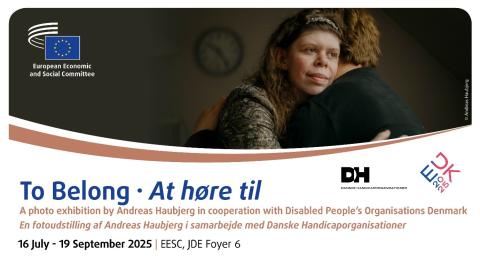
The EESC is hosting To Belong, a photo exhibition by Danish photographer Andreas Haubjerg that powerfully captures the lived realities of people with disabilities.
The EESC is hosting To Belong, a photo exhibition by Danish photographer Andreas Haubjerg that powerfully captures the lived realities of people with disabilities.
Already shown in Copenhagen, Paris and Berlin, the exhibition will be on display at the EESC from 16 July to 19 September.
To mark the start of the Danish Presidency of the Council of the EU, twenty remarkable photographs, curated and held by the Disabled People’s Organisations Denmark, each offer a glimpse into the experience of a person living with a disability. In the accompanying descriptions, the subjects share the challenges they have faced, while also expressing their wish to be seen beyond their disability. Photographing the subjects in settings familiar to them, Andreas Haubjerg has captured the innate human need for connection and community.
Aligning with one of the EESC's 2025 communication priorities, Inclusive Societies, this cultural initiative seeks to raise awareness of the barriers many individuals face, while also emphasising the shared values and experiences that bring us together.(cwb)
Top representatives of organised civil society have met in Warsaw to call for stronger EU action on living and working conditions.
On 25 and 26 June 2025, the presidents and secretaries-general of the EU’s Economic and Social Councils (ESCs) and the European Economic and Social Committee (EESC) held their annual meeting to discuss how to improve living and working conditions across the EU. ESCs from 13 Member States participated, alongside officials from the Polish Presidency of the Council of the EU.
Under the theme Improving living and working conditions across the EU: the role of organised civil society, discussions focused on economic governance, housing and employment.
EESC president Oliver Röpke stressed the need for civil dialogue, calling it 'a necessity' in the face of growing social and economic challenges. With housing becoming increasingly unaffordable, especially for young people, low-income families and the elderly, participants called for coordinated EU and national action. Key proposals included investing in social and affordable housing, tackling homelessness, reforming EU fiscal rules to allow more public investment and supporting energy-efficient renovations.
The ESCs and the EESC also called for policies that anticipate labour market changes driven by digitalisation and demographic shifts. Priorities included boosting reskilling and digital skills, improving work-life balance and promoting decent, secure jobs.
The meeting concluded with a call to keep social progress at the heart of EU policymaking. Magdalena Sobkowiak-Czarnecka, representing the Polish Presidency of the Council of the EU, commended the way civil society was being substantially involved, saying that this was 'invaluable in shaping our agenda and influencing progress at EU level.'
The annual meeting, which took place in Warsaw, was organised jointly by the EESC and the Polish Councils, the Social Dialogue Council (RDS) and the Council for Public Benefit Activity (RDPP) under the Polish Council Presidency. (tk)
This summer's film evenings at the EESC continue with the screening of a Golden Bear winner which looks at France's efforts to confront its colonial past and make restitution. The film screenings are organised in collaboration with the LUX European Audience Film Award.
This summer's film screenings at the EESC continue with the screening of a Golden Bear winner which looks at France's efforts to confront its colonial past and make restitution. The film screenings are organised in collaboration with the LUX European Audience Film Award.
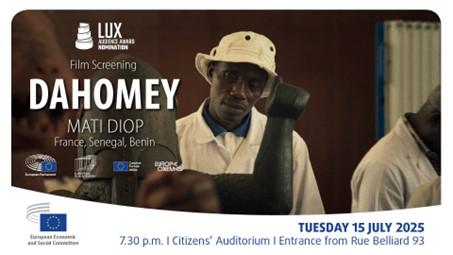
The European Economic and Social Committee has hosted the screening of Dahomey, a documentary by director Mati Diop and winner of the Golden Bear at the 74th Berlin Film Festival.
Dahomey tells the story of the return of 26 royal treasures, stolen by French colonial troops in 1892, from Paris to present-day Benin. For some students at the University of Abomey-Calavi, France's restitution efforts are seen as a drop in the ocean given the number of artefacts yet to be repatriated to their countries of origin.
French-Senegalese director Diop, known for the film Atlantique ('Atlantics'), which won the Grand Prix at the Cannes Film Festival in 2019, has masterfully woven elements of fiction into Dahomey, creating an immersive experience for the viewer.
The EESC regularly hosts film screenings as part of its ongoing support for European cinema and ongoing appreciation of the creative industries. Nominated for the 2025 LUX European Audience Film Award, Dahomey was shown on 15 July at the EESC's Citizens' Auditorium. (cwb)
The European Economic and Social Committee (EESC) has called on the European Commission to adopt a more ambitious and inclusive approach to implementing the European Pillar of Social Rights (EPSR). First introduced in 2017, the EPSR sets out 20 principles aimed at promoting fair labour markets and strong welfare systems across the EU.
The European Economic and Social Committee (EESC) has called on the European Commission to adopt a more ambitious and inclusive approach to implementing the European Pillar of Social Rights (EPSR). First introduced in 2017, the EPSR sets out 20 principles aimed at promoting fair labour markets and strong welfare systems across the EU.
While the current action plan (2021–2025) has led to progress in employment and social inclusion, the EESC believes the next phase must go further. EESC president Oliver Röpke stressed that the EPSR should be a practical tool for building a people-focused Union. He urged the Commission to deliver a new action plan that produces concrete results and strengthens the EU’s social dimension.
European Commission Executive Vice-President Roxana Mînzatu supported this vision, saying that a public consultation was being launched on the next EPSR action plan. She described the EPSR as both a 'compass and shield', essential for guiding citizens through employment challenges and societal changes.
Representing the Polish Presidency of the Council of the EU, Deputy Minister Katarzyna Nowakowska acknowledged recent progress in reducing poverty — 2.8 million people had been lifted out of poverty last year — but said that more work is needed. She also noted that shifting geopolitical dynamics demand renewed focus on social policy.
In the opinion The New Action Plan on the implementation of the European Pillar of Social Rights, the EESC calls for binding measures, stronger governance and actionable proposals to ensure that social rights are fully realised across the EU. It positions the EPSR as a key instrument for creating a fairer, more inclusive Europe that truly leaves no one behind. (lm)
The EESC welcomed the Commission’s ongoing commitment and acknowledged the positive impact of initiatives such as the EU Disability Card, the AccessibleEU Centre and guidance on independent living. However, it criticised the lack of legal force behind many of these actions, which has limited their effectiveness in practice.
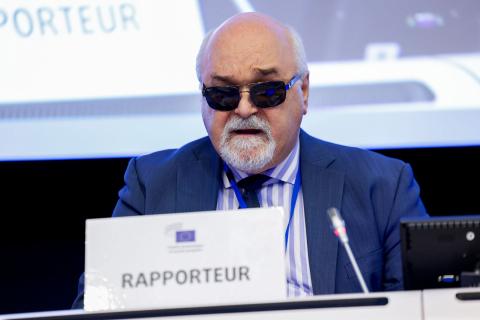
Rapporteur Ioannis Vardakastanis emphasised that the strategy must not stall halfway through its 10-year programme. He called for new, tangible action that improves the daily lives of persons with disabilities, combats discrimination and promotes community-based services over institutionalisation.
To ensure meaningful progress, the EESC proposed several targeted measures: a Disability Employment and Skills Guarantee, modelled on the Youth Guarantee; a directive on freedom of movement for persons with disabilities; establishment of a fully-fledged EU Accessibility Agency with regulatory powers; greater protection for women and girls with disabilities, including a ban on forced sterilisation; a Fund for Accessible Housing to address housing challenges; mutual recognition of assistive technologies across Member States and anti-discrimination safeguards in AI and algorithmic management.
The EESC also called for a dedicated budget under the next Multiannual Financial Framework and for meaningful consultation with persons with disabilities and their representative organisations throughout the strategy’s implementation phase. (lm)