Civil Society Perspectives on Security, Digital Threats, and EU Relations
The 35th meeting of the EEA Consultative Committee focused on several timely and relevant topics, including: Ariane Rodert (EESC) presented on European security and the role of civil society in times of crisis – Lukas Lanzrein (Mission of Switzerland to the EU) updated participants on recent EU–Switzerland developments, including the December 2024 package deal – Alice Stollmeyer (Defend Democracy) and John Comer (EESC) addressed strategies to combat disinformation and safeguard democracy – Franca Salis-Madinier (EESC) discussed opportunities and challenges of using artificial intelligence in the workplace.
On 26 March 2025, President Stefano Mallia met a delegation from the Federation of Employers of Ukraine (FEU) for a focused exchange on strengthening EU-Ukraine economic cooperation in the context of Ukraine’s candidate status for EU membership.
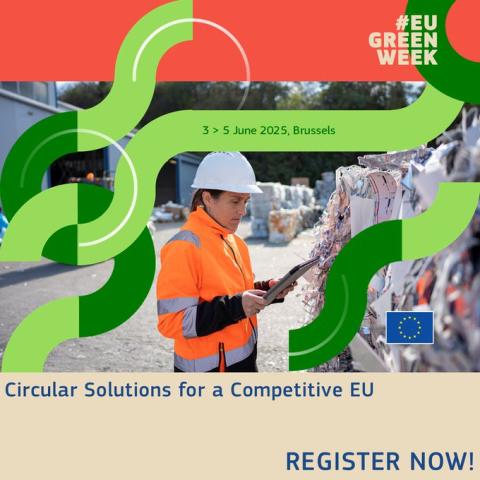
Taking place from 3 to 5 June, the EU Green Week will unpack the 'three Cs' ─ Clean, Competitive and Circular.
The European Circular Economy Stakeholders Platform (ECESP), the flagship initiative by the European Economic and Social Committee (EESC) and the Commission, is proud to co-organise EU Green Week 2025, focusing on circular solutions for a competitive EU. This year's conference will address how the circular economy can enhance sustainable competitiveness, reduce waste, and drive innovation. From 3-4 June, high-level debates will explore the policy aspects of circularity, followed by in-depth discussions with stakeholders on 5 June about the potential of circularity for a resource-efficient and competitive Europe.
The event will also be the occasion to present the report from the stakeholder dialogue held on 10 April at the EESC. This warm-up event to the conference was the opportunity for stakeholders to have lively discussions on the Clean Industrial Deal, the bio-economy strategy, and the upcoming Circular Economy Act.
You can register for the EU Green Week conference here. (ac)
The rising cost of living has impacted competitiveness and social costs. Services of general interest (SGIs) can ensure access to essential services for a decent life and can mitigate the impact of inflation and crises due to their non-profit-driven spirit.
The EESC advocates greater scope for long-term investment in social infrastructure and emphasizes the importance of public investment in accessible and affordable housing.
Reducing fossil fuel subsidies can provide short-term support for vulnerable households and more durable solutions for decarbonised electricity and heating systems, renovations and access to affordable SGIs.