Political decision-making must always have the concerns and well-being of citizens and workers at its core. They are important human factors that should be taken into account. It is the only way to ensure decent living conditions. Through policies that ensure these decent conditions for all we increase trust and widespread acceptance of current and future political measures and prevent popular disenchantment that provides a fertile ground for right-wing populism and extremism.
These concerns were the foundation of the Workers' Group priorities for 2023-2025, setting clear demands for future EU leaders to embark on a progressive agenda with a more social and human dimension at its core. After decades of crises, the costs of which have unequivocally been borne by European citizens and workers, we hope that the EU debate can again shift towards what really matters – social progress.
Our priorities outline the Workers' Group's vision of a Europe that is not only social and sustainable but that also upholds the rule of law, human rights, gender equality, solidarity and diversity. We need a Europe that prioritises tackling inequality, poverty and the climate emergency, ensures just green and digital transitions and secures decent work for all. It is the best way of empowering our democracy and society and every individual in it. We hope that this vision can be taken on board.
Europe is falling behind on competitiveness and needs to address the shortcomings of its single market urgently, but in a way that benefits both business and Europeans.
Europe is falling behind on competitiveness and needs to address the shortcomings of its single market urgently, but in a way that benefits both business and Europeans.
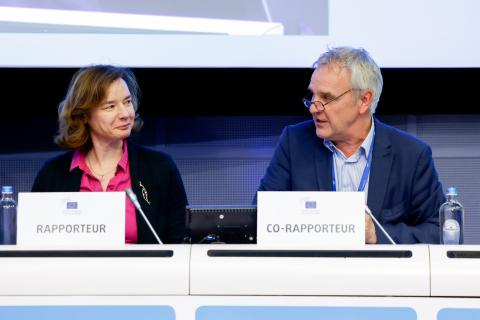
The EESC January plenary held a debate on European competitiveness and the future of the internal market. The EESC opinion at the centre of this debate was requested by the Belgian Presidency of the EU, which has pledged to use its six months to focus on competitiveness and the single market. The opinion will also help shape Enrico Letta's high-level report on the future of the single market, set to be presented to the European Council in March.
In it, the EESC stresses that the internal market needs to rise to the challenges of a very different world to the one for which it was created back in the 1990s. As a result, the EU is facing multiple pressures: maintaining a level playing field while subsidising its industries to help finance the green transition; keeping jobs in Europe while ensuring EU businesses stay competitive; and securing raw materials while upholding labour and environmental standards.
Rapporteur Sandra Parthie said: "The single market has helped make the EU one of the most powerful trading blocs in the world – but this powerful position is about to be eroded. What we propose in our opinion is to focus on the development of a European industrial policy that is not the sum of 27 national industrial policies, but rather a truly European view of our industrial potential".
Speaking at the debate, Markus Beyrer, Director General of Business Europe, said: "We have an issue with competitiveness. We are falling behind our global competitors, and the single market is one of the tools available to us to remedy this. The goal is to produce the margin we need to feed the European model as we know it, including the social aspects".
Ludovic Voet, Confederal Secretary of the European Trade Union Confederation (ETUC), stressed that the European social contract is the basis of the single market and that contract needs to be reinforced, saying: "In our competitive system, businesses have to pay fair salaries, offer good jobs and not harm the environment. Europe has to keep the momentum for a just green transition".
The EESC opinion includes a proposal to appoint a commissioner for services of general economic interest (SGEI) in the next Commission, with a five-year plan to develop secure, good-quality and sustainable SGEI. These account for 25% of EU GDP and 20% of total employment, and cover key sectors such as transport, energy, communications, access to water and sanitation. However, they are also very important in healthcare and social services. (dm)