At its June plenary session, the European Economic and Social Committee (EESC) became the first EU body to formally endorse the Declaration of principles for a gender-equal society, backing the European Commission’s Roadmap for Women’s Rights. This move sends a clear signal that urgent, concrete action is needed to close persistent gender gaps.
At its June plenary session, the European Economic and Social Committee (EESC) became the first EU body to formally endorse the Declaration of principles for a gender-equal society, backing the European Commission’s Roadmap for Women’s Rights. This move sends a clear signal that urgent, concrete action is needed to close persistent gender gaps.
According to its Global Gender Gap Report, it will take another 134 years to close the gender gap worldwide if progress continues at the current pace. EESC President Oliver Röpke stressed this urgency: ‘We don’t have 134 years to wait for gender equality – and we won’t. The EESC reaffirms its unwavering commitment to closing the gap, standing with our EU and international partners to ensure women’s rights are firmly embedded in every EU policy.’
In a video message, European Commissioner for Equality, Preparedness and Crisis Management, Hadja Lahbib, thanked the EESC for its leadership, stating: ‘Achieving gender equality takes all of us. It is no longer enough to say that equality is at the heart of our Union. We must defend it.’
Belén Sanz Luque, UN Women Regional Director for Europe and Central Asia, added: ‘Thirty years after the Beijing Platform for Action, social barriers still block gender equality across the world. The EU must lead by example, building stronger solidarity and investing in real progress for women and girls everywhere.’
The European Commission’s Roadmap for Women’s Rights, together with its Declaration of principles for a gender-equal society, sets out concrete principles to advance gender equality and protect women’s rights across the EU: ending gender-based violence, closing the pay gap, ensuring fair working conditions, protecting health, promoting political participation and supporting inclusive education.
To support these goals, the EESC adopted a resolution committing to real action. It pledges to work with civil society and young people, address overlapping discrimination, defend key rights such as access to reproductive health and care systems, and push for inclusive policies backed by data. The EESC will now work closely with EU institutions and Member States to turn these principles into real progress. (gb)
underscores the strategic importance of a high-quality, inclusive education and a skilled workforce for Europe’s competitiveness, social cohesion, and sustainable development. Addressing current challenges requires bold, systemic reforms and investment in inclusive, high-quality education and training systems;
stresses that the success of the Union of skills depends on effective and cooperative governance, adequate financing, and inclusive representation of social partners, national authorities and other stakeholders, including civil society organisations, teachers and learners
Believes the APS should be intersectional and gender-responsive, based on a multidimensional definition of poverty
Recommends setting ambitious, measurable targets, including the eradication of extreme poverty, and framing poverty as a violation of fundamental rights
In significant recognition of youth participation in EU policymaking, the European Parliament (EP) has officially commended the European Economic and Social Committee (EESC) on the EESC Youth Test in the 2023 discharge report.
In significant recognition of youth participation in EU policymaking, the European Parliament (EP) has officially commended the European Economic and Social Committee (EESC) on the EESC Youth Test in the 2023 discharge report.
The EESC Youth Test is designed to ensure that the voices and perspectives of young people are systematically considered when the EESC draws up its opinions. It represents a forward-thinking model for inclusive governance and is already influencing how institutions approach youth participation. The European Commission has based its Youth Check on the EESC’s model and the Parliament has requested multiple meetings with the EESC as they begin to plan its version of the tool.
In the 2022 discharge, the European Parliament had already 'welcomed the efforts made by the Committee to enhance youth involvement in policymaking'. However, the 2023 discharge goes a step further. In addition to the Youth Test, it explicitly commends the EESC on its proactive and innovative approach to youth participation. This is thanks to the work of the EESC Youth Group, launched in 2023, and initiatives by EESC sections such as the youth delegate to COP and the Youth Climate and Sustainability Roundtables.
This commendation by the European Parliament not only validates the EESC’s work but also sets a precedent for other EU institutions to follow suit in integrating youth perspectives into the heart of EU policymaking. (epv)
At the end of June, I had the honour of meeting several men and women just released from Belarusian prisons. Among them was Siarhei Tsikhanouski, husband of democratic leader Sviatlana Tsikhanouskaya, who spent over five years behind bars. He was among the first political prisoners of the 2020 uprising. His body bore marks of imprisonment, but not his spirit. I saw resilience – a man still determined to fight for dignity and freedom.
At the end of June, I had the honour of meeting several men and women just released from Belarusian prisons. Among them was Siarhei Tsikhanouski, husband of democratic leader Sviatlana Tsikhanouskaya, who spent over five years behind bars. He was among the first political prisoners of the 2020 uprising. His body bore marks of imprisonment, but not his spirit. I saw resilience – a man still determined to fight for dignity and freedom.
Tsikhanouski’s release, along with 13 others – including RFE/RL journalist Ihar Karnei and university lecturer Natallia Dulina – was not a gesture of goodwill. It was the result of sustained diplomatic pressure from the United States, including a rare visit by Special Envoy Keith Kellogg to Minsk. These individuals were not freed – they were expelled. Taken to the Lithuanian border, bundled in black bags, they were told to leave their homeland.
Belarus remains a prison. Nearly 1200 political prisoners are still behind bars. In 2025 alone, there have been over 1700 new political arrests and other forms of repression. These are not just numbers; they are people with families and futures. Some elderly, some seriously ill. Some, like Valiantsin Shtermer, didn’t survive. He died earlier this year in detention, denied proper medical care after suffering a stroke. Others died soon after release, worn down by inhumane conditions in jail.
This is both a legal and a humanitarian crisis. And it demands an urgent, coordinated response from the European Union.
Releasing political prisoners gives hope to the people of Belarus, who often feel forgotten. Yet the dictator continues to use human lives as bargaining chips. This is nothing new: the regime has traded political prisoners since the 1990s, since the founding of Viasna by Nobel laureate Ales Bialiatski, now again behind bars.
Some argue prisoner releases should be rewarded with eased sanctions. But listen to survivors of the regime’s prisons. ‘Lifting sanctions in exchange for hostages is like making a deal with a cannibal,’ Dulina said. Her words are hard, but necessary. Since January, 105 political prisoners have been released through pardons, while 167 new prisoners have been added to the list. This cycle is blackmail, not progress.
We must not ease pressure until all political prisoners are free and systemic repression ends.
Meanwhile, Lukashenka continues to aid the Kremlin’s war on Ukraine. Belarus hosts Russian troops and drones, produces military parts and allows Russian nuclear weapons, violating non-proliferation norms. The upcoming Zapad 2025 joint military exercises represent another provocation and threat.
But the Belarusian people have not given up. Despite propaganda and terror, they resist quietly and bravely. They learn the Belarusian language. They teach banned history. They speak the truth. Polls show that 97% of Belarusians oppose joining Russia’s war. Most oppose missile launches from Belarusian territory and hosting nuclear weapons on Belarusian soil. This is not a pro-Kremlin society – it is a society held hostage.
It is crucial to distinguish the regime from the people. Supporting civil society, media and youth initiatives is not charity – it is a long-term investment in European security.
The European Economic and Social Committee has already played a leading role, highlighting repression, supporting free media and defending the rights of the Belarusian people. We appreciate the EESC’s recent memorandum with Belarusian democratic forces. It is a meaningful gesture of solidarity and an essential recognition of the legitimacy of our struggle.
We must go further. The EU should stand firm: no sanctions relief without substantial, verifiable change. Continue to expose the regime’s crimes. Offer protection and professional opportunities to Belarusian exiles in Europe. Engage closely with democratic actors who are building alternative structures and support systems – even in exile.
Change can come swiftly. Authoritarian regimes can collapse in an instant. But we must be ready. That means keeping hope alive and standing firmly with those still imprisoned.
Belarus stands at a crossroads today. In the hands of its people, it can become a peaceful, democratic European nation. In the hands of dictators, it remains a source of instability and aggression.
Let us help tip the balance toward freedom, justice and Europe.
The first, simplest and most urgent step: demanding the release of all political prisoners.
This is not a concession. It is the beginning of everything.
Exiled Belarusian journalist Hanna Liubakova writes about the quiet resistance of the Belarusian people, living in a society held hostage by terror and pro-Kremlin propaganda. The recent release of Siarhei Tsikhanouski – husband of Belarusian opposition leader Sviatlana Tsikhanouskaya – has offered a glimmer of hope to Belarusians who often feel forgotten. Yet with 1200 political prisoners still behind bars, the country remains a prison. The EU and the international community must not ease pressure until all are freed and systemic repression ends. This is not charity, but a crucial investment in European security.
Exiled Belarusian journalist Hanna Liubakova writes about the quiet resistance of the Belarusian people, living in a society held hostage by terror and pro-Kremlin propaganda. The recent release of Siarhei Tsikhanouski – husband of Belarusian opposition leader Sviatlana Tsikhanouskaya – has offered a glimmer of hope to Belarusians who often feel forgotten. Yet with 1200 political prisoners still behind bars, the country remains a prison. The EU and the international community must not ease pressure until all are freed and systemic repression ends. This is not charity, but a crucial investment in European security.
Hanna Liubakova is a journalist and political analyst from Belarus. She is a non-resident senior fellow at the Atlantic Council and has written about developments in Belarus for international outlets including The Washington Post, The Economist and others. Liubakova began her career at Belsat TV, the only independent Belarusian television channel, banned by the regime in Minsk. She also worked for Radio Free Europe/Radio Liberty (RFE/RL) in Prague, Czechia. She is currently an advisor for the EESC information report on social media and AI.
Liubakova has received several awards for her work, including the Freedom of the Media Award from the Transatlantic Leadership Network and the One Young World Journalist of the Year Award. She has also been a finalist for the European Press Prize. In retaliation for her reporting, the Lukashenka regime sentenced her in absentia to ten years in prison. She is on the wanted list in Russia and across all Commonwealth of Independent States (CIS) countries.
Minutes of the 117th meeting of the Section for Consultative Commission on Industrial Change
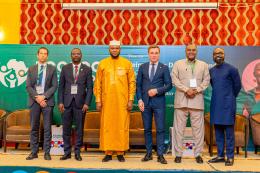
The European Economic and Social Committee (EESC) President Oliver Röpke led a high-level mission to Malabo this week, reaffirming the EESC’s strategic partnership with the African Union Economic, Social and Cultural Council (AU ECOSOCC). The visit centred on civil society’s role in peacebuilding, democratic renewal, and reparative justice across Africa and the broader Global South.