The European institutions should jointly develop unified guidelines for civil dialogue. An interinstitutional agreement could help, for example by assigning distinct roles and objectives to each institution according to its competences. The European institutions must also address capacity issues that prevent civil society organisations and institutions from fully engaging in dialogue.
The European institutions should jointly develop unified guidelines for civil dialogue. An interinstitutional agreement could help, for example by assigning distinct roles and objectives to each institution according to its competences. The European institutions must also address capacity issues that prevent civil society organisations and institutions from fully engaging in dialogue.
These are some of the main recommendations of a new EESC study on Mapping civil dialogue practices in the EU institutions that was released on 16 July. The study was requested by the Civil Society Organisations’ Group and carried out by the Centre for European Policy Studies (CEPS). Two of its co-authors, Berta Mizsei and Timothy Yeung, presented the study’s key findings and recommendations at the launch event.
Séamus Boland,president of the Civil Society Organisations’ Group, said his group commissioned the study because an overview of current practice is essential for advancing civil dialogue in an efficient, sustainable and inclusive way at EU level.
The study identifies an increase in civil dialogue over the past 10 years but also that some challenges remain: ‘The study on current civil dialogue practice in the EU institutions found that the institutions and their departments still have different understandings of what structured engagement between them and civil society means. They organise civil dialogue differently and, in some cases, there is perceived competition between civil dialogue, direct democratic initiatives and elected representation.’
The study not only takes stock of civil dialogue practice, but it also provides concrete recommendations for next steps. The co-authors, Ms Mizsei and Mr Yeung, said: ‘We agree with existing calls for the EU, including the EESC, to settle on a definition of civil dialogue and provide guidelines for implementing it, and that this should lead to an interinstitutional agreement on civil dialogue. The guidelines could be integrated into the Better Regulation toolbox to reflect the unique nature of civil dialogue.’This agreement could also assign roles and objectives according to each institution’s competences and harmonise existing initiatives.
The publication of the EESC study comes at a crucial time. The European Commission has pledged to step up engagement with civil society and better protect civil society in its work during its 2024-2029 term. In addition, civil society faces numerous challenges in the face of geopolitical and socio-economic changes.
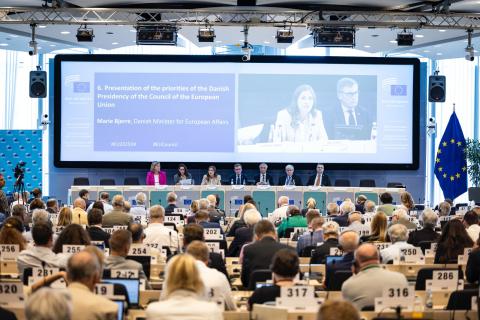
The EESC’s July plenary session hosted a debate on the political priorities of the current Presidency of the Council of the European Union, which started on 1 July and will come to an end on 31 December 2025. Under the motto ‘A strong Europe in a changing world’, the Danish Council Presidency will work for a secure, competitive and green EU, making sure that the EU takes more ownership of its own security and strengthens its competitiveness.
The EESC’s July plenary session hosted a debate on the political priorities of the current Presidency of the Council of the European Union, which started on 1 July and will come to an end on 31 December 2025. Under the motto ‘A strong Europe in a changing world’, the Danish Council Presidency will work for a secure, competitive and green EU, making sure that the EU takes more ownership of its own security and strengthens its competitiveness.
Europe is currently undergoing significant change, with uncertainty, global competition and increased conflict in a number of areas. ‘For this reason – said Marie Bjerre, Denmark’s Minister of European Affairs – we need a strong, competitive and green Europe. A Europe that is able to take responsibility for its own security. And a Europe that is able to innovate and compete at global level. Supporting Ukraine and moving forward on enlargement will be key’.
For his part, EESC President Oliver Röpke stressed that ‘the Danish presidency arrives at a defining moment for Europe. Its priorities on security, competitiveness and the green transition closely align with the EESC’s core concerns. We stand ready to provide practical expertise and reflect the voices of Europe’s organised civil society in support of a resilient, values-based Europe that is connected to its people.’ (mp)
At its plenary session on 17 July, the EESC held an enlargement forum focusing onBuilding an inclusive future in the Enlarged EU: The role of social dialogue, civil society and youth engagement. The civil society representatives from candidate countries commended the Committee’s Enlargement Candidate Members initiative as a vital tool for shaping their countries’ European integration process and bolstering public support for EU accession.
At its plenary session on 17 July, the EESC held an enlargement forum focusing onBuilding an inclusive future in the Enlarged EU: The role of social dialogue, civil society and youth engagement. The civil society representatives from candidate countries commended the Committee’s Enlargement Candidate Members initiative as a vital tool for shaping their countries’ European integration process and bolstering public support for EU accession.
The event opened with a high-level debate featuring Maida Gorčević, Minister for European Affairs in Montenegro, Orhan Murtezani, Minister for European Affairs in North Macedonia, and Antoine Kasel, Director for Labour Mobility and International Affairs at the European Commission’s Directorate-General for Employment, Social Affairs and Inclusion.
The forum brought together approximately 75 representatives from social partners and civil society organisations across the EU candidate countries. It formed part of the EESC’s pioneering Enlargement Candidate Members Initiative (ECM). The project’s success has already led to additional financial backing by the European Commission for its reinforcement and permanent implementation.
EESC President Oliver Röpke said: ‘We are trying to build a successful enlargement that puts civil society in the driving seat. Enlargement is not simply a geopolitical strategy: it is a promise to uphold democracy, rights and dignity for all.’
The Minister for European Affairs of Montenegro, Ms Gorčević, highlighted the close cooperation between the government and civil society organisations in the accession process and stressed that ‘citizens are more likely to support reforms when they see members of their civil society organisations actively engaged in government policy.’
On the other hand, the Minister for European Affairs in North Macedonia, Mr Murtezani, described his country’s story as complex but transformative and added that ‘it is not easy to wait in line for 20 years, but this could be the example of resilience and persistence in achieving the final goal.’
Moved by the optimism and enthusiasm shown by the representatives of the candidate countries, Mr Kasel of the European Commission said: ‘Talking to young people is key in this process, as building social dialogue and dialogue with the EU institutions is a matter of trust.’
The EESC members and rapporteurs for the opinion, Ionuţ Sibian, Decebal-Ștefăniță Pădure and Dumitru Fornea, stressed that a structured and properly institutionalised civil and social dialogue is essential for ensuring stability, economic development and social cohesion in candidate and partner countries. (mt)